
Topic 11 has eight sub-topics: 11.1 Formulae, functional groups and terminology; 11.2 Naming organic compounds; 11.3 Fuels; 11.4 Alkanes; 11.5 Alkenes; 11.6 Alcohols; 11.7 Carboxylic acids; 11.8 Polymers. Core statements cover displayed and general formulae, homologous series, the C1–C2 compounds, petroleum fractions, combustion, cracking, the bromine test, ethanol manufacture, reactions of ethanoic acid, poly(ethene) and plastics. Supplement statements add structural formulae and isomers, naming compounds up to C4 and esters, substitution and addition reactions, oxidation and esterification, and condensation polymers including nylon, PET and proteins.
Central idea: carbon atoms form four bonds and join into chains. A chain with a particular functional group belongs to a homologous series, and every member reacts in the same way. Learn the reactions of the functional group once and you can apply them to any member.
Before you start
- Covalent bonding: C forms 4 bonds, H 1, O 2, Cl and Br 1 (Topic 2).
- Balancing equations; empirical and molecular formulae (Topic 3).
- Reactions of acids with metals, bases and carbonates; strong and weak acids (Topic 7).
- Oxidation; catalysts and activation energy; reversible reactions (Topics 5 and 6).
Learning objectives
- Draw and interpret displayed formulae; write general formulae; define functional group, homologous series, saturated and unsaturated; Supplement structural formulae and structural isomers.
- Name and draw alkanes, alkenes, alcohols, carboxylic acids and (Supplement) esters.
- Describe fractional distillation of petroleum, the trends in the fractions and their uses.
- Describe the reactions of alkanes (combustion, substitution), alkenes (cracking, bromine test, addition), alcohols (manufacture, combustion, oxidation) and carboxylic acids (acid reactions, esterification).
- Describe addition polymerisation and the problems of plastics; Supplement condensation polymers: nylon, PET and proteins.
Introduction: one element, millions of compounds
Petrol, plastic bottles, vinegar, the alcohol in hand gel, the proteins in your muscles — all are compounds of carbon. Carbon is unusual in forming stable chains and rings of its own atoms, so the number of possible compounds is enormous. Chemists make sense of them by sorting them into families. Each family is defined by a small reactive part of the molecule, the functional group, and once you know how that group behaves you can predict the chemistry of every member of the family.
11.1 · Formulae, functional groups and terminology
1Ways of writing organic formulae 11.1.1, 11.1.7 CoreSupplement
| Type | Ethanol | What it shows |
|---|---|---|
| molecular formula | C2H6O (or C2H5OH) | the number of atoms of each element in one molecule |
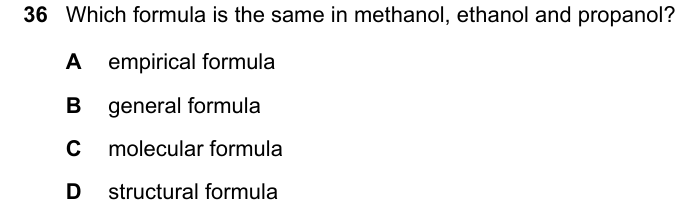
| general formula | CnH2n+1OH | the formula shared by every member of the homologous series |
| Supplement structural formula | CH3CH2OH | an unambiguous description of how the atoms are arranged, without drawing every bond — e.g. CH2=CH2, CH3CH2OH, CH3COOCH3 |
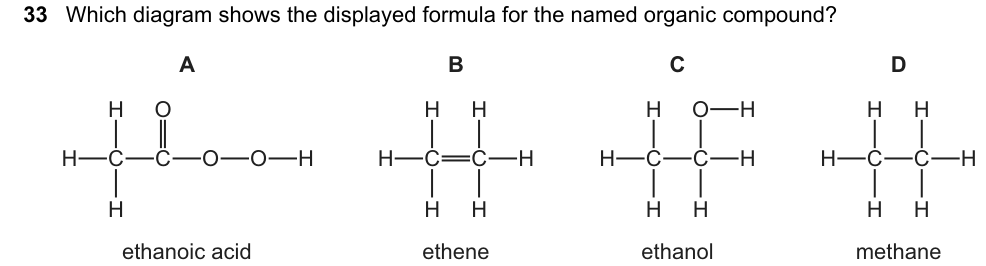
| displayed formula | drawn with every atom and every bond | all the atoms and all the bonds, including C–H and O–H |
In a displayed formula, check each atom's number of bonds: carbon 4, oxygen 2, hydrogen 1, chlorine and bromine 1. A double bond counts as two. The commonest error is to write –OH at the end of a chain without drawing the O–H bond.
2Functional groups and homologous series 11.1.2–11.1.6, 11.1.9 CoreSupplement
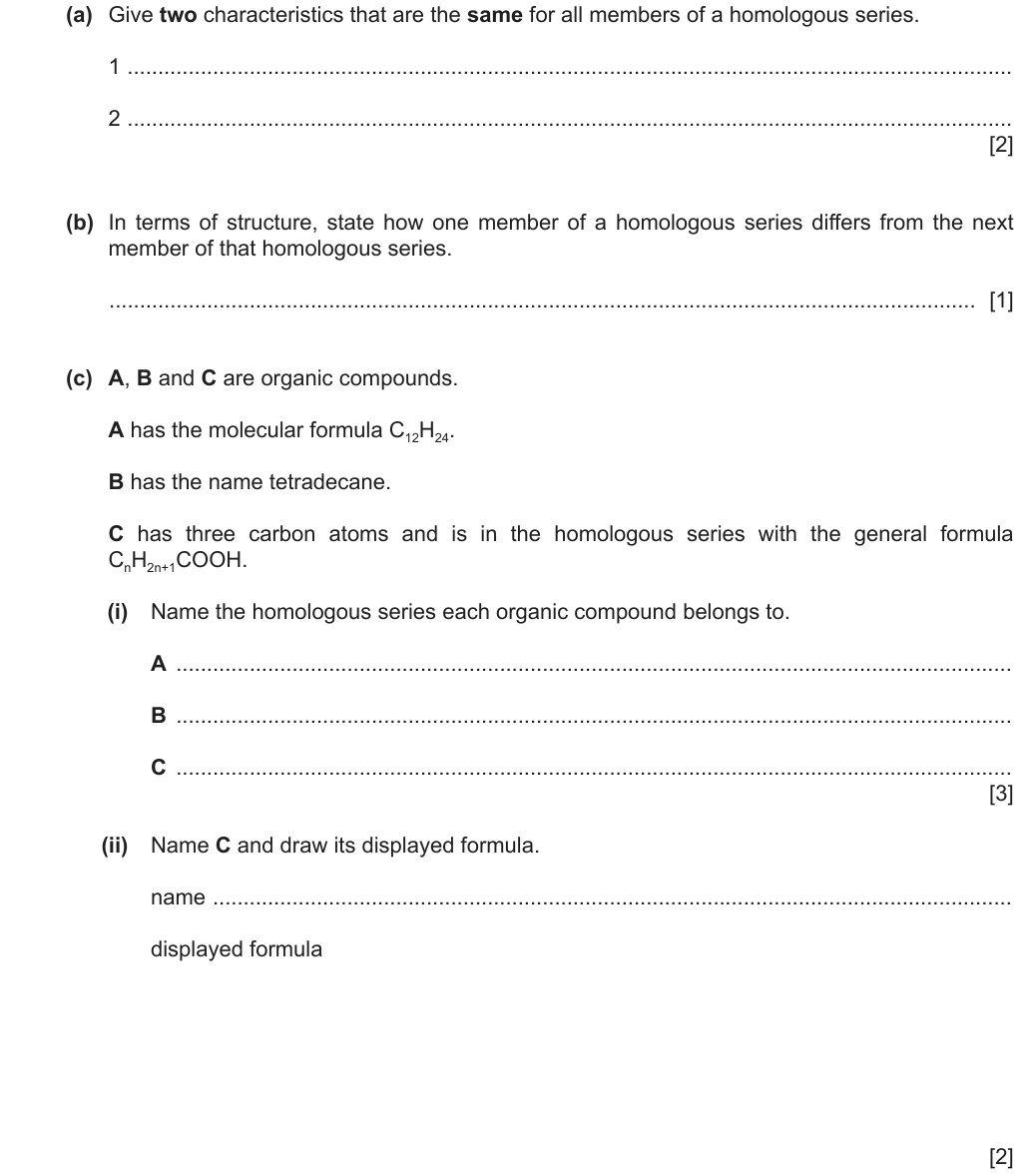
A functional group is an atom or group of atoms that determines the chemical properties of a homologous series.
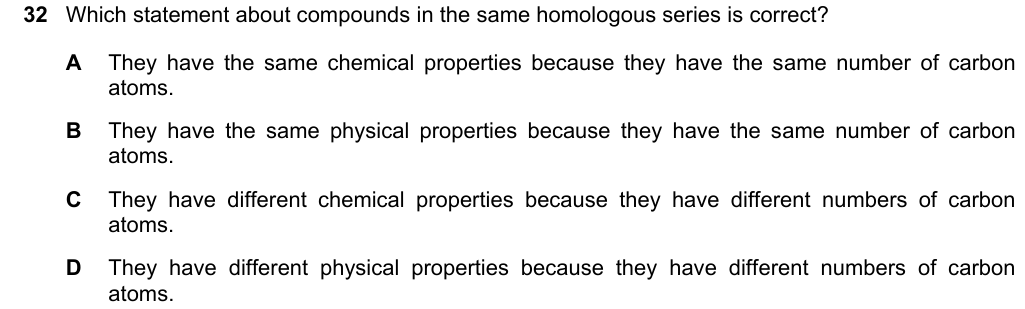
A homologous series is a family of similar compounds with similar chemical properties due to the presence of the same functional group.
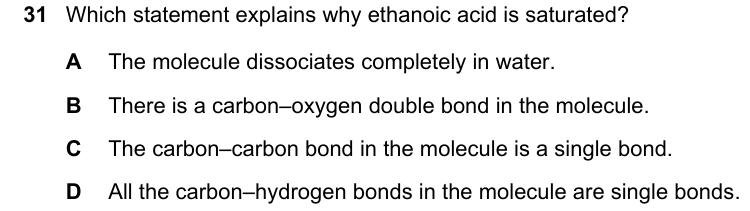
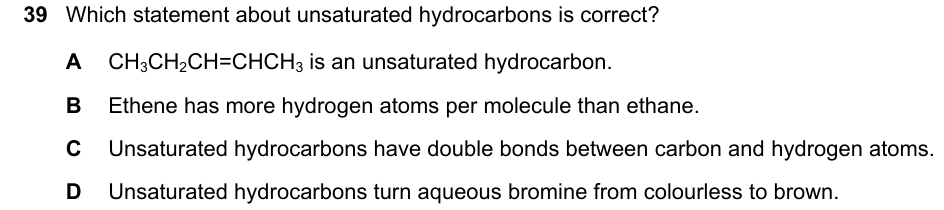
A saturated compound has molecules in which all carbon–carbon bonds are single bonds. An unsaturated compound has molecules in which one or more carbon–carbon bonds are not single bonds.
| Series | General formula | Functional group | Name ending | First member |
|---|---|---|---|---|
| alkanes | CnH2n+2 | (C–C single bonds only) | -ane | methane, CH4 |
| alkenes | CnH2n | C=C | -ene | ethene, C2H4 |
| alcohols | CnH2n+1OH | –OH | -ol | methanol, CH3OH |
| carboxylic acids | CnH2n+1COOH | –COOH | -oic acid | methanoic acid, HCOOH (n = 0) |
Supplement The members of a homologous series:
- have the same functional group;
- have the same general formula;
- differ from one member to the next by a –CH2– unit;
- display a trend in physical properties (for example, boiling point rises as the chain gets longer);
- share similar chemical properties.
Ethanoic acid is saturated: its only carbon–carbon bond is single. The C=O in its –COOH group is a carbon–oxygen bond and does not make the compound unsaturated.
3Structural isomers 11.1.8 Supplement
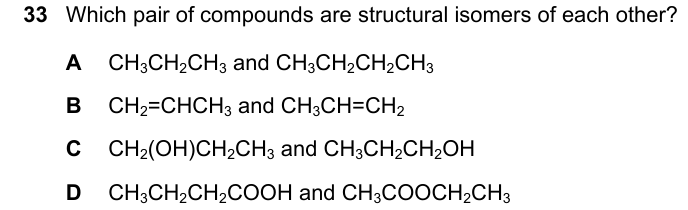
Structural isomers are compounds with the same molecular formula but different structural formulae.
- C4H10: butane, CH3CH2CH2CH3, and methylpropane, CH3CH(CH3)CH3 (a branched chain).
- C4H8: but-1-ene, CH3CH2CH=CH2, and but-2-ene, CH3CH=CHCH3 (different position of the double bond).
- C3H7OH: propan-1-ol and propan-2-ol (different position of the –OH group).
- Isomers can even belong to different series: butanoic acid, CH3CH2CH2COOH, and ethyl ethanoate, CH3COOCH2CH3, are both C4H8O2.
Two drawings of the same molecule are not isomers. CH2=CHCH3 and CH3CH=CH2 are both propene written from different ends; CH2(OH)CH2CH3 and CH3CH2CH2OH are both propan-1-ol. Sketch the displayed formula and number the chain from the end nearer the functional group.
Attempt these before opening the solutions. Each reference gives the component, session and question number of the original examination; the answers follow the published mark scheme.
Solutions and mark-scheme guidance · set A
A1 Answer D
Members have the same functional group, so similar chemical properties, but different numbers of carbon atoms, so different physical properties. Many assumed members have the same number of carbon atoms (A).
A2 Answer B
Methanol, ethanol and propanol share the general formula CnH2n+1OH. Their empirical formulae differ — A was a common wrong choice.
A3 Answer C
Saturated means all carbon–carbon bonds are single — ethanoic acid has one C–C single bond. Weaker candidates guessed evenly across the options.
A4 Answer A
Pent-2-ene contains a C=C bond: unsaturated. Hydrogen forms only one bond, so C cannot be right; alkenes turn aqueous bromine from orange to colourless, not the reverse.
A5 Answer D
Butanoic acid and ethyl ethanoate are both C4H8O2 with different structures. Nearly half chose C, which shows two representations of the same molecule.
A6 [8]
(a) Same general formula ✓; same functional group ✓.
(b) By a –CH2– unit ✓.
(c)(i) A alkenes ✓; B alkanes ✓; C carboxylic acids ✓. (ii) propanoic acid ✓; displayed formula with every bond, including O–H ✓.
Examiner feedback: repeating “similar chemical properties” from the stem did not score. Relatively few knew the –CH2– difference. Propenoic acid (an alkene) is not propanoic acid; –OH drawn without the O–H bond lost the mark.
11.2 · Naming organic compounds
4Naming organic compounds 11.2.1–11.2.4 CoreSupplement
An organic name has two parts: a stem for the number of carbon atoms in the longest chain, and an ending for the homologous series.
| Carbon atoms | 1 | 2 | 3 | 4 |
|---|---|---|---|---|
| stem | meth- | eth- | prop- | but- |
| alkane (-ane) | methane CH4 | ethane CH3CH3 | propane CH3CH2CH3 | butane CH3CH2CH2CH3 |
| alkene (-ene) | — | ethene CH2=CH2 | propene CH2=CHCH3 | but-1-ene CH2=CHCH2CH3; but-2-ene CH3CH=CHCH3 |
| alcohol (-ol) | methanol CH3OH | ethanol CH3CH2OH | propan-1-ol CH3CH2CH2OH; propan-2-ol CH3CH(OH)CH3 | butan-1-ol; butan-2-ol CH3CH(OH)CH2CH3 |
| carboxylic acid (-oic acid) | methanoic acid HCOOH | ethanoic acid CH3COOH | propanoic acid CH3CH2COOH | butanoic acid CH3CH2CH2COOH |
The number in but-1-ene or propan-2-ol gives the position of the double bond or –OH group, counting from the end of the chain nearer to it. In a carboxylic acid, the carbon of –COOH is counted as part of the chain: propanoic acid has three carbon atoms in total.
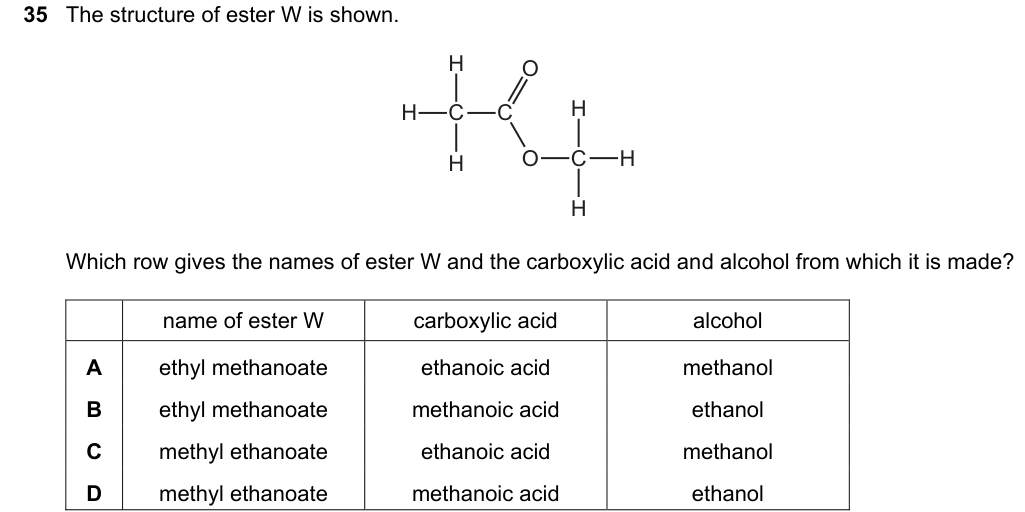
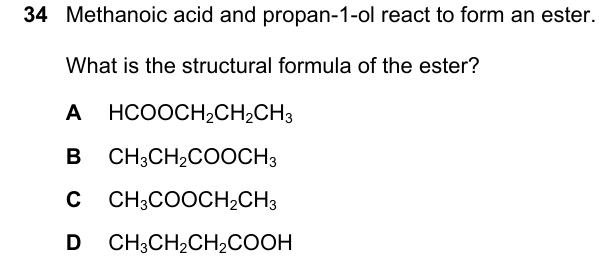
Supplement Esters are named from the alcohol and the acid that make them: the alkyl group from the alcohol comes first, then the acid name ending in -oate. Ethanol + ethanoic acid → ethyl ethanoate, CH3COOCH2CH3; methanol + propanoic acid → methyl propanoate, CH3CH2COOCH3. In the structural formula the acid part is written first (…COO…) and the alkyl part last. To name an ester from its formula, the part joined to C=O is the acid; the part joined only to –O– is the alcohol.
Name the ester HCOOCH2CH2CH3 and its parent acid and alcohol.
| Acid part | HCOO– has one carbon (the C=O): methanoic acid → “methanoate” |
| Alcohol part | –CH2CH2CH3 has three carbons: propan-1-ol → “propyl” |
| Name | propyl methanoate |
Attempt these before opening the solutions. Each reference gives the component, session and question number of the original examination; the answers follow the published mark scheme.
Solutions and mark-scheme guidance · set B
B1 Answer C
The ethanol structure is the correct displayed formula for its name. Option B, the “ethene” drawing, gives carbon five bonds — a third of weaker candidates chose it.
B2 Answer C
The C=O carbon carries a CH3 (acid part: ethanoic acid), and the O carries a CH3 (alcohol part: methanol): methyl ethanoate.
B3 Answer A
Methanoic acid gives HCOO–; propan-1-ol gives –CH2CH2CH3: HCOOCH2CH2CH3. D, a carboxylic acid, shows the ester structure was not recognised.
B4 Answer C
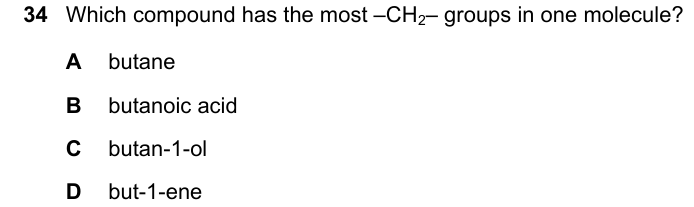
Butan-1-ol, CH3CH2CH2CH2OH, has three –CH2– groups; butane and butanoic acid have two, but-1-ene one. A quick sketch helps.
B5 [3]
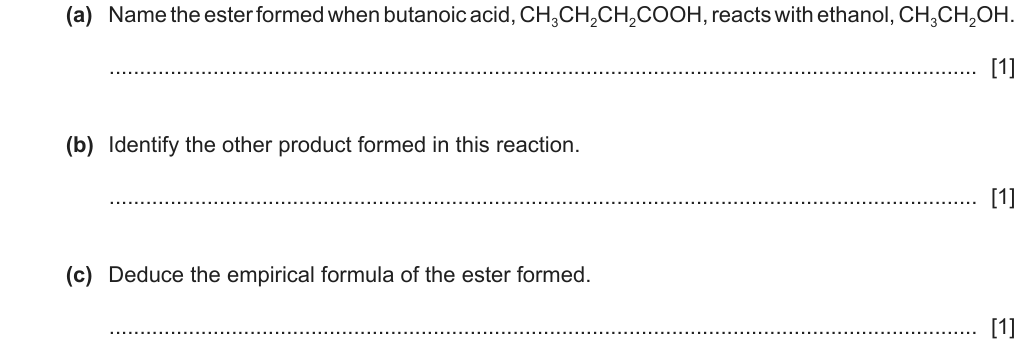
(a) ethyl butanoate ✓. (b) water ✓. (c) The ester is C6H12O2, so the empirical formula is C3H6O ✓.
Examiner feedback: “butanote” was a common misspelling. Many gave the molecular formula instead of simplifying it.
11.3 · Fuels
5Fossil fuels and the fractional distillation of petroleum 11.3.1–11.3.7 Core
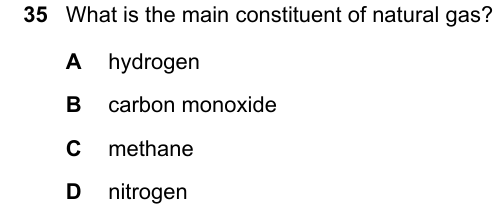
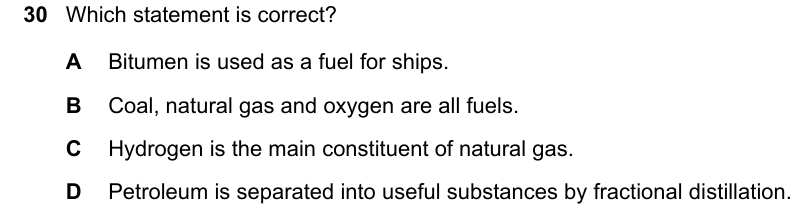
The fossil fuels are coal, natural gas and petroleum (crude oil). The main constituent of natural gas is methane. Hydrocarbons are compounds that contain hydrogen and carbon only; petroleum is a mixture of hydrocarbons with a wide range of chain lengths.
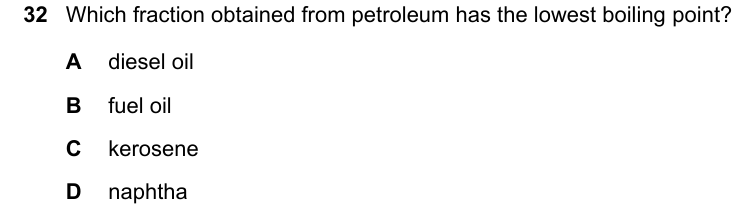
Petroleum is separated into useful fractions — mixtures of hydrocarbons with similar boiling points — by fractional distillation. The petroleum is heated so that most of it vaporises, and the vapour enters the bottom of a fractionating column, which is hot at the bottom and cooler at the top. As the vapour rises it cools; each fraction condenses at the level where the temperature falls below its boiling point and is drawn off. The shortest molecules (refinery gas) do not condense and leave at the top; the longest (bitumen) never vaporise and are drawn off at the bottom.
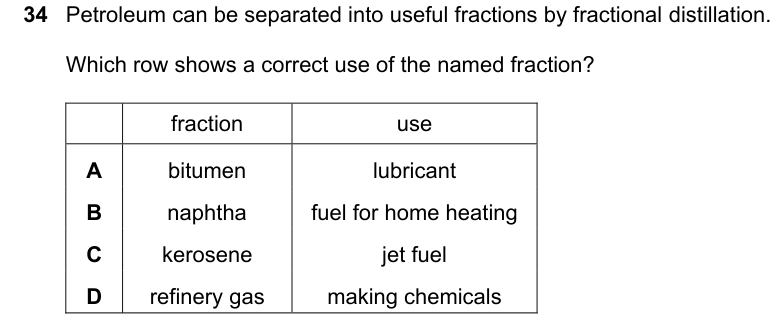
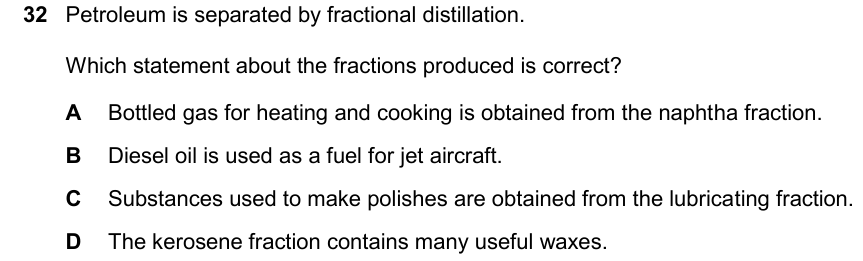
| Fraction | Use |
|---|---|
| refinery gas | gas used in heating and cooking |
| gasoline / petrol | fuel used in cars |
| naphtha | chemical feedstock (raw material for making chemicals) |
| kerosene / paraffin | jet fuel |
| diesel oil / gas oil | fuel used in diesel engines |
| fuel oil | fuel used in ships and home heating systems |
| lubricating oil | lubricants, waxes and polishes |
| bitumen | making roads |
From the bottom to the top of the column the fractions show:
- decreasing chain length (fewer carbon atoms per molecule);
- higher volatility (they evaporate more easily);
- lower boiling points (weaker forces between the smaller molecules);
- lower viscosity (they flow more easily).
Attempt these before opening the solutions. Each reference gives the component, session and question number of the original examination; the answers follow the published mark scheme.
Solutions and mark-scheme guidance · set C
C1 Answer C
Natural gas is mainly methane. Hydrogen and nitrogen were common wrong answers, confusing natural gas with air.
C2 Answer D
Of these, naphtha is highest in the column and has the lowest boiling point. Fuel oil and kerosene were common wrong answers.
C3 Answer C
Kerosene — jet fuel. Bitumen is for roads, naphtha is a chemical feedstock, refinery gas is for heating and cooking.
C4 Answer C
Polishes come from the lubricating oil fraction. Bottled gas is refinery gas; jet fuel is kerosene; waxes come from lubricating oil.
C5 Answer D
Petroleum is separated by fractional distillation. Bitumen is for roads, oxygen is not a fuel, and natural gas is mainly methane.
11.4 · Alkanes
6Alkanes: combustion and substitution 11.4.1–11.4.4 CoreSupplement
The bonding in alkanes is single covalent; alkanes are saturated hydrocarbons. They are generally unreactive, except for combustion and substitution by chlorine.
Combustion. In plenty of oxygen, alkanes burn completely to carbon dioxide and water, releasing a great deal of energy — which is why they are used as fuels. In a limited supply of oxygen, incomplete combustion produces carbon monoxide and carbon (soot) as well (Topic 10).
CH4 + 2O2 → CO2 + 2H2O 2C2H6 + 7O2 → 4CO2 + 6H2O
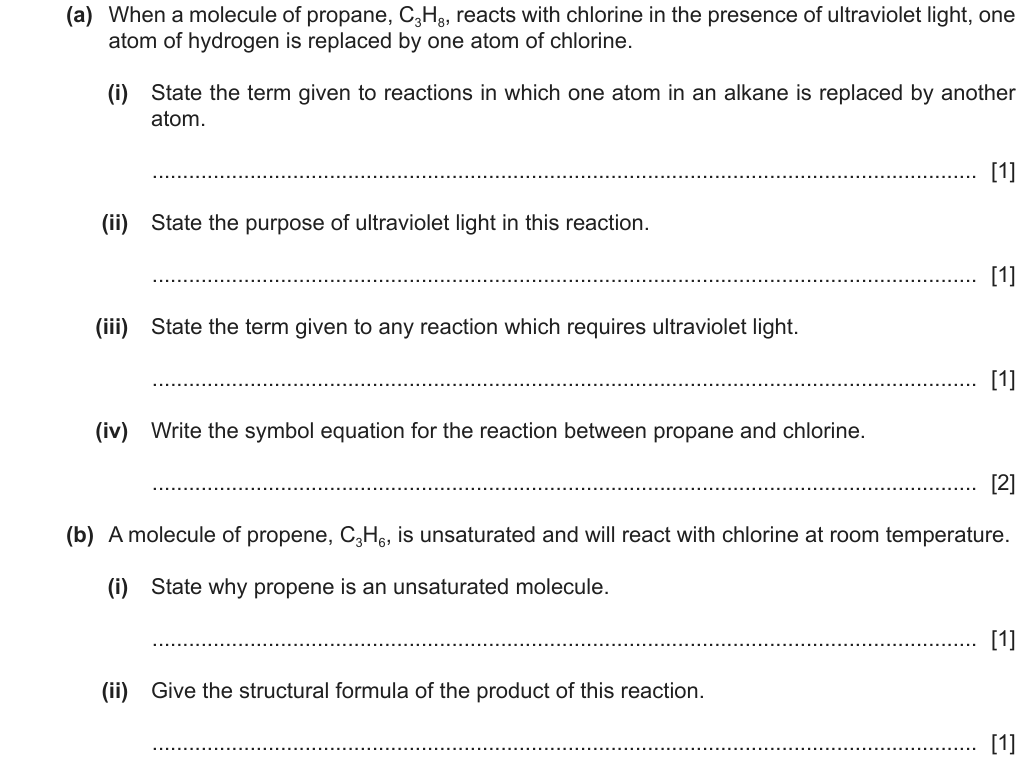
Supplement Substitution. In a substitution reaction one atom or group of atoms is replaced by another atom or group of atoms. Alkanes react with chlorine only in the presence of ultraviolet light, which provides the activation energy: it is a photochemical reaction. One hydrogen atom is replaced by a chlorine atom, and hydrogen chloride is the other product:
CH4 + Cl2 → CH3Cl + HCl C2H6 + Cl2 → C2H5Cl + HCl
The syllabus requires monosubstitution products, but further substitution can continue, so methane can give CH3Cl, CH2Cl2, CHCl3 and CCl4. With propane, monosubstitution can give two isomers: 1-chloropropane, CH3CH2CH2Cl, and 2-chloropropane, CH3CHClCH3.
Substitution of an alkane by chlorine always makes HCl — never H2. Ultraviolet light provides the activation energy; it is not a catalyst. An equation such as C3H6 + Cl2 → C3H6Cl2 is addition to an alkene.
Attempt these before opening the solutions. Each reference gives the component, session and question number of the original examination; the answers follow the published mark scheme.
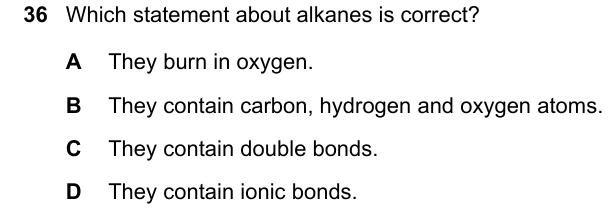
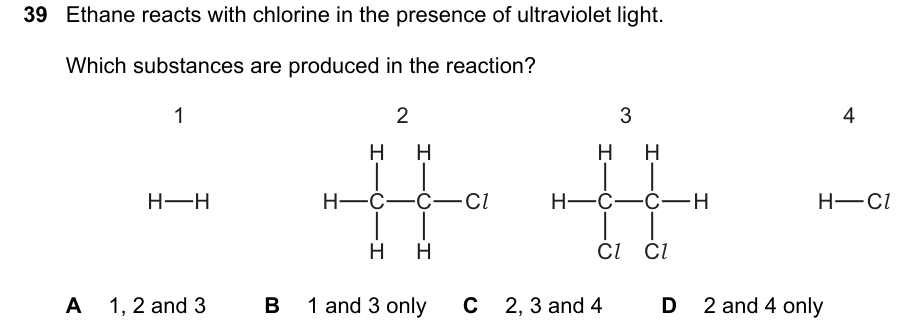

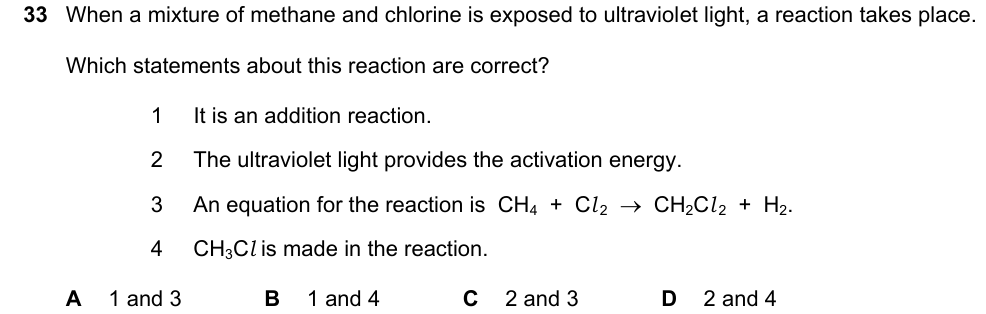
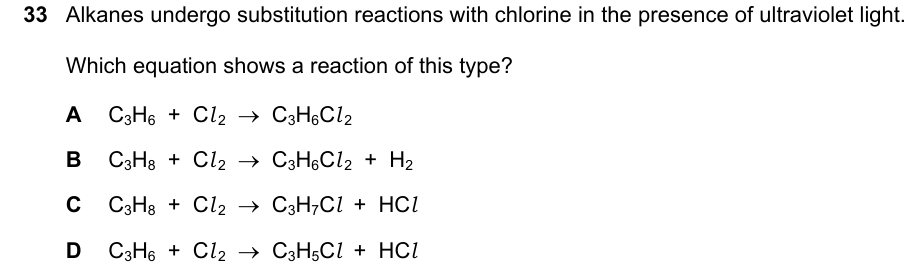
Solutions and mark-scheme guidance · set D
D1 Answer A
Alkanes burn in oxygen. They contain only C and H, only single bonds, and covalent (not ionic) bonds.
D2 Answer C
Chlorine replaces H atoms in ethane; products include chloroethane, dichloroethane and HCl. D was the commonest wrong answer.
D3 Answer C
Each of the four H atoms can be replaced in turn: CH3Cl, CH2Cl2, CHCl3, CCl4 — four products. Option A was the most popular.
D4 Answer D
UV light provides the activation energy (2) and CH3Cl is made (4). It is substitution, not addition, and hydrogen is not a product — only a minority spotted that statement 3 is wrong.
D5 Answer C
C3H8 + Cl2 → C3H7Cl + HCl: alkane, one H replaced, HCl formed. B (making H2) was the commonest error.
D6 [7]
(a)(i) substitution ✓. (ii) To provide the activation energy ✓. (iii) photochemical ✓. (iv) C3H8 + Cl2 → C3H7Cl + HCl: HCl ✓; balanced ✓.
(b)(i) It has a carbon–carbon bond that is not a single bond ✓. (ii) CH3CHClCH2Cl ✓.
Examiner feedback: the role of UV light was not well known. “It has a carbon double bond” is too vague — it must be carbon–carbon. 1,3- and 1,1-dichloropropane and the ambiguous C3H6Cl2 did not score.
11.5 · Alkenes
7Alkenes and cracking 11.5.1–11.5.3 Core
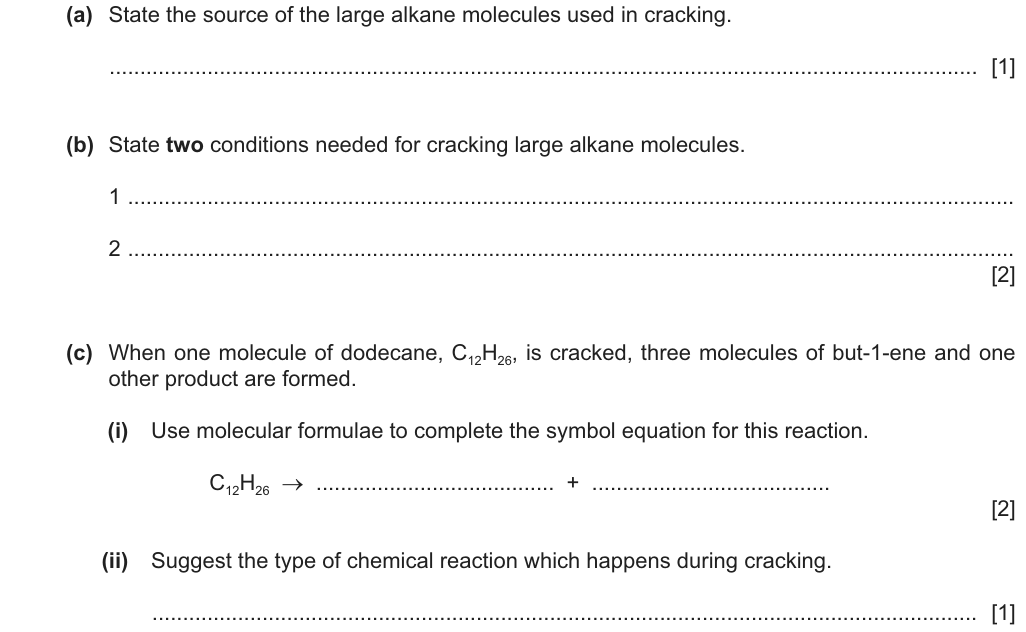
Alkenes contain a C=C double covalent bond; they are unsaturated hydrocarbons. They are manufactured, together with hydrogen, by cracking larger alkane molecules using a high temperature and a catalyst. Cracking is a thermal decomposition: the long chain breaks into a shorter alkane and an alkene, or an alkene and hydrogen:
C10H22 → C8H18 + C2H4 C12H26 → 3C4H8 + H2
Why crack? Fractional distillation produces more of the long-chain fractions than are needed and not enough of the short-chain fractions such as petrol, which are in high demand. Cracking converts the less useful long chains into more useful shorter-chain alkanes for fuels, and produces alkenes (used to make polymers and ethanol) and hydrogen (used to make ammonia and as a fuel).
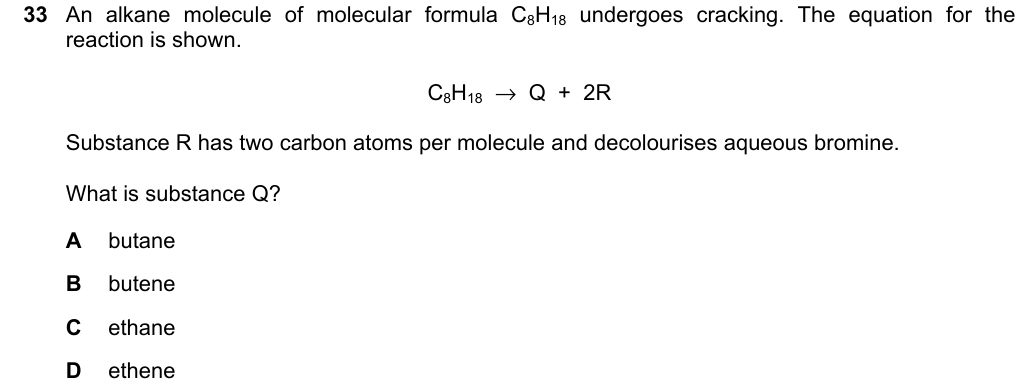
C8H18 is cracked to give one molecule of Q and two molecules of an alkene R with two carbon atoms. Identify Q.
| R | two carbons and decolourises bromine: ethene, C2H4; 2R = C4H8 |
| Q | C8H18 − C4H8 = C4H10: butane |
| Check | C: 8 = 4 + 4; H: 18 = 10 + 8 ✓ |
8The bromine test and addition reactions 11.5.4–11.5.6 CoreSupplement
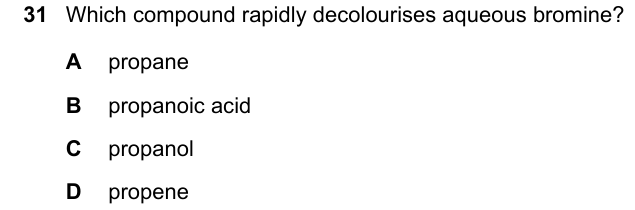
Test for unsaturation. Shake the hydrocarbon with aqueous bromine (orange). An alkene (unsaturated) decolourises it — orange to colourless. An alkane (saturated) gives no change — the solution stays orange.
Supplement In an addition reaction only one product is formed: the two reactant molecules join, and the C=C becomes a single bond. Alkenes undergo addition with:
| Reagent | Conditions | Product | Equation |
|---|---|---|---|
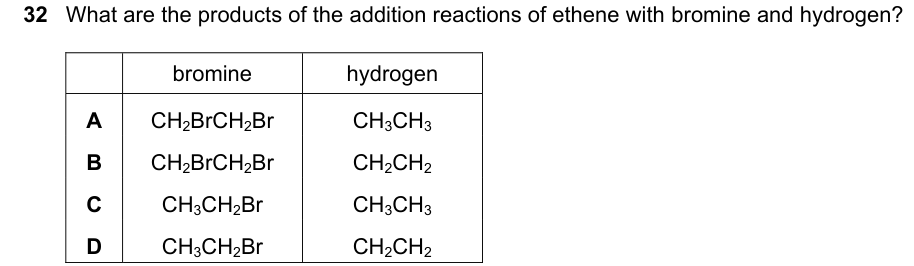
| bromine or aqueous bromine | room temperature | 1,2-dibromoethane | CH2=CH2 + Br2 → CH2BrCH2Br |
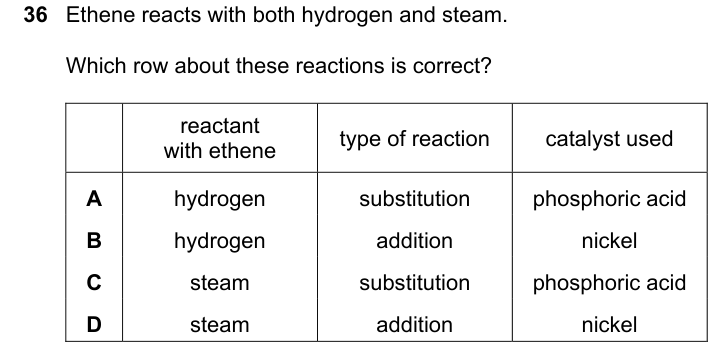
| hydrogen | nickel catalyst | ethane | CH2=CH2 + H2 → CH3CH3 |
| steam | acid catalyst (300 °C, 60 atm) | ethanol | CH2=CH2 + H2O → CH3CH2OH |
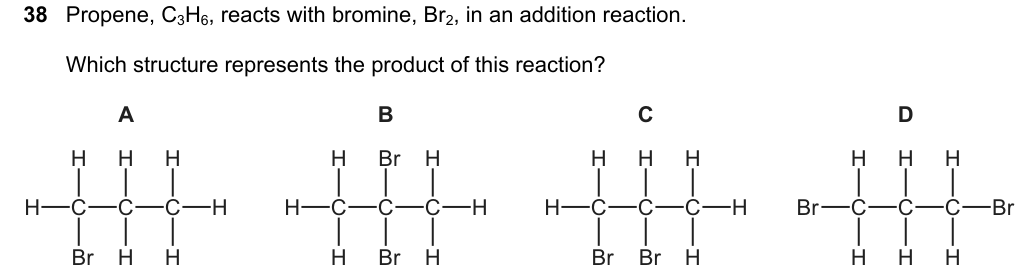
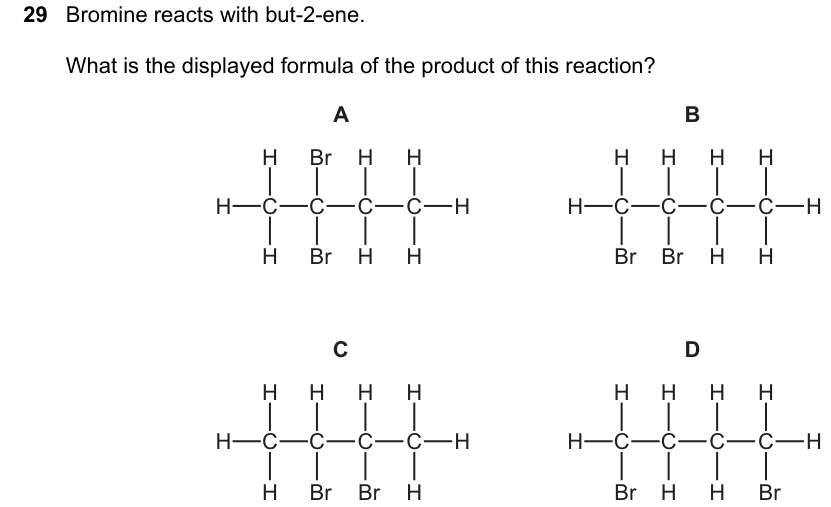
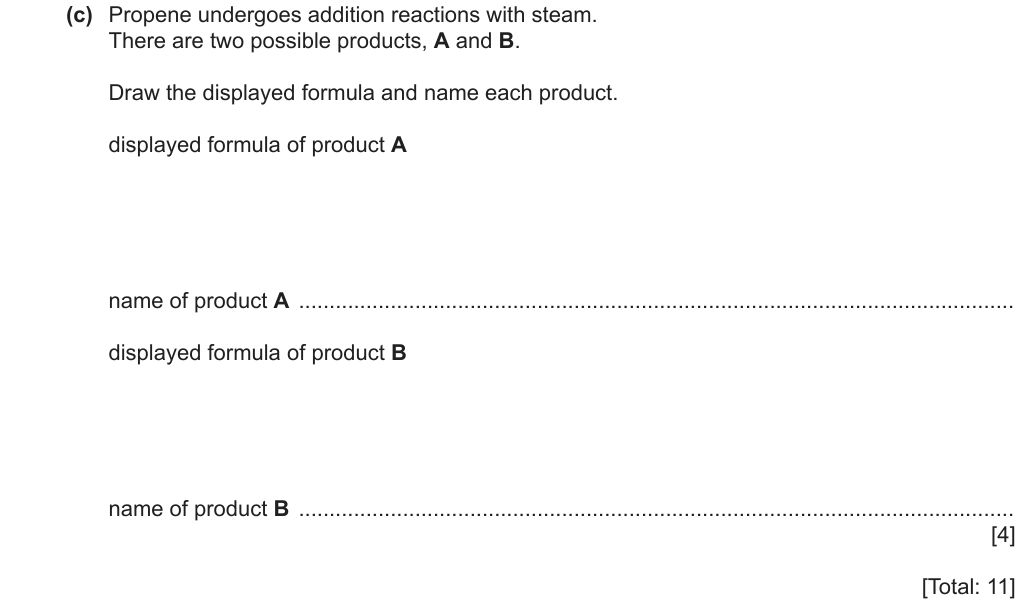
With longer alkenes the two new atoms add to the two carbons of the double bond: propene + bromine → CH3CHBrCH2Br; but-2-ene + bromine → CH3CHBrCHBrCH3. Propene + steam gives a mixture of propan-1-ol and propan-2-ol, because the –OH can add to either carbon.
Bromine adds one Br to each carbon of the C=C — both Br atoms are not placed on the same carbon, and no H is removed. In the bromine test, the colour change is orange → colourless (not colourless → orange). Adding hydrogen needs nickel; adding steam needs an acid catalyst.
Attempt these before opening the solutions. Each reference gives the component, session and question number of the original examination; the answers follow the published mark scheme.
Solutions and mark-scheme guidance · set E
E1 Answer D
Propene has a C=C bond and rapidly decolourises bromine. Weaker candidates chose propanoic acid, mistaking its C=O for unsaturation.
E2 Answer A
Bromine: CH2BrCH2Br; hydrogen: CH3CH3. Option C (CH3CH2Br) confuses addition of Br2 with substitution.
E3 Answer C
One Br adds to each carbon of the double bond: CH3CHBrCH2Br. Almost half of weaker candidates chose D. Products of organic reactions must be known.
E4 Answer C
Br adds to carbons 2 and 3: CH3CHBrCHBrCH3. Weaker candidates chose A.
E5 Answer B
Ethene + hydrogen is addition with a nickel catalyst. Alkenes undergo addition, which eliminates two options at once.
E6 Answer A
R is ethene; 2 × C2H4 = C4H8; Q = C4H10, butane. Many answered with R instead of Q.
E7 [6]
(a) petroleum ✓. (b) High temperature ✓; catalyst ✓. (c)(i) C12H26 → 3C4H8 + H2: C4H8 ✓; balanced ✓. (ii) thermal decomposition ✓.
Examiner feedback: the syllabus conditions are simply “high temperature and a catalyst”. C4H8 + C8H18 ignored “three molecules of but-1-ene”. “Decomposition” alone was not enough.
E8 [4]
Displayed formulae of propan-1-ol ✓ and propan-2-ol ✓, each correctly named ✓✓, with the O–H bond shown.
Examiner feedback: “propanol” is not enough for propan-1-ol; many omitted the O–H bond in the displayed formula.
11.6 · Alcohols
9Ethanol: manufacture, combustion and uses 11.6.1–11.6.4 CoreSupplement
Ethanol is manufactured in two ways:
| Fermentation | Catalytic addition of steam to ethene | |
|---|---|---|
| equation | C6H12O6(aq) → 2C2H5OH(aq) + 2CO2(g) | C2H4(g) + H2O(g) → C2H5OH(g) |
| conditions | aqueous glucose, yeast, 25–35 °C, absence of oxygen | 300 °C, 6000 kPa / 60 atm, acid catalyst |
| Supplement advantages | uses a renewable raw material (sugar from plants); low temperature, so less energy | fast; continuous process; produces pure ethanol; high yield |
| Supplement disadvantages | slow; batch process; produces impure ethanol (dilute solution that must be distilled) | ethene comes from petroleum, a non-renewable resource; high temperature and pressure need a lot of energy |
The temperature for fermentation is a balance: below 25 °C the yeast enzymes work slowly; above about 35 °C they are denatured. Oxygen is excluded so that the yeast respires anaerobically and ethanol is not oxidised to ethanoic acid.
Combustion of ethanol. Ethanol burns with a clean blue flame, releasing energy: C2H5OH + 3O2 → 2CO2 + 3H2O. Uses: ethanol is used as a solvent and as a fuel.
Fermentation conditions are not well known: sunlight and oxygen are common wrong answers; the key conditions are yeast and absence of oxygen. The conditions for adding steam to ethene are often replaced by Haber-process values. An addition reaction is one in which only one product forms — “water is added to ethene” just repeats the question. Say that fermentation “uses a renewable resource”, not simply “is renewable”.
Attempt these before opening the solutions. Each reference gives the component, session and question number of the original examination; the answers follow the published mark scheme.
Solutions and mark-scheme guidance · set F
F1 Answer C
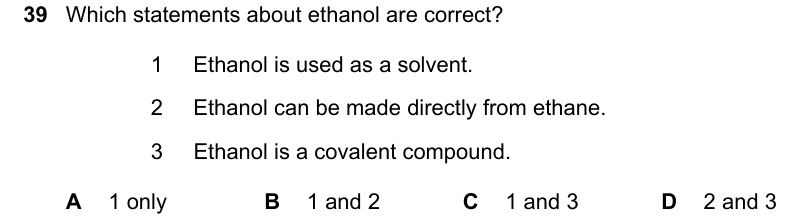
Ethanol is a solvent (1) and a covalent compound (3). It is made from ethene, not ethane.
F2 Answer B
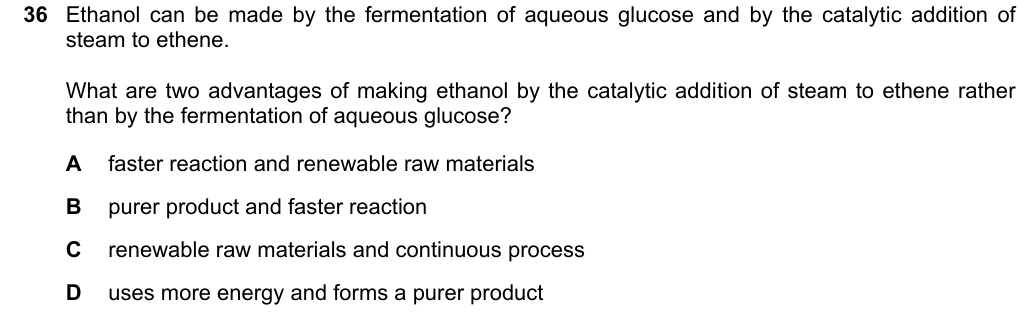
Addition of steam to ethene gives a purer product and a faster reaction. Renewable raw materials are an advantage of fermentation.
F3 Answer D
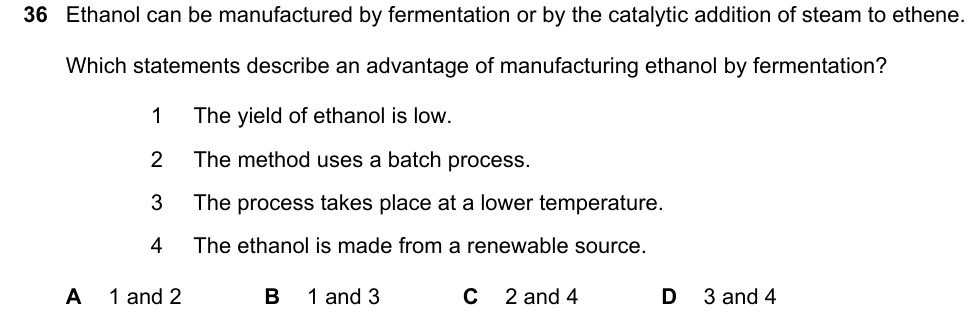
Fermentation's advantages: lower temperature (3) and a renewable source (4). A low yield and a batch process are disadvantages.
F4 Answer D
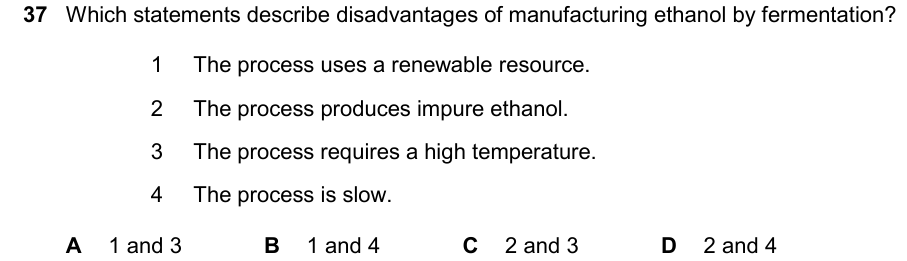
Disadvantages of fermentation: impure ethanol (2) and slow (4). Using a renewable resource is an advantage; fermentation needs a low temperature.
F5 Answer D
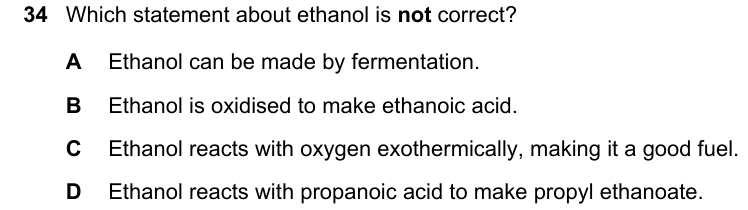
Ethanol + propanoic acid gives ethyl propanoate, not propyl ethanoate, so D is the incorrect statement. Some chose C — a correct statement, not the answer to a “not” question.
F6 [12]
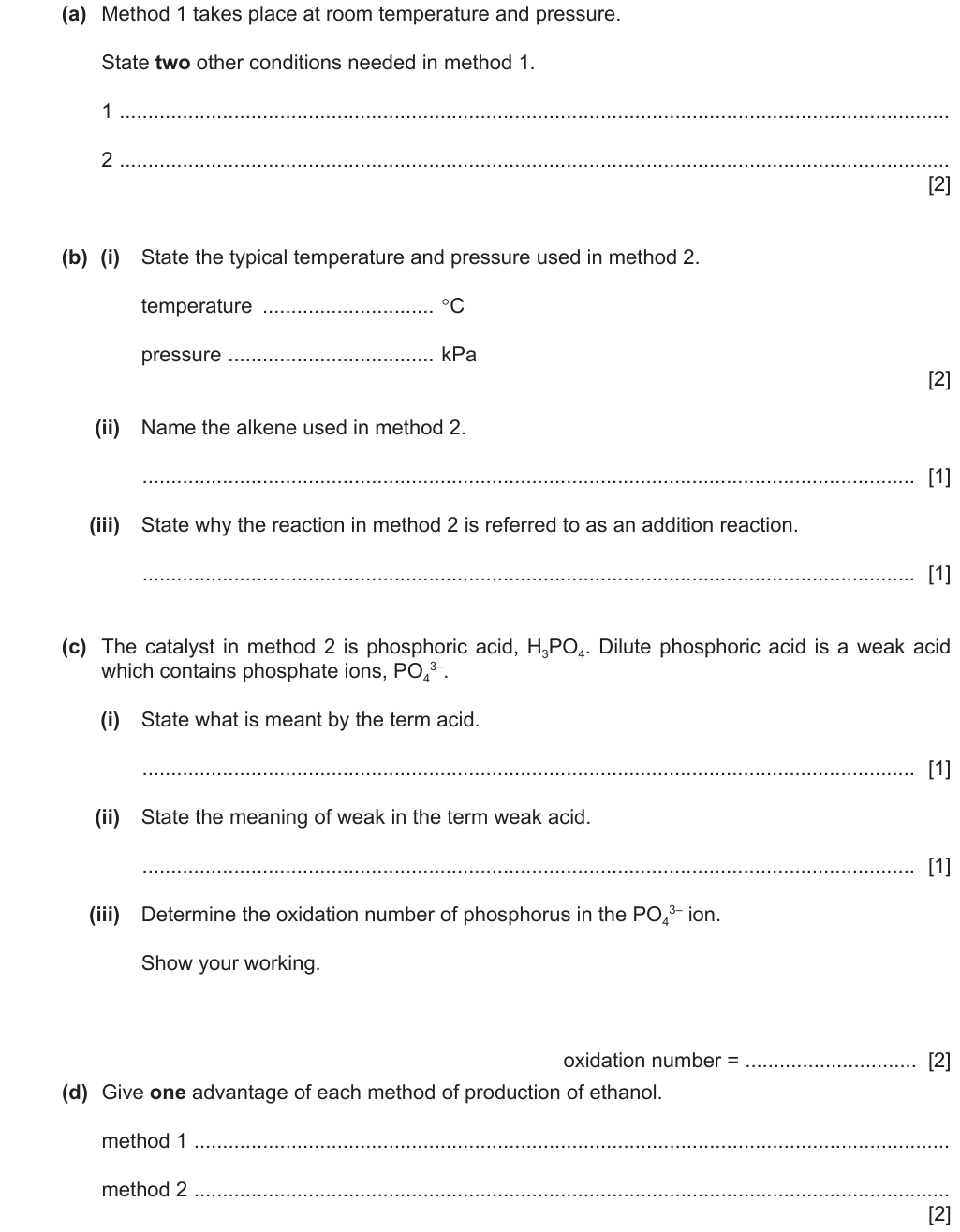
(a) yeast ✓; absence of air (oxygen) ✓.
(b)(i) 300 °C ✓; 6000 kPa ✓. (ii) ethene ✓. (iii) Only one product is formed ✓.
(c)(i) A proton donor ✓. (ii) Partially dissociated ✓. (iii) 4 × (−2) = −8 ✓; P + (−8) = −3, so P = +5 ✓.
(d) Method 1: uses renewable resources ✓. Method 2: faster (high rate) ✓.
Examiner feedback: sunlight and oxygen were common wrong conditions; few knew anaerobic conditions. Haber-process conditions were often quoted. Many repeated the stem for an addition reaction. “Low pH”, “releases H+” and “fewer H+ ions” did not define acid or weak. −3 (the charge on the ion) was a common wrong oxidation number.
11.7 · Carboxylic acids
10Carboxylic acids and esters 11.7.1–11.7.3 CoreSupplement
Ethanoic acid, CH3COOH, is a weak acid (Topic 7) and shows the typical reactions of acids. Its salts are ethanoates, containing the CH3COO− ion:
| With | Products | Example |
|---|---|---|
| metals | salt + hydrogen | 2CH3COOH + Mg → (CH3COO)2Mg + H2 (magnesium ethanoate) |
| bases | salt + water | CH3COOH + NaOH → CH3COONa + H2O (sodium ethanoate) |
| carbonates | salt + water + carbon dioxide | 2CH3COOH + Na2CO3 → 2CH3COONa + H2O + CO2 |
Because it is weak, ethanoic acid reacts more slowly than hydrochloric acid of the same concentration. With a Group II metal such as calcium or magnesium, two ethanoate ions balance the 2+ charge: (CH3COO)2Ca, not CH3COOCa.
Supplement Making ethanoic acid. Ethanol is oxidised to ethanoic acid:
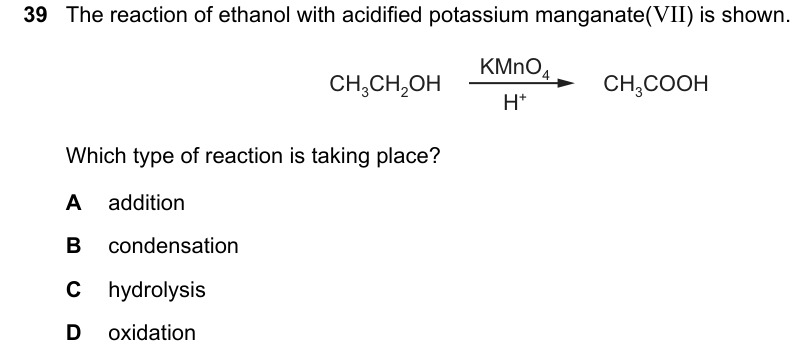
- by warming with acidified aqueous potassium manganate(VII), which changes from purple to colourless — ethanol is the reducing agent;
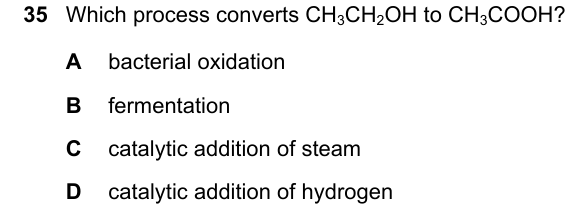
- by bacterial oxidation during vinegar production (wine left open to the air turns sour).
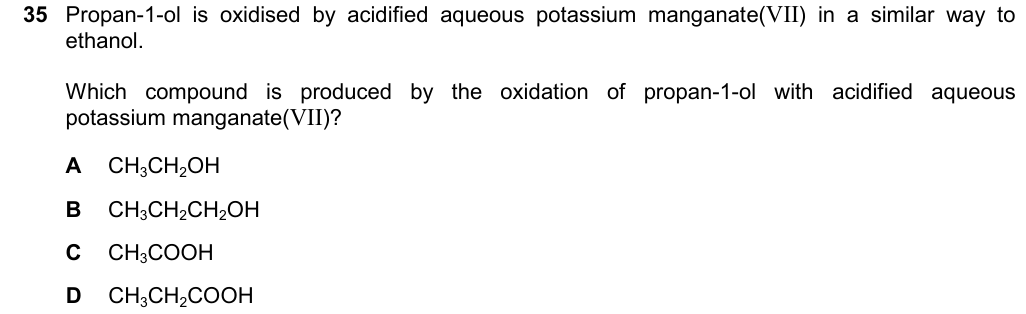
Propan-1-ol is oxidised in the same way to propanoic acid, CH3CH2COOH.
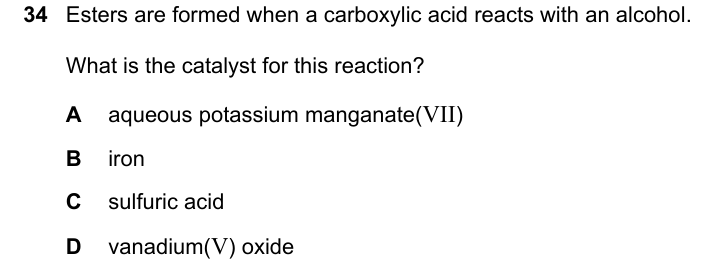
Supplement Esterification. A carboxylic acid reacts with an alcohol, with an acid catalyst (concentrated sulfuric acid), to form an ester and water:
CH3COOH + CH3CH2OH ⇌ CH3COOCH2CH3 + H2O
ethanoic acid + ethanol ⇌ ethyl ethanoate + water
The –OH of the acid and the H of the alcohol's –OH leave as water, and the two parts join through the ester linkage, –COO–. Esters have fruity smells and are used in flavourings and perfumes.
Attempt these before opening the solutions. Each reference gives the component, session and question number of the original examination; the answers follow the published mark scheme.
Solutions and mark-scheme guidance · set G
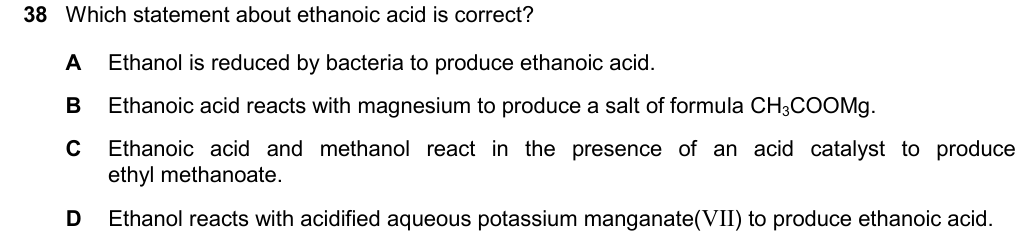
G1 Answer A
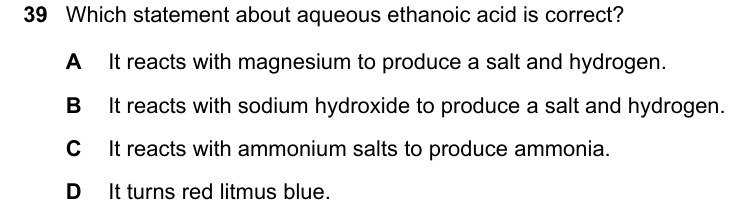
Ethanoic acid + magnesium → salt + hydrogen. With sodium hydroxide, a base, it gives salt + water — B was the commonest answer.
G2 Answer D
Ethanol → ethanoic acid with acidified KMnO4 is oxidation.
G3 Answer A
Bacterial oxidation converts ethanol to ethanoic acid. Fermentation and addition of steam make ethanol — B and C were the commonest choices.
G4 Answer D
Propan-1-ol is oxidised to propanoic acid, CH3CH2COOH. B, the commonest wrong answer, is the reactant.
G5 Answer C
Esterification uses an acid catalyst — sulfuric acid. Many confused it with oxidation of an alcohol (A).
G6 Answer D
Ethanol + acidified KMnO4 → ethanoic acid. Bacteria oxidise ethanol; the magnesium salt is (CH3COO)2Mg; ethanoic acid + methanol gives methyl ethanoate, not ethyl methanoate (C, the weaker candidates' choice).
G7 [5]
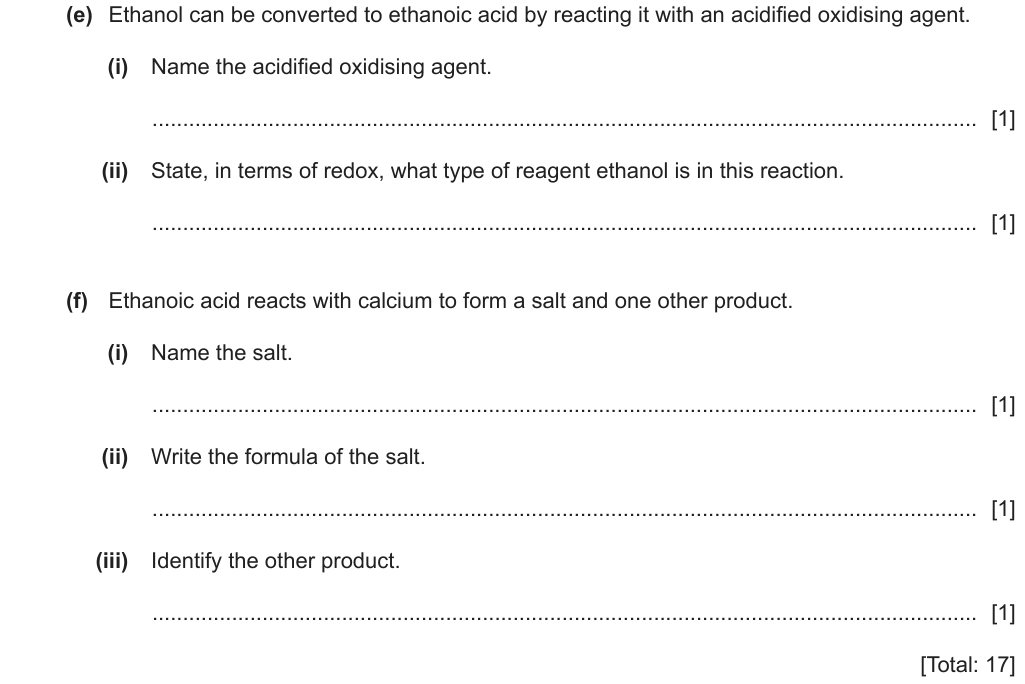
(e)(i) potassium manganate(VII) ✓. (ii) A reducing agent ✓.
(f)(i) calcium ethanoate ✓. (ii) (CH3COO)2Ca ✓. (iii) hydrogen ✓.
11.8 · Polymers
11Polymers, poly(ethene) and plastics 11.8.1–11.8.5, 11.8.7 CoreSupplement
Polymers are large molecules built up from many smaller molecules called monomers.
In addition polymerisation, many alkene monomers join together: the C=C double bond in each monomer opens and the molecules link into a long chain. Poly(ethene) is made from ethene:
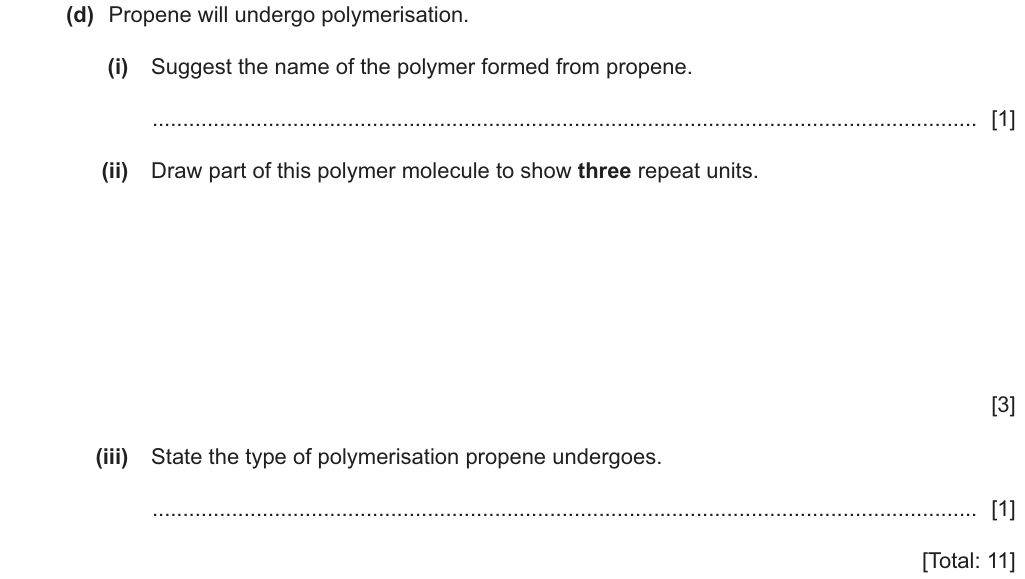
Supplement Deducing structures. To draw the repeat unit of any addition polymer, draw the two carbons of the C=C with a single bond between them, keep every other atom or group attached to them, and add continuation bonds. Propene, CH2=CHCH3, gives poly(propene) with repeat unit –CH2–CH(CH3)–: the CH3 group is a side group, not part of the main chain, so three repeat units contain a chain of six carbon atoms with three CH3 branches. Working backwards, take a two-carbon repeat unit and put a double bond between its carbons to find the monomer.
Plastics are made from polymers. Their useful properties — they are unreactive, durable, light and do not rot — create problems when they are thrown away:
- disposal in landfill sites: most plastics are non-biodegradable, so they remain for hundreds of years and landfill space runs out;
- accumulation in oceans: plastic waste harms aquatic life, which can be trapped by it or swallow it;
- formation of toxic gases from burning: burning some plastics releases toxic gases (such as hydrogen chloride from PVC, and carbon monoxide from incomplete combustion).
12Condensation polymers: nylon, PET and proteins 11.8.6, 11.8.8–11.8.13 Supplement
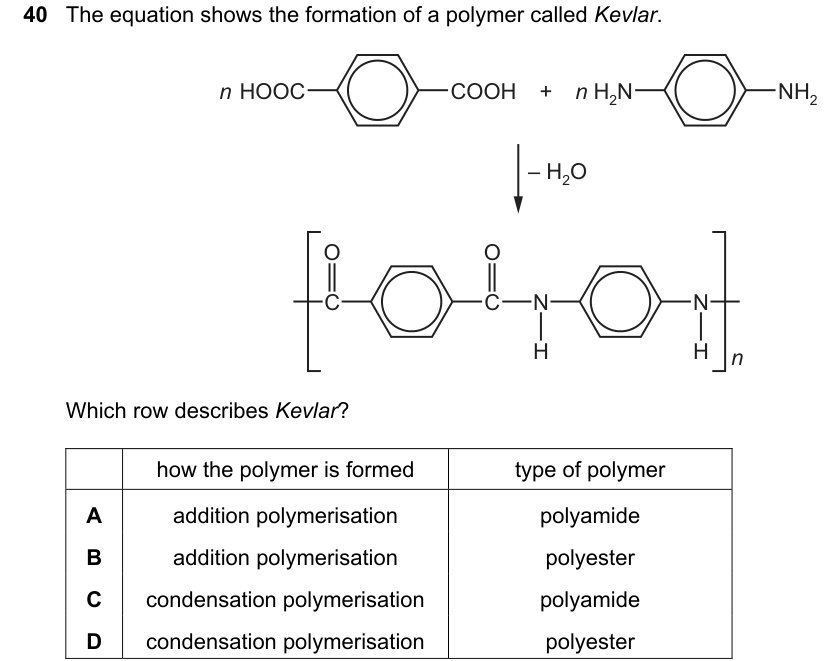
In condensation polymerisation, monomers with two functional groups each join together, and a small molecule — usually water — is eliminated at every link.
| Addition | Condensation | |
|---|---|---|
| monomers | alkenes (contain C=C) | two different monomers, each with two functional groups (or one monomer with two different groups) |
| products | polymer only | polymer and water (small molecule) |
| linkage | C–C in the chain | amide –CONH– or ester –COO– |
| examples | poly(ethene), poly(propene) | nylon, PET, proteins |
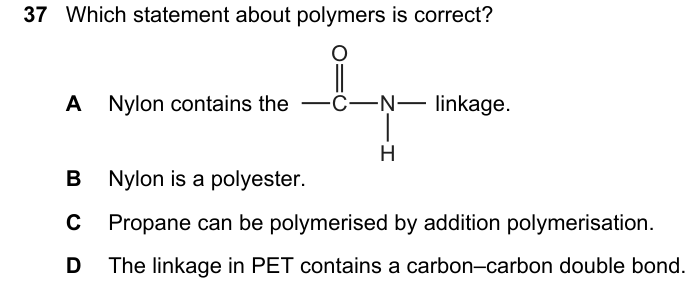
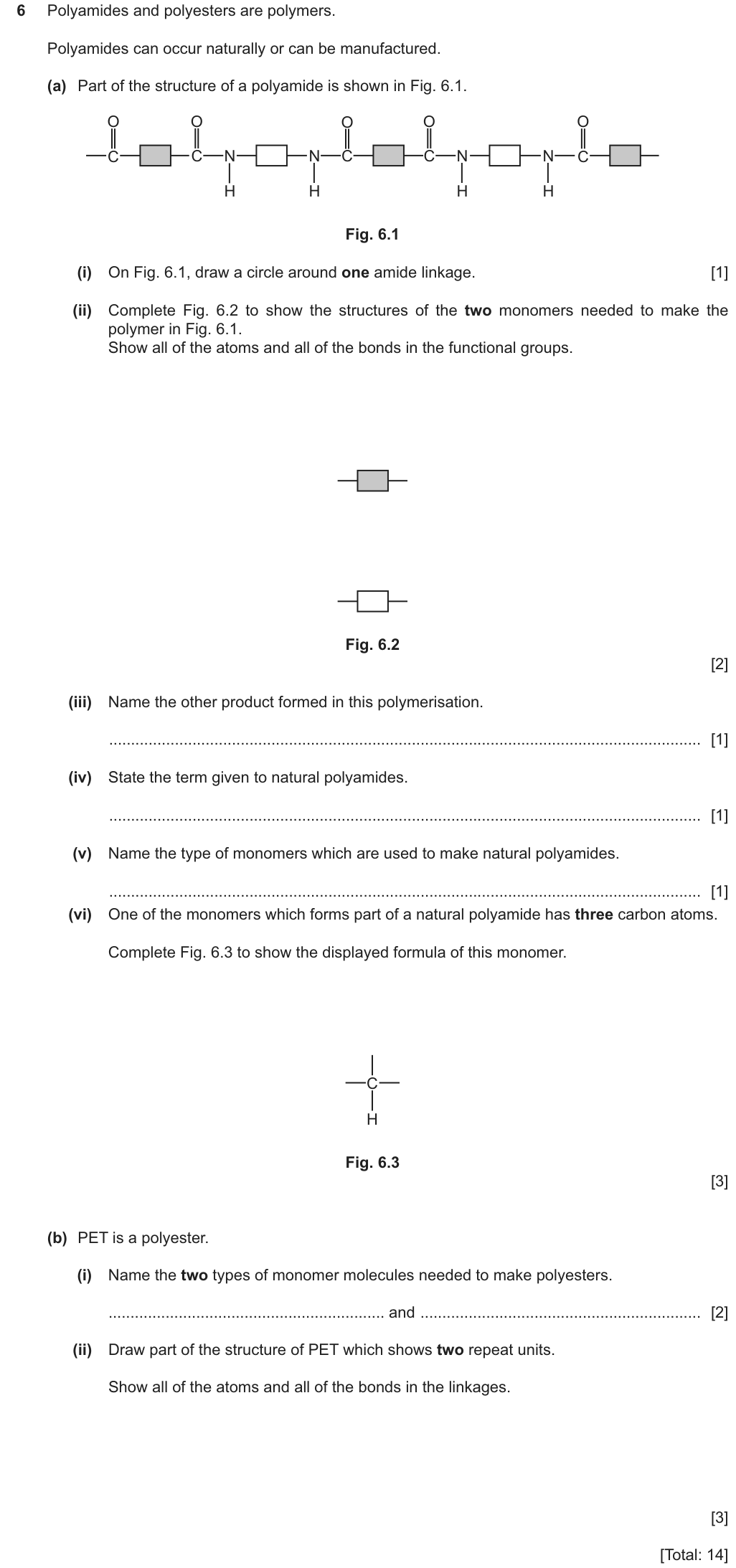
- Polyamides are made from a dicarboxylic acid and a diamine, joined by amide linkages, –CO–NH–. Nylon is a polyamide.
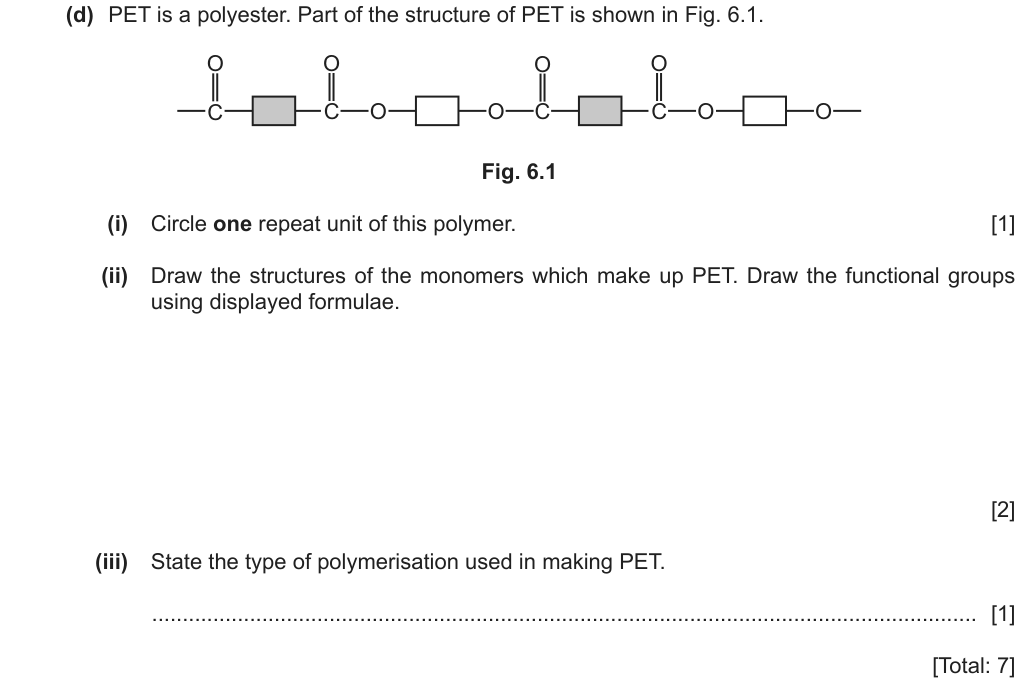
- Polyesters are made from a dicarboxylic acid and a diol, joined by ester linkages, –CO–O–. PET is a polyester; it can be converted back into its monomers and re-polymerised, which allows it to be recycled.
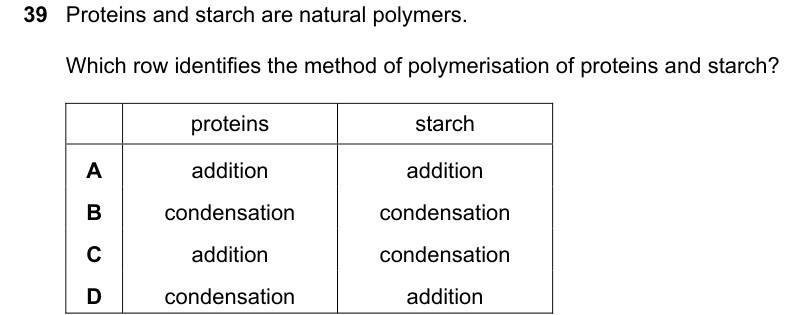
- Proteins are natural polyamides formed from amino acid monomers, H2N–CHR–COOH, where R is a side chain. Each amino acid has an amine group and a carboxylic acid group on the same carbon atom; water is eliminated as they join by amide linkages.
Nylon is a polyamide, not a polyester; both nylon and proteins have amide linkages — decide which by the monomers (diamine + dicarboxylic acid for nylon; amino acids for proteins). Polyester monomers are a diol and a dicarboxylic acid — “an alcohol and a carboxylic acid” would make only a single ester. Monomers are separate molecules: they have no continuation bonds. In an amino acid, NH2 and COOH are on the same carbon.
Attempt these before opening the solutions. Each reference gives the component, session and question number of the original examination; the answers follow the published mark scheme.
Solutions and mark-scheme guidance · set H
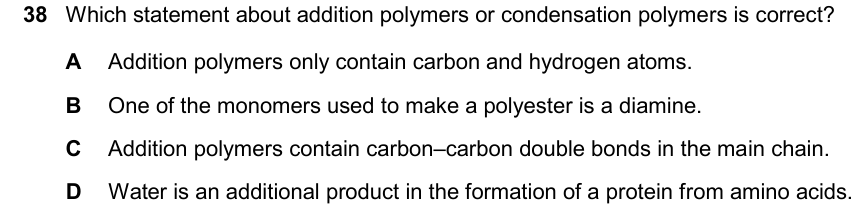
H1 Answer A
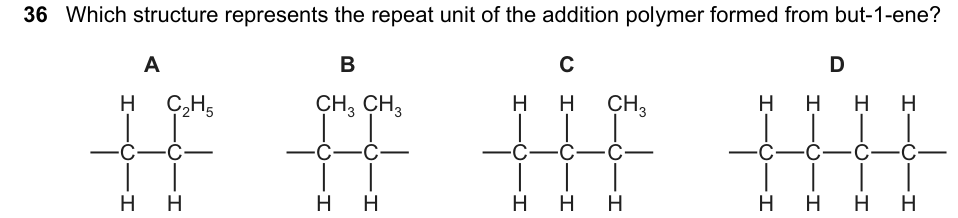
But-1-ene, CH2=CHCH2CH3: the two C=C carbons form the chain and C2H5 is a side group: repeat unit –CH2–CH(C2H5)–. Less than half answered correctly.
H2 Answer C
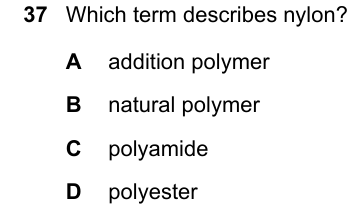
Nylon is a polyamide. Some chose polyester, and many confused condensation with addition polymerisation.
H3 Answer C
Water is eliminated (condensation) and the linkage is –CO–NH– (polyamide). Use the linkage to classify an unfamiliar polymer.
H4 Answer A
Nylon contains the amide linkage. Propane (an alkane) cannot be polymerised — many misread it as propene; others confused the amide and ester linkages.
H5 Answer B
Proteins and starch are both formed by condensation. Many thought proteins form by addition.
H6 Answer C
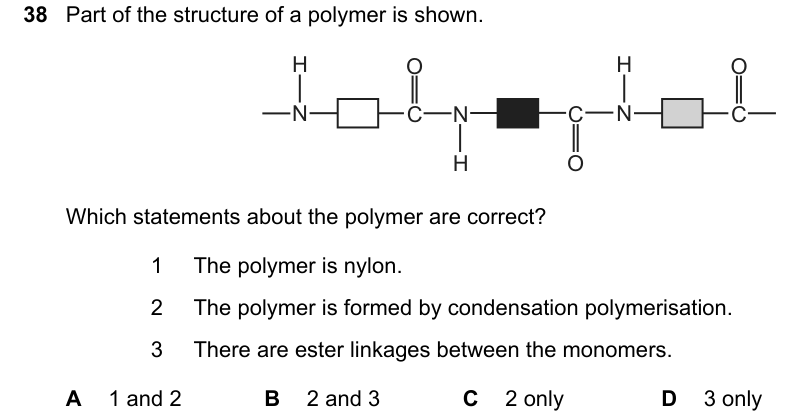
The chain has amide linkages with one carbon between N and C=O: a protein, formed by condensation only. Many chose A, not distinguishing a protein from nylon.
H7 Answer D
Water is eliminated when amino acids join to form a protein. Addition polymers such as PVC contain other elements; polyesters need a diol, not a diamine; addition polymer main chains have C–C single bonds.
H8 [5]
(i) poly(propene) ✓. (ii) A chain of six carbon atoms joined by single bonds ✓, with three CH3 groups on alternate carbons ✓, and continuation bonds at both ends ✓. (iii) addition ✓.
Examiner feedback: many drew nine carbons in the main chain, not realising only the two C=C carbons of each monomer form the backbone.
H9 [14]
(a)(i) One –CO–NH– circled, including the H ✓. (ii) Dicarboxylic acid: –COOH groups fully displayed on the shaded block ✓; diamine: –NH2 groups fully displayed on the other block ✓. (iii) water ✓. (iv) proteins ✓. (v) amino acids ✓. (vi) 2-aminopropanoic acid: NH2 or COOH displayed ✓; both on the same carbon ✓; fully correct with CH3 as R ✓.
(b)(i) dicarboxylic acids ✓ and diols ✓. (ii) Two repeat units with fully displayed ester linkages in the correct orientation and continuation bonds ✓✓✓.
Examiner feedback: the H of N–H was often left out of the circled linkage. Many redrew parts of the polymer instead of monomers. Nearly all placed NH2 and COOH on different carbons. “Carboxylic acid and alcohol” were given instead of dicarboxylic acid and diol.
H10 [4]
(i) One complete repeat unit circled ✓. (ii) A diol (HO–block–OH, displayed) ✓ and a dicarboxylic acid (HOOC–block–COOH, displayed) ✓ on the correct blocks. (iii) condensation ✓.
Examiner feedback: some circled only the ester linkage. Monomers were drawn with continuation bonds, or with O–H joined to the block through the H.
Review · Topic 11
13Misconceptions and the examiner’s view
- “Members of a homologous series have the same number of carbon atoms.” They differ by –CH2–.
- “A C=O bond makes a compound unsaturated.” Unsaturation refers to carbon–carbon bonds.
- “Two ways of writing the same molecule are isomers.” Isomers must have different structures.
- “Chlorine substitution gives hydrogen.” It gives HCl; UV provides activation energy.
- “Both bromine atoms go on one carbon.” One adds to each carbon of the C=C.
- “Fermentation needs oxygen and sunlight.” It needs yeast, 25–35 °C and the absence of oxygen.
- “Ethanoic acid + NaOH gives hydrogen.” A base gives salt + water; only metals give hydrogen.
- “Nylon is a polyester” / “proteins form by addition.” Both are condensation polyamides.
Organic chemistry rewards precise structures and exact terminology. Displayed formulae lose marks when the O–H bond is not drawn, when carbon is given five bonds, or when both bromine atoms are placed on one carbon; product structures of organic reactions must be known. Terminology is often vague: “saturated” and “unsaturated” must refer to carbon–carbon bonds, an addition reaction is one that forms only one product, and the difference between members of a homologous series is a –CH2– unit. Structural isomers are confused with two representations of the same molecule. In alkane chemistry, the role of ultraviolet light (activation energy) is not well known and hydrogen is wrongly shown as a product. Conditions are frequently confused between processes: fermentation (yeast, absence of oxygen), hydration of ethene (300 °C, 6000 kPa, acid catalyst), hydrogenation (nickel), esterification (acid catalyst) and oxidation (acidified potassium manganate(VII) or bacteria). Questions that ask for Q often receive the answer for R, and questions containing “not” need particular care. In polymer chemistry, candidates struggle to draw repeat units of addition polymers from substituted alkenes, confuse amide and ester linkages and nylon with proteins, give “alcohol and carboxylic acid” instead of diol and dicarboxylic acid, and draw monomers with continuation bonds. Strong answers sketch the displayed formula before deciding, count bonds on every atom, and name compounds with the correct stem, position number and ending.
14Summary and knowledge organiser
Essential knowledge
- General formulae: CnH2n+2, CnH2n, CnH2n+1OH, CnH2n+1COOH.
- Fractions (top → bottom): refinery gas, petrol, naphtha, kerosene, diesel, fuel oil, lubricating oil, bitumen.
- Alkanes: combustion; substitution with Cl2 in UV → chloroalkane + HCl.
- Cracking: high temperature + catalyst → alkene + shorter alkane / hydrogen. Bromine test: orange → colourless for alkenes.
- Addition: Br2; H2/Ni; steam/acid catalyst.
- Ethanol: fermentation (yeast, 25–35 °C, no O2) or ethene + steam (300 °C, 60 atm, acid catalyst).
- Ethanoic acid: acid reactions; made by oxidation (KMnO4/H+ or bacteria); + alcohol → ester + water.
- Polymers: addition (alkenes) vs condensation (nylon, PET, proteins; water eliminated).
Examination checklist
- Displayed formulae: every atom, every bond, C = 4 bonds, O–H drawn.
- Give the reagent and the conditions for each reaction.
- Name esters: alkyl (from alcohol) + -oate (from acid).
- Repeat units: two-carbon backbone per alkene monomer, side groups hanging, continuation bonds.
- Polyamide: diamine + dicarboxylic acid; polyester: diol + dicarboxylic acid.
Knowledge organiser · organic chemistry
| Idea | What to know | Must-remember distinctions and common errors |
|---|---|---|
| Terminology 11.1 | Functional group, homologous series, saturated, isomers. | C–C bonds decide saturation; same molecule ≠ isomer. |
| Naming 11.2 | meth/eth/prop/but; -ane, -ene, -ol, -oic acid, -yl -oate. | Position numbers: but-2-ene, propan-2-ol. |
| Fuels 11.3 | Fossil fuels; fractional distillation; fractions and uses. | Up the column: shorter, more volatile, lower bp, less viscous. |
| Alkanes 11.4 | Combustion; substitution with Cl2/UV. | HCl product; photochemical. |
| Alkenes 11.5 | Cracking; bromine test; addition of Br2, H2, H2O. | Ni for H2; acid catalyst for steam. |
| Alcohols 11.6 | Fermentation vs hydration; combustion; solvent and fuel. | Renewable vs fast, pure, continuous. |
| Carboxylic acids 11.7 | Salts (ethanoates); oxidation of ethanol; esterification. | (CH3COO)2Mg; acid catalyst. |
| Polymers 11.8 | Poly(ethene); plastics' problems; nylon, PET, proteins. | Amide vs ester linkage; water eliminated in condensation. |