
Topic 5 of the syllabus has a single sub-topic, 5.1 Exothermic and endothermic reactions. Core statements 5.1.1–5.1.3 cover the direction of energy transfer and reading reaction pathway diagrams; Supplement statements 5.1.4–5.1.8 add ΔH, activation energy, drawing pathway diagrams and bond-energy calculations.
Central idea: every reaction breaks some bonds and makes others. Breaking bonds takes energy in; making bonds gives energy out. Whichever is larger decides whether the surroundings warm up or cool down.
Before you start
- Temperature is a measure of the average kinetic energy of particles (Topic 1).
- Covalent bonds are shared pairs of electrons; dot-and-cross and displayed formulae show which bonds a molecule contains (Topic 2).
- Balanced equations give the number of each molecule reacting (Topic 3).
Learning objectives
- State what happens to the temperature of the surroundings in exothermic and endothermic reactions.
- Interpret reaction pathway diagrams.
- Supplement State the meaning and sign of ΔH; define activation energy; draw and label pathway diagrams.
- Supplement Explain ΔH in terms of bond breaking and bond making, and calculate ΔH from bond energies.
Introduction: hand warmers and cold packs
Squeeze a hand warmer and it becomes hot for an hour: iron powder inside is slowly oxidising, releasing energy to your fingers. Snap a sports cold pack and it becomes icy: ammonium nitrate dissolving in water takes energy from its surroundings. Burning fuels, respiration in cells and neutralising an acid all release energy; photosynthesis, thermal decomposition and cooking an egg take it in. Chemical energetics explains which way the energy flows and how much.
5.1 · Exothermic and endothermic reactions
1Exothermic and endothermic reactions 5.1.1–5.1.2 Core
An exothermic reaction transfers thermal energy to the surroundings, leading to an increase in the temperature of the surroundings.
An endothermic reaction takes in thermal energy from the surroundings, leading to a decrease in the temperature of the surroundings.
In experiments the “surroundings” are mainly the water or solution in which the reaction happens and the container. A thermometer placed in the mixture therefore rises for an exothermic reaction and falls for an endothermic one. The temperature change is the evidence; the energy transfer is the explanation.
| Exothermic (temperature rises) | Endothermic (temperature falls) |
|---|---|
| combustion of fuels; respiration | thermal decomposition, e.g. CaCO3 → CaO + CO2 |
| neutralisation of an acid by an alkali | photosynthesis |
| reactive metals with acids or water | dissolving ammonium nitrate or potassium chloride in water |
| displacement reactions; rusting | sodium hydrogencarbonate with an acid; citric acid with sodium hydrogencarbonate |
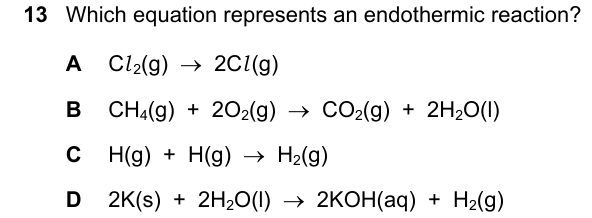
| forming bonds, e.g. H(g) + H(g) → H2(g) | breaking bonds, e.g. Cl2(g) → 2Cl(g) |
“The reaction feels cold, so it is releasing cold.” There is no such thing as cold being released: an endothermic reaction absorbs energy from the surroundings, so the surroundings — including your hand — lose energy and their temperature falls.
2Measuring energy changes in the laboratory 5.1.1–5.1.2 Core
A simple method: measure a known volume of water or solution into an insulated container (a polystyrene cup, often inside a beaker for stability), record the initial temperature, add the second reactant, stir, and record the highest (or lowest) temperature reached. The temperature change is final − initial.
- A polystyrene cup is used because it is a good insulator, so less heat is lost to (or gained from) the surroundings, and the measured temperature change is closer to the true value. A glass beaker conducts heat much better.
- A lid reduces heat loss by evaporation and convection.
- A burette or pipette measures volumes more accurately than a measuring cylinder.
The energy transferred can be estimated from the temperature change: energy (J) = mass of water (g) × 4.2 × temperature change (°C), taking 1 cm3 of water as 1 g. Paper 6 questions supply this relationship when it is needed.
In practical questions on temperature change, candidates often explained a polystyrene cup as “more accurate for measuring volume”; the reason is that it is an insulator, so less heat is lost. Temperatures must be recorded to the same resolution (27.0, not 27), units must be given, and when data lie on a curve the best-fit line must be a curve, not a ruler line joining the first and last points.
3Reaction pathway diagrams 5.1.3 Core
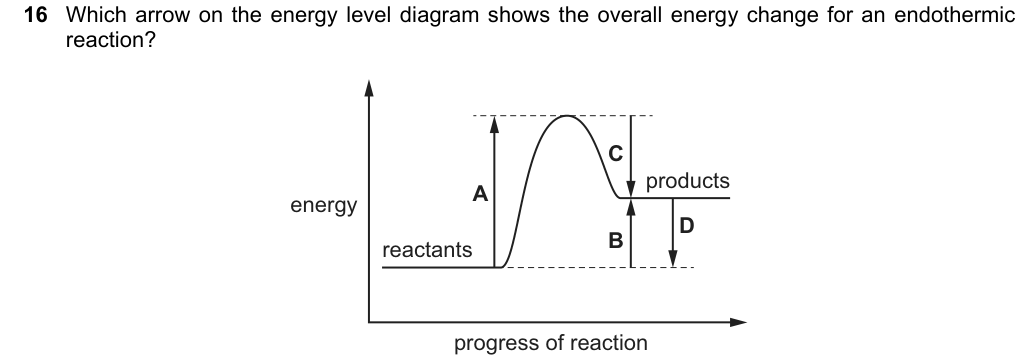
A reaction pathway diagram (energy level diagram) plots energy against the progress of the reaction. The reactants and products are drawn as horizontal levels. In an exothermic reaction the products are lower in energy than the reactants — the difference has been released to the surroundings. In an endothermic reaction the products are higher than the reactants.
4Enthalpy change, activation energy and drawing pathway diagrams 5.1.4–5.1.6 Supplement
The transfer of thermal energy during a reaction is called the enthalpy change, ΔH, of the reaction. ΔH is negative for exothermic reactions and positive for endothermic reactions.
Activation energy, Ea, is the minimum energy that colliding particles must have to react.
The sign convention looks at the energy of the reacting chemicals: in an exothermic reaction they lose energy (ΔH negative) while the surroundings gain it. ΔH is measured in kJ/mol, meaning per mole of the reaction as written in the equation.
Even an exothermic reaction must first be given enough energy to start: bonds must begin to break before new ones can form. This energy barrier is the activation energy — the hump on the pathway diagram. A lit match provides it for a fuel; ultraviolet light provides it for the reaction of methane with chlorine. The activation energy is also central to rates (Topic 6): only collisions with energy ≥ Ea lead to reaction, and a catalyst provides a pathway with a lower Ea.
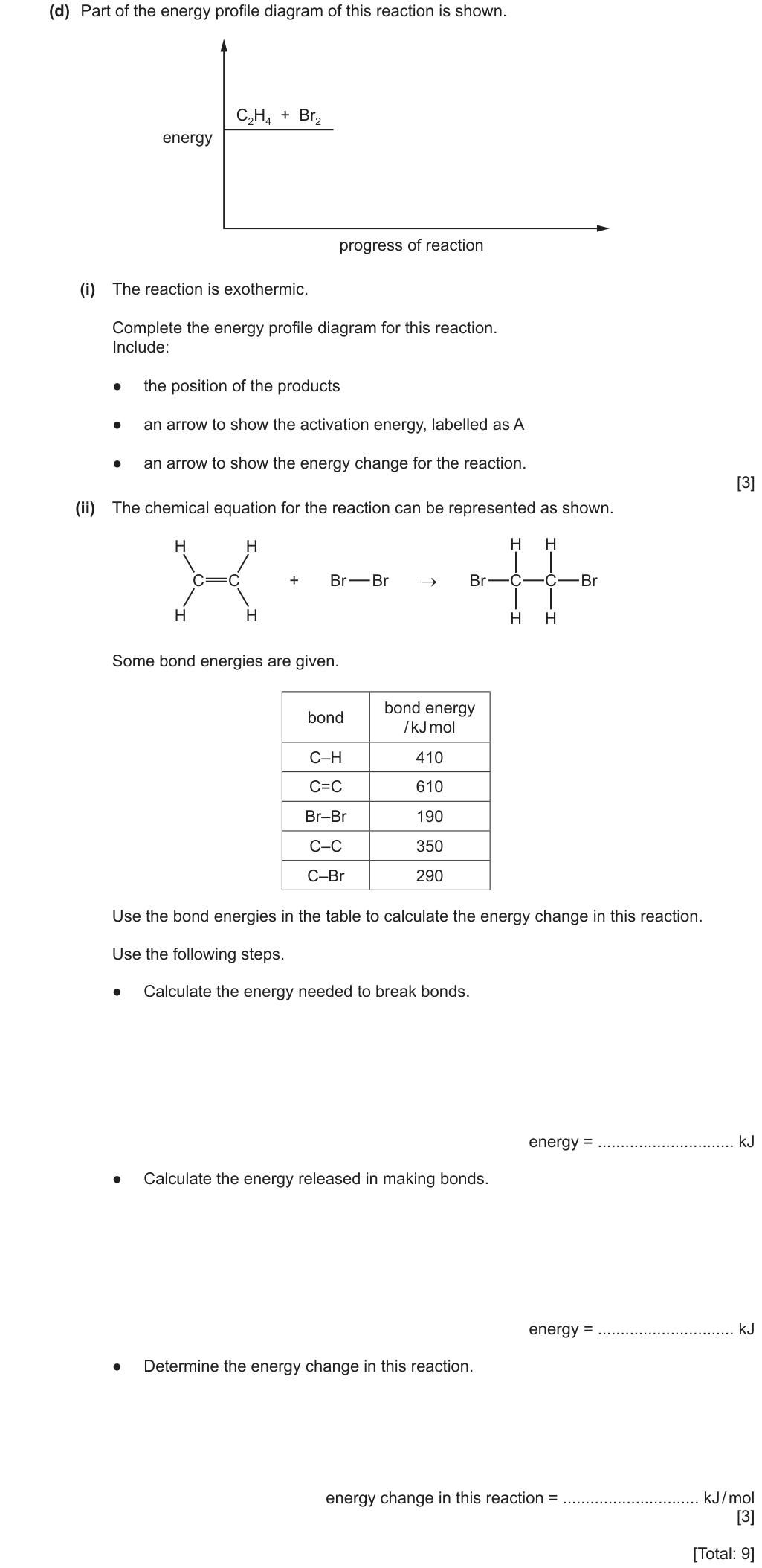
When you draw a pathway diagram from given information, include: the reactants level and the products level (labelled with names or formulae), placed correctly for the sign of ΔH; a curve rising to a single maximum; an arrow for Ea from the reactants up to the top of the curve; and a single-headed arrow for ΔH from the reactants to the products.
Activation energy: “the minimum energy that colliding particles must have to react” — “the minimum energy for a reaction to take place” is incomplete. On diagrams, the Ea arrow must reach the top of the hump (not stop short, and not just a label at the top), and the ΔH arrow must point in one direction only.
5Bond breaking and bond making 5.1.7 Supplement
Bond breaking is endothermic: energy must be supplied to pull bonded atoms apart. Bond making is exothermic: energy is released when atoms form a bond. In any reaction the bonds in the reactants are broken and the bonds in the products are made.
- If more energy is released making the new bonds than is taken in breaking the old ones, the reaction is exothermic (ΔH negative).
- If more energy is taken in breaking bonds than is released making bonds, the reaction is endothermic (ΔH positive).
6Calculating the enthalpy change from bond energies 5.1.8 Supplement
A bond energy is the energy needed to break one mole of a particular covalent bond (in kJ/mol); the same amount is released when one mole of that bond forms. Tables give average values.
ΔH = total energy needed to break bonds (reactants) − total energy released making bonds (products)
Method: (1) draw or list every bond in every reactant and product molecule, using the balanced equation — count bonds in all the molecules, so 2O2 means two O=O bonds; (2) add up the energy to break the reactant bonds; (3) add up the energy released making the product bonds; (4) subtract, and give the sign.
CH4 + 2O2 → CO2 + 2H2O. Bond energies / kJ/mol: C–H 412, O=O 496, C=O 805, O–H 463.
| Break | 4 × C–H + 2 × O=O = 4(412) + 2(496) = 1648 + 992 = 2640 kJ |
| Make | 2 × C=O + 4 × O–H = 2(805) + 4(463) = 1610 + 1852 = 3462 kJ |
| ΔH | 2640 − 3462 = −822 kJ/mol |
| Check | negative: combustion is exothermic, as expected |
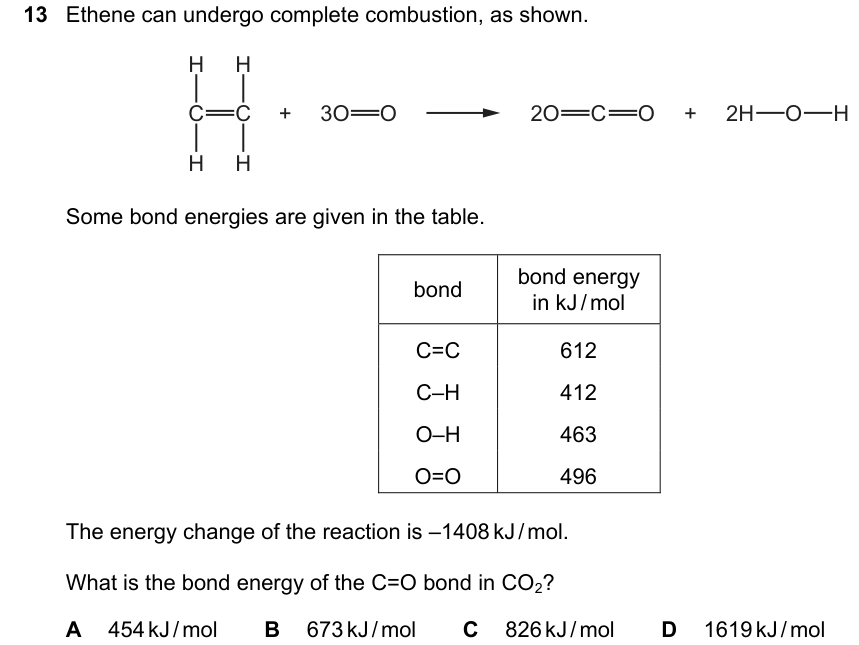
C2H4 + 3O2 → 2CO2 + 2H2O, ΔH = −1408 kJ/mol. C=C 612, C–H 412, O=O 496, O–H 463. Find the C=O bond energy.
| Break | 612 + 4(412) + 3(496) = 3748 kJ |
| Make | 4(C=O) + 4(463) = 4x + 1852 |
| Solve | 3748 − (4x + 1852) = −1408 → 4x = 3304 → x = 826 kJ/mol |
Bond-energy calculations are often done well when steps are given; the commonest errors are a reversed sign (+130 for −130) and missing the sign altogether despite an instruction to include it. In multiple-choice questions, many reverse the sign because they forget that bond energies are energies needed to break bonds — forming bonds releases energy, so the enthalpy change for forming bonds is negative.
Attempt these before opening the solutions. Each reference gives the component, session and question number of the original examination; the answers follow the published mark scheme.

Solutions and mark-scheme guidance · set A
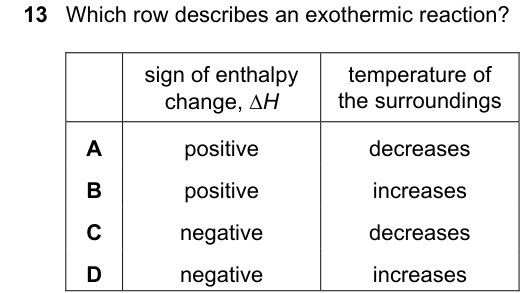
A1 Answer D
Exothermic: energy is released, so ΔH is negative and the temperature of the surroundings increases. The least able candidates spread their answers evenly across the other options.
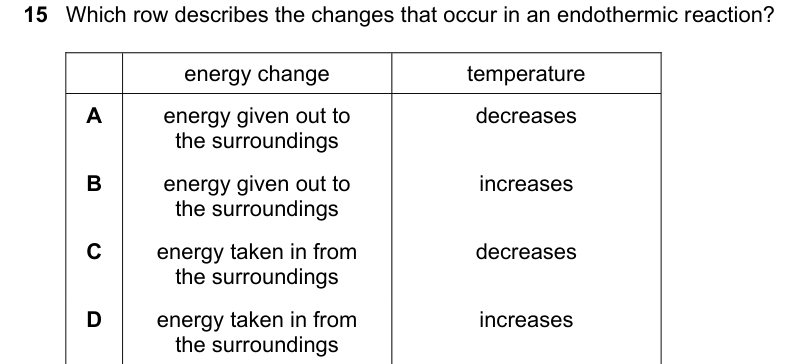
A2 Answer C
Endothermic: energy is taken in from the surroundings, so their temperature decreases. A third of candidates chose D, which combines “taken in” with a temperature increase.
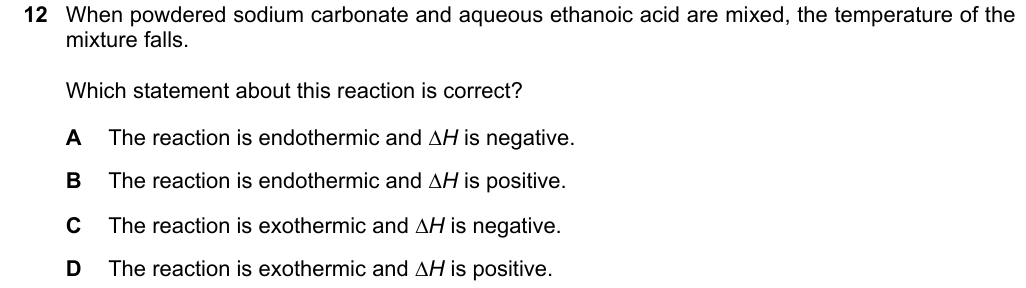
A3 Answer B
The temperature falls, so energy is taken in: endothermic, ΔH positive. Candidates who chose C linked the terms correctly but misread the observation.
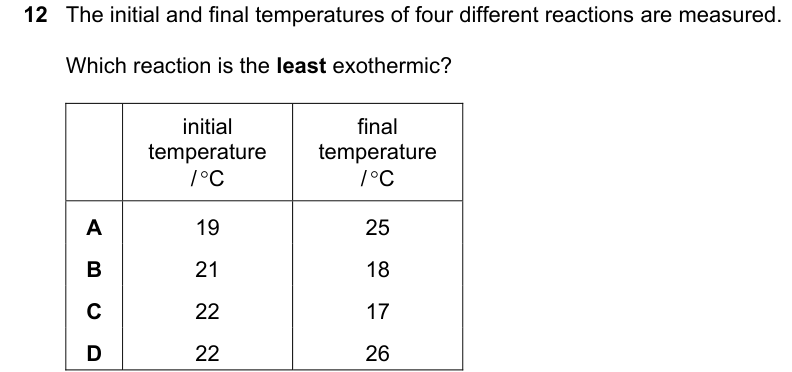
A4 Answer D
Exothermic means a temperature rise: A (+6 °C) and D (+4 °C). The least exothermic is the smaller rise, D. B and C are temperature falls (endothermic); C was the commonest wrong answer.
A5 Answer A
Breaking a bond is endothermic: Cl2(g) → 2Cl(g) is the only equation that breaks bonds without making any. Combustion (B), bond formation (C) and potassium with water (D) are exothermic. B was most often chosen.
A6 Answer B
ΔH is measured from reactants to products; for an endothermic reaction the products are higher, so the arrow points up from the reactants to the products — B. Option A, the arrow to the top of the curve, is the activation energy.
A7 Answer A
Forming 4 C–H bonds releases 4 × 413 = 1652 kJ, so ΔH = −1652 kJ. D has the right size but the sign for bond breaking and was the most common wrong answer.
A8 Answer C
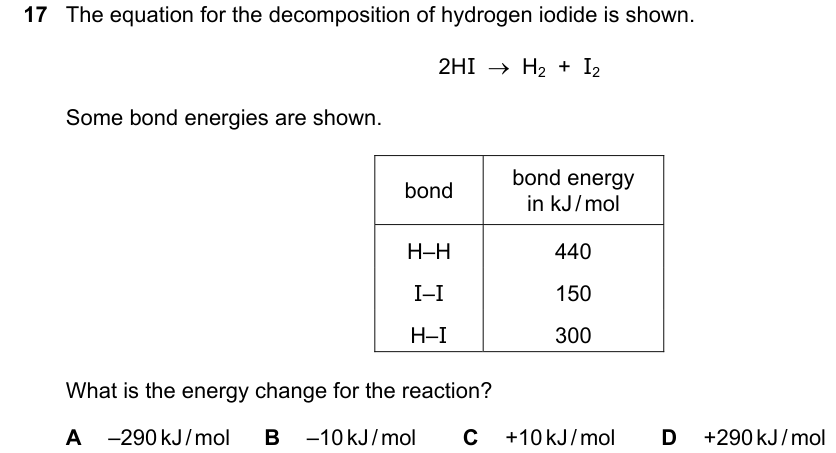
Break 2 H–I: 2 × 300 = 600 kJ. Make H–H + I–I: 440 + 150 = 590 kJ. ΔH = 600 − 590 = +10 kJ/mol. B has the opposite sign, confusing breaking and making.
A9 Answer C
Break: 612 + 4(412) + 3(496) = 3748. Make: 4x + 4(463) = 4x + 1852. 3748 − 4x − 1852 = −1408 → x = 826 kJ/mol.
A10 [6]
(i) Products line below the reactants, to the right, labelled C2H4Br2 ✓; a hump with an upward arrow labelled A from the reactants level to the top ✓; one downward arrow from the reactants level to the products level ✓.
(ii) Break: 4(C–H) + C=C + Br–Br = 4(410) + 610 + 190 = 2440 kJ ✓. Make: 4(C–H) + C–C + 2(C–Br) = 1640 + 350 + 580 = 2570 kJ ✓. ΔH = 2440 − 2570 = −130 kJ/mol ✓.
Examiner feedback: many Ea arrows stopped short of the top of the hump or were replaced by a label; some drew a double-headed ΔH arrow. The calculation was done very well; the commonest error was +130.
A11 [5]
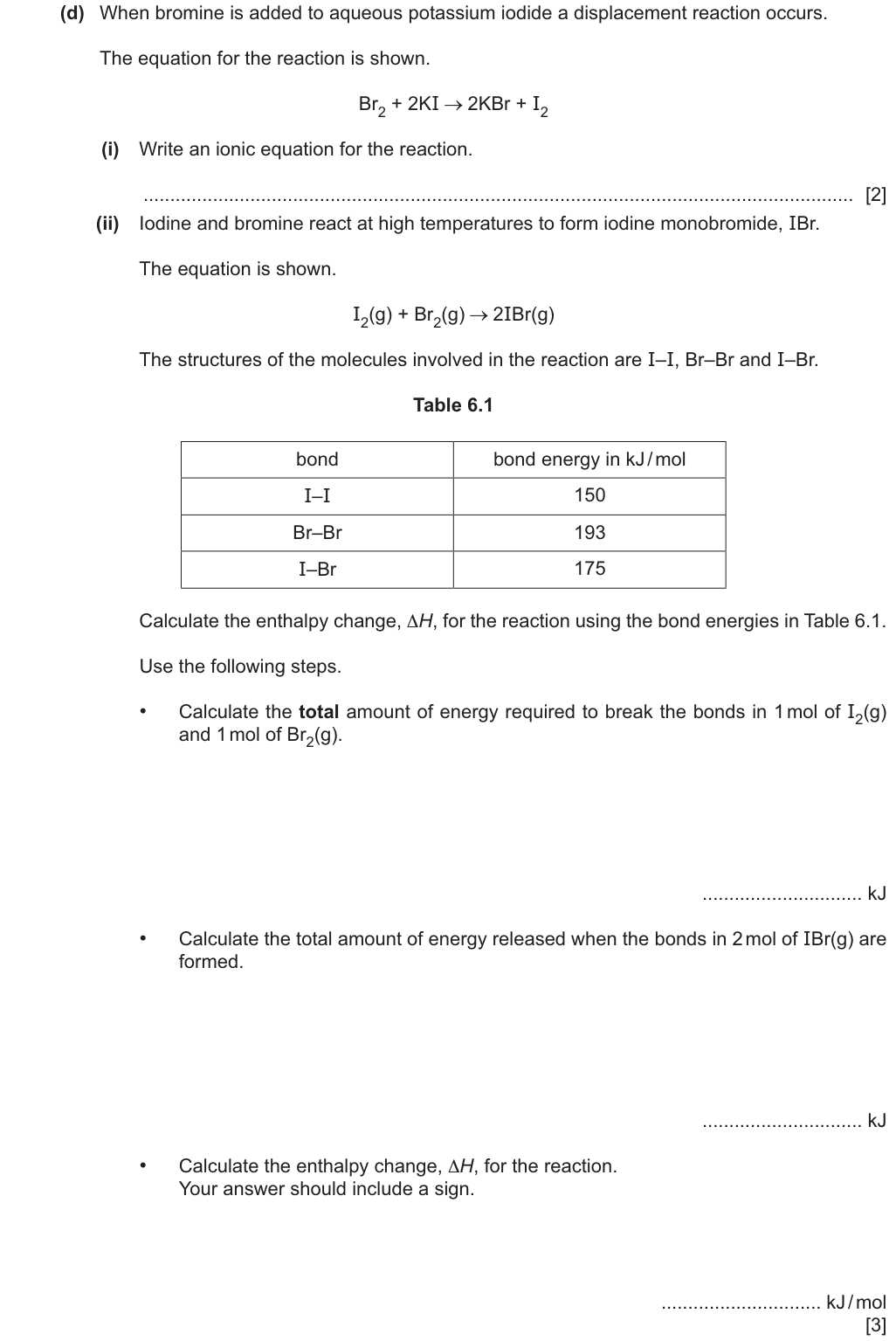
(i) Br2 + 2I− → 2Br− + I2: I− as reactant and Br− as product ✓, fully correct ✓ (potassium ions are spectators).
(ii) Break: 150 + 193 = 343 kJ ✓; make: 2 × 175 = 350 kJ ✓; ΔH = 343 − 350 = −7 kJ/mol ✓.
Examiner feedback: (i) was extremely challenging — many attempted a precipitation or half-equation, or repeated the given equation. (ii) was answered very well, but some final answers had no sign.
A12 [7]
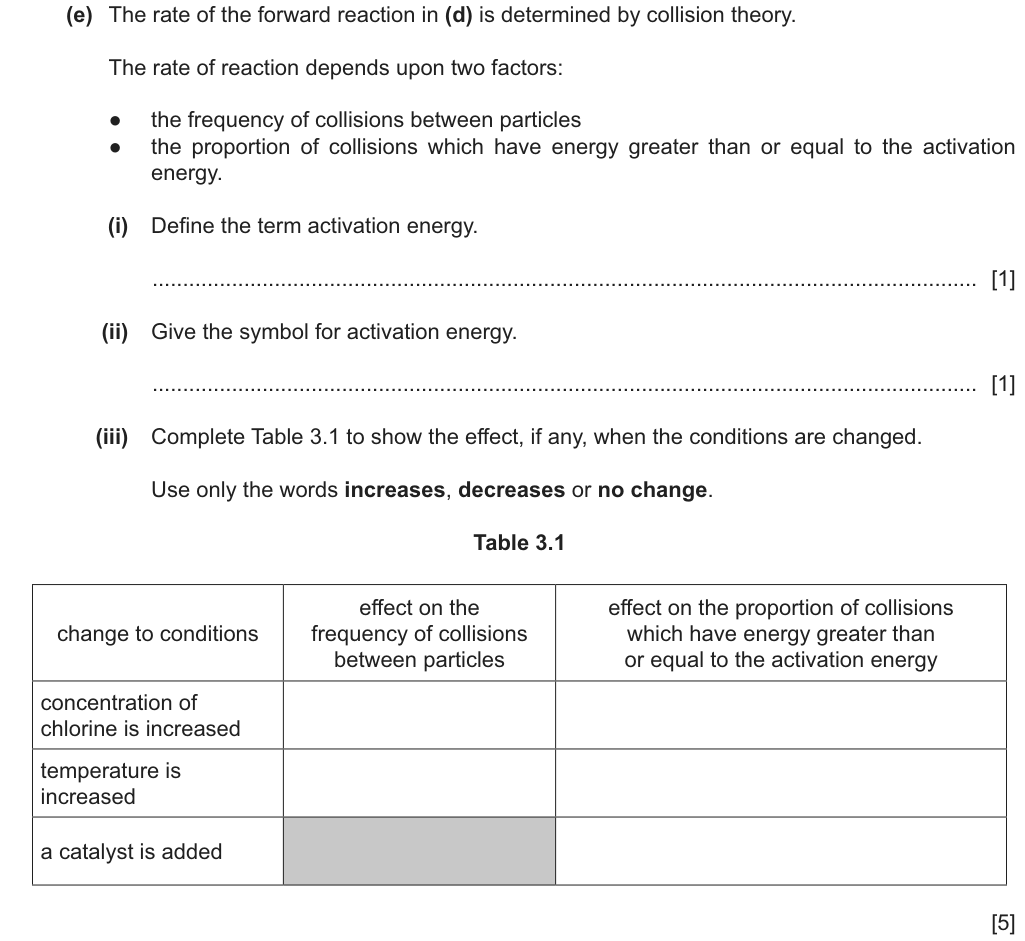
(i) The minimum energy that colliding particles must have to react ✓. (ii) Ea ✓. (iii) Increasing concentration: frequency of collisions increases, proportion with E ≥ Ea no change; increasing temperature: both increase; adding a catalyst: proportion increases ✓✓✓✓✓.
Examiner feedback: very few gave the exact definition — “the minimum energy for a reaction to take place” is incomplete. Errors in (iii) concerned the effect of temperature and of a catalyst on the proportion of successful collisions (see Topic 6).
A13 [5]
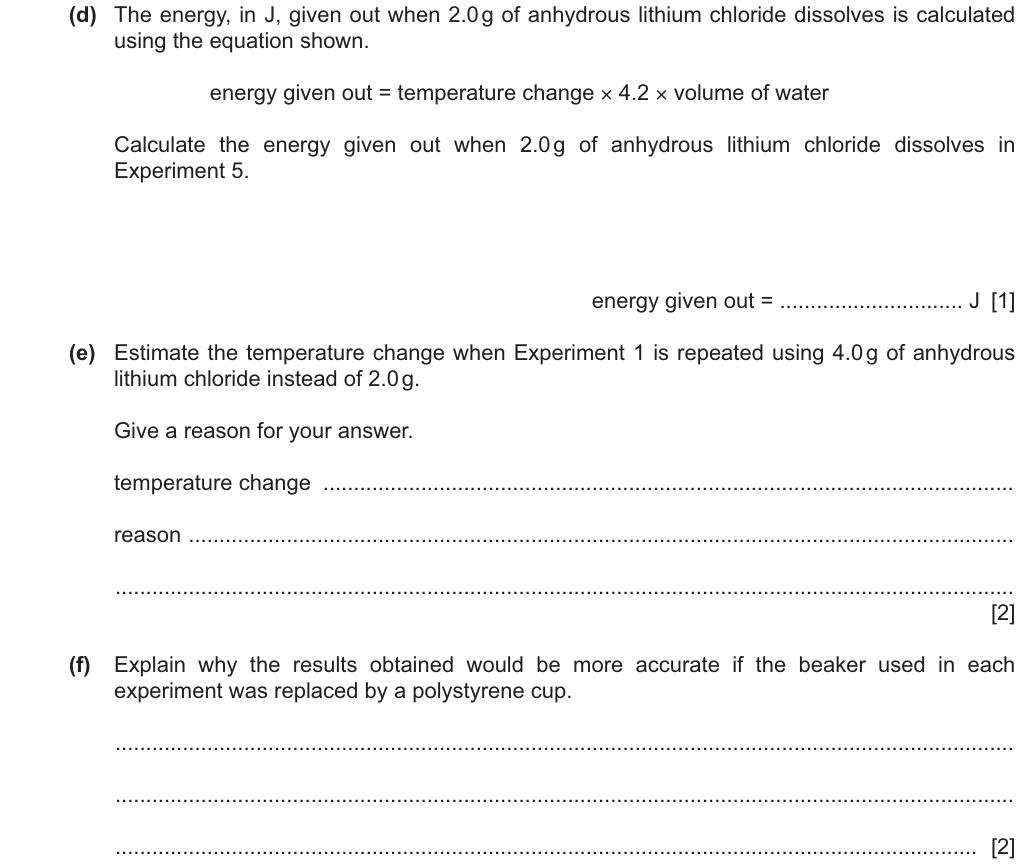
(d) Experiment 5: 13.5 × 4.2 × 15 = 850.5 J (851) ✓.
(e) About double the temperature change of Experiment 1 (≈ 9 °C) ✓, because twice as much lithium chloride dissolves, releasing twice the energy ✓ (also accepted: the same as Experiment 4, same solid : water ratio).
(f) Polystyrene is a (better) insulator ✓, so less heat is lost to the surroundings ✓.
Examiner feedback: 850.5 was sometimes wrongly rounded to 850. In (e) a quantitative answer was needed; some thought more solid would need more energy, though the process releases energy. In (f) many said a polystyrene cup measures volume more accurately.
Review · Topic 5
7Misconceptions and the examiner’s view
- “Endothermic means the temperature goes up because energy is taken in.” The chemicals take energy from the surroundings, so the surroundings (and thermometer) cool.
- “Bond making needs energy.” Making bonds releases energy; breaking bonds needs it.
- “ΔH is positive for exothermic reactions because energy comes out.” ΔH is from the point of view of the chemicals: they lose energy, so ΔH is negative.
- “Activation energy is the energy change of the reaction.” Ea is the barrier from reactants to the top of the curve; ΔH is reactants to products.
- “A catalyst changes ΔH.” It lowers Ea only.
- “A polystyrene cup makes the volume more accurate.” It insulates, reducing heat loss.
The terms exothermic and endothermic are frequently confused, particularly when a question starts from an observation: many candidates link an endothermic reaction with a temperature rise, pick a temperature fall as the “least exothermic” reaction, or choose combustion as an endothermic process. The link between bond breaking (endothermic) and bond making (exothermic) is not secure, so the sign of ΔH is often reversed in bond-energy questions, although structured calculations with steps provided are done very well and usually reach the correct magnitude. On pathway diagrams, activation energy arrows stop short of the peak or are replaced by a label, and ΔH arrows are drawn double-headed. The definition of activation energy is seldom given in full — it must refer to colliding particles and the minimum energy needed to react. In practical questions, polystyrene cups are wrongly justified by volume accuracy, temperatures are not recorded to a consistent resolution, and quantitative predictions are replaced by vague statements. Strong answers keep the chemicals and the surroundings distinct, state signs every time and show every bond counted from the balanced equation.
8Summary and knowledge organiser
Essential knowledge
- Exothermic: energy to surroundings, temperature rises, ΔH negative. Endothermic: energy from surroundings, temperature falls, ΔH positive.
- Pathway diagram: products below reactants (exo) or above (endo); Ea from reactants to peak; ΔH from reactants to products.
- Ea = minimum energy colliding particles must have to react.
- Bond breaking endothermic; bond making exothermic. ΔH = bonds broken − bonds made.
Examination checklist
- Say what happens to the temperature of the surroundings.
- Always give a sign with ΔH; units kJ/mol.
- Count bonds from the balanced equation (2O2 = two O=O).
- Draw single-headed arrows: Ea up to the peak, ΔH reactants → products.
- Practical: insulate, stir, record to consistent resolution, include units.
Knowledge organiser · chemical energetics
| Idea | What to know | Must-remember distinctions and common errors |
|---|---|---|
| Exo / endo 5.1.1–2 | Exo: surroundings warm. Endo: surroundings cool. | Combustion, neutralisation exo; thermal decomposition, photosynthesis endo. |
| Pathway diagrams 5.1.3, 5.1.6 | Reactants, products, Ea, ΔH labelled. | Ea arrow from reactants to top; ΔH single-headed. |
| ΔH, Ea 5.1.4–5 | ΔH negative exo, positive endo. Ea: minimum energy of colliding particles to react. | Catalyst lowers Ea, not ΔH. |
| Bond energies 5.1.7–8 | ΔH = Σ(broken) − Σ(made). | Breaking needs energy; making releases it. Sign every answer. |