
Topic 2 of the syllabus: 2.1 Elements, compounds and mixtures; 2.2 Atomic structure and the Periodic Table; 2.3 Isotopes; 2.4 Ions and ionic bonds; 2.5 Simple molecules and covalent bonds; 2.6 Giant covalent structures; 2.7 Metallic bonding. Metallic bonding (2.7) is entirely Supplement; each of the other sub-topics has Core statements with Supplement extensions, marked section by section.
Central idea: the number of electrons in the outer shell of an atom decides how it bonds — by losing, gaining or sharing electrons — and the type of bonding and structure decides the properties of the substance.
Before you start
- All matter is made of particles (Topic 1). The particles in a solid are held together by attractive forces; separating them needs energy.
- Opposite electric charges attract; like charges repel.
- The Periodic Table lists the elements in order of proton number, in groups (columns) and periods (rows).
Learning objectives
- Describe the differences between elements, compounds and mixtures.
- Describe the structure of an atom; state the relative charge and mass of protons, neutrons and electrons; define proton number and mass number.
- Determine the electronic configuration of atoms and ions with proton numbers 1 to 20, and link it to group and period.
- Define isotopes, interpret nuclide symbols, explain why isotopes have the same chemical properties and calculate relative atomic mass from isotopic data. Supplement
- Describe the formation of ions and of ionic and covalent bonds using dot-and-cross diagrams.
- Describe and explain the properties of ionic, simple molecular and giant covalent substances and of metals in terms of structure and bonding.
Introduction: why is salt so different from sodium and chlorine?
Sodium is a soft, shiny metal that reacts violently with water. Chlorine is a toxic green gas. When they react, the product is sodium chloride — white crystals we sprinkle on food, which melt only above 800 °C. Nothing new has been added: the product contains exactly the sodium and chlorine atoms that reacted. What has changed is the arrangement of the electrons. This topic builds the model of the atom needed to understand that change, and then uses it to explain why some substances are hard crystals with high melting points, others are gases, and others are shiny metals that conduct electricity.
2.1 · Elements, compounds and mixtures
1Elements, compounds and mixtures 2.1.1 Core
An element is a substance made of only one type of atom. It cannot be broken down into anything simpler by chemical means.
A compound is a substance containing two or more different elements chemically combined (bonded) in a fixed proportion.
A mixture contains two or more substances (elements or compounds) that are not chemically combined.
An element may exist as single atoms (argon, Ar), as molecules containing more than one atom of the same kind (oxygen, O2; chlorine, Cl2) or as a giant structure (diamond, C; copper, Cu). “Two atoms joined” does not make a compound: O2 is an element because both atoms are oxygen. Carbon dioxide, CO2, is a compound because it contains two different elements bonded together.
| Compound | Mixture | |
|---|---|---|
| Composition | fixed — water is always H2O, 2 H to 1 O | variable — air, sea water and brass can have different proportions |
| Properties | different from those of the elements it contains | the components keep their own properties |
| Separation | only by a chemical reaction | by physical methods: filtration, distillation, chromatography (Topic 12) |
| Formation | usually involves an energy change and a new substance | components simply mixed; no new substance |
A mixture of iron filings and sulfur powder can be separated with a magnet, because each substance keeps its properties. Heat the mixture, and a reaction produces iron(II) sulfide, FeS — a compound that is not magnetic and cannot be separated into iron and sulfur by any physical method. An alloy such as brass (copper and zinc) is a mixture of a metal with other elements (Topic 9).
Classify: (a) a sample of pure water; (b) air; (c) a gas jar of hydrogen, H2. Answer: (a) compound; (b) mixture of elements (N2, O2, Ar) and compounds (CO2); (c) element.
Attempt these before opening the solutions. Each reference gives the component, session and question number of the original examination; the answers follow the published mark scheme.
Solutions and mark-scheme guidance · set A
A1 Answer B
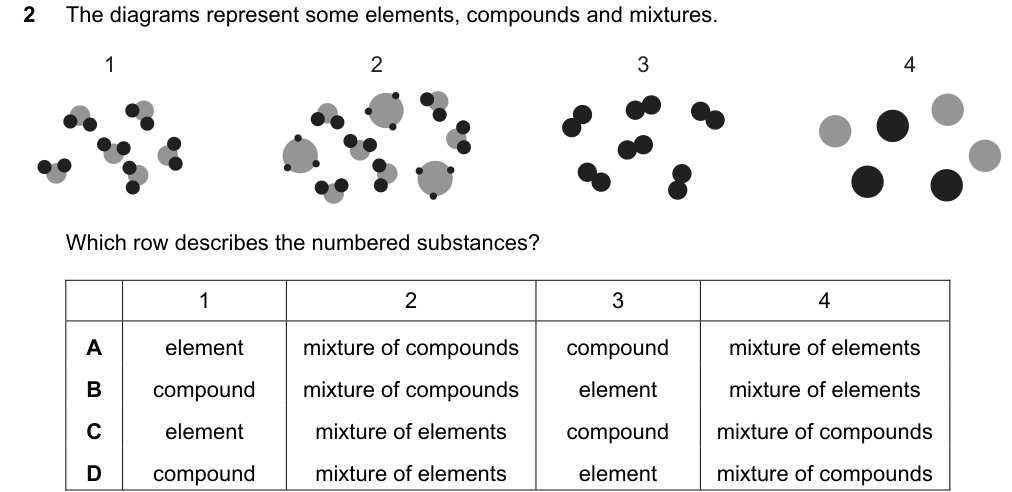
1: every particle is identical and contains two different atoms joined — a compound. 2: two different kinds of particle, each made of different atoms joined — a mixture of compounds. 3: identical particles, each made of two atoms of the same kind — an element (diatomic molecules). 4: separate atoms of two different kinds, not joined — a mixture of elements.
A2 Answer C
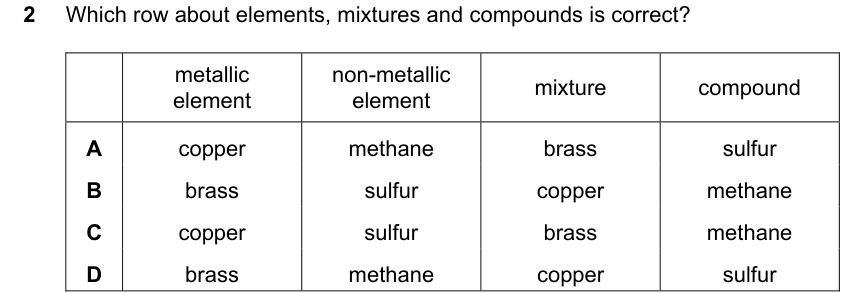
Copper is a metallic element; sulfur is a non-metallic element; brass (copper + zinc) is a mixture; methane, CH4, is a compound. Brass is sometimes mistaken for an element or a compound, but an alloy is a mixture.
Only two verified items on this statement appear in the supplied papers; the distinction is also tested inside many other questions in this chapter.
2.2 · Atomic structure and the Periodic Table
2The structure of the atom 2.2.1–2.2.2 Core
An atom has a tiny central nucleus containing protons and neutrons, surrounded by electrons arranged in shells (energy levels). The nucleus contains almost all the mass of the atom but occupies a minute fraction of its volume; most of the atom is empty space occupied by the moving electrons.
| Particle | Where found | Relative charge | Relative mass |
|---|---|---|---|
| proton | nucleus | +1 | 1 |
| neutron | nucleus | 0 | 1 |
| electron | shells around the nucleus | −1 | 1/1840 (negligible) |
Charges and masses are relative: they compare the particles with one another, not measure them in coulombs or grams. An atom is electrically neutral because it has equal numbers of protons and electrons; neutrons carry no charge and so have no effect on it.
Write the relative charges with their signs: +1 (or +) for the proton and −1 for the electron; the neutron’s relative charge is 0 and its relative mass is 1, not 0. The electron’s relative mass is 1/1840 (accept “negligible”).
3Proton number and mass number 2.2.3–2.2.4 Core
The proton number (atomic number), Z, is the number of protons in the nucleus of an atom.
The mass number (nucleon number), A, is the total number of protons and neutrons in the nucleus of an atom.
The proton number identifies the element: every atom with 11 protons is sodium. Because a neutral atom has as many electrons as protons, Z also gives the number of electrons in the atom. The number of neutrons is found by subtraction:
number of neutrons = mass number − proton number = A − Z
Both numbers are shown in the nuclide notation, with the mass number at the top left and the proton number at the bottom left of the symbol: 2311Na has 11 protons, 11 electrons and 23 − 11 = 12 neutrons.
4Electronic configuration and the Periodic Table 2.2.5–2.2.6 Core
Electrons occupy shells at increasing distances from the nucleus. For the first 20 elements the shells fill in order, with a maximum of 2 electrons in the first shell and 8 in the second; the third shell takes 8 before the fourth shell begins to fill at potassium. The electronic configuration lists the number of electrons in each shell, starting from the innermost: sodium (11 electrons) is 2,8,1; chlorine (17) is 2,8,7; calcium (20) is 2,8,8,2.
The configuration explains the layout of the Periodic Table:
- the number of occupied shells equals the period number — sodium has three occupied shells and is in Period 3;
- for Groups I to VII, the number of outer-shell electrons equals the group number — chlorine has 7 outer electrons and is in Group VII;
- the Group VIII noble gases have a full outer shell (helium 2; neon 2,8; argon 2,8,8). This full outer shell is why they are so unreactive (Topic 8).
Element X has proton number 15. Give its electronic configuration and its position in the Periodic Table.
| Electrons | 15 (neutral atom: electrons = protons) |
| Fill shells | 2 in the first, 8 in the second, 5 in the third → 2,8,5 |
| Position | three occupied shells → Period 3; five outer electrons → Group V (phosphorus) |
Attempt these before opening the solutions. Each reference gives the component, session and question number of the original examination; the answers follow the published mark scheme.

Solutions and mark-scheme guidance · set B
B1 Answer A
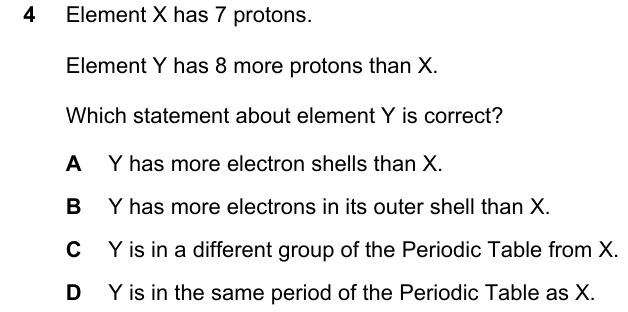
X has 7 protons: 2,5 (nitrogen, Group V, Period 2). Y has 7 + 8 = 15 protons: 2,8,5 (phosphorus, Group V, Period 3). Y has the same number of outer electrons (same group) but one more occupied shell, so A is correct; B, C and D are all false.
B2 Answer D
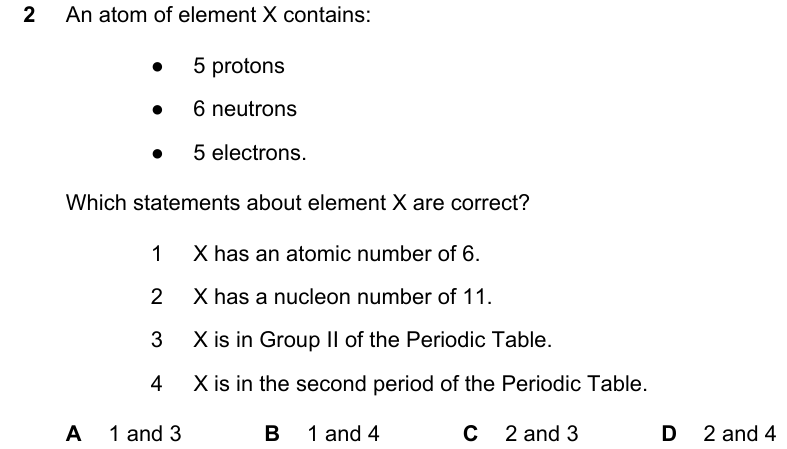
5 protons means atomic number 5, not 6 (statement 1 is wrong — 6 is the neutron number). Nucleon number = 5 + 6 = 11 (2 correct). Configuration 2,3: three outer electrons, so Group III, not Group II (3 wrong); two occupied shells, so Period 2 (4 correct).
B3 Answer B
The nitride ion, N3−, has 7 + 3 = 10 electrons: 2,8. Al3+ (13 − 3 = 10), Na+ (11 − 1 = 10) and O2− (8 + 2 = 10) are all 2,8. Cl− has 17 + 1 = 18 electrons: 2,8,8 — not the same. Read “not” carefully; ticking or crossing each option helps.
B4 Answer B
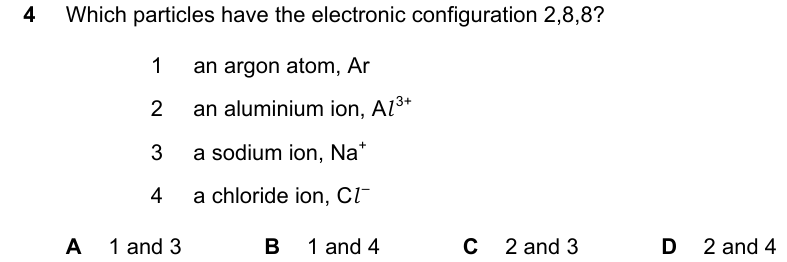
Count electrons: Ar = 18 (2,8,8); Al3+ = 13 − 3 = 10 (2,8); Na+ = 11 − 1 = 10 (2,8); Cl− = 17 + 1 = 18 (2,8,8). Particles 1 and 4 have 2,8,8.
B5 [2]
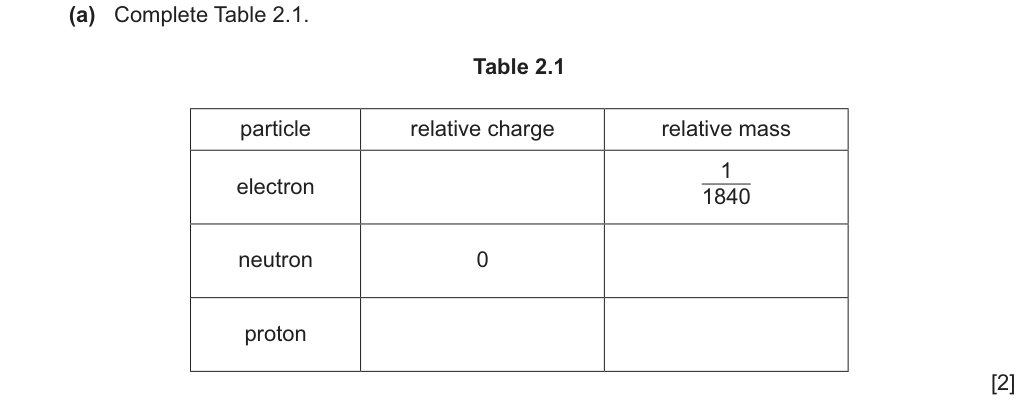
Electron: relative charge −1, relative mass 1/1840 (given). Neutron: charge 0 (given), relative mass 1. Proton: relative charge +1, relative mass 1. One mark for each correct column.
Examiner feedback: answered well; the commonest errors were leaving out the plus sign on the proton, writing only “−” and “+”, and giving the neutron a relative mass of zero.
2.3 · Isotopes
5Isotopes and nuclide symbols 2.3.1–2.3.2 Core
Isotopes are different atoms of the same element that have the same number of protons but different numbers of neutrons.
Chlorine has two naturally occurring isotopes, 3517Cl and 3717Cl. Both have 17 protons and 17 electrons; chlorine-35 has 18 neutrons and chlorine-37 has 20. Hydrogen has three isotopes, 11H (no neutrons), 21H (one neutron) and 31H (two neutrons).
The nuclide notation works for ions too. The charge is written at the top right: 3517Cl− has 17 protons, 18 neutrons and 17 + 1 = 18 electrons; 2412Mg2+ has 12 protons, 12 neutrons and 12 − 2 = 10 electrons.
Read a nuclide symbol in three steps. Bottom number → protons. Top minus bottom → neutrons. Protons minus the charge → electrons (a 2+ ion has two electrons fewer than protons; a 1− ion has one more).
6Chemical properties of isotopes and relative atomic mass 2.3.3–2.3.4 Supplement
Chemical reactions involve only the electrons, especially those in the outer shell. Isotopes of the same element have the same number of electrons and therefore the same electronic configuration, so they have the same chemical properties. They differ only in mass, so physical properties that depend on mass (such as density) differ slightly.
Most elements exist as a mixture of isotopes. The relative atomic mass, Ar, is the average mass of the atoms of an element, taking into account the abundance of each isotope, on a scale where one atom of carbon-12 has a mass of exactly 12 (Topic 3). It is calculated as a weighted average:
Ar = Σ (relative mass of isotope × percentage abundance) ÷ 100
Chlorine is 75% chlorine-35 and 25% chlorine-37. Calculate Ar.
| Given | 35 (75%), 37 (25%) |
| Relationship | Ar = Σ(mass × abundance) ÷ 100 |
| Substitute | (35 × 75) + (37 × 25) = 2625 + 925 = 3550 |
| Calculate | 3550 ÷ 100 = 35.5 |
| Check | 35.5 lies between 35 and 37, nearer 35, the more abundant isotope. Ar has no units. |
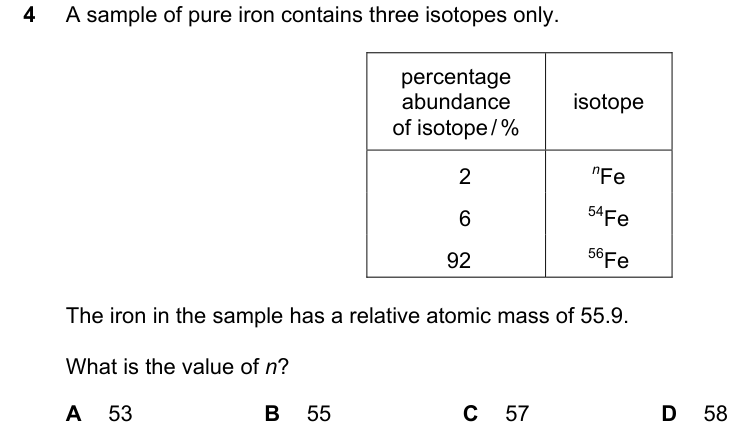
A sample of iron is 2% nFe, 6% 54Fe and 92% 56Fe, and Ar = 55.9. Find n.
| Set up | (2n + 54 × 6 + 56 × 92) ÷ 100 = 55.9 |
| Rearrange | 2n + 324 + 5152 = 5590 → 2n = 114 → n = 57 |
| Check | A value of 53 would make the average too low — the commonest wrong choice. |
Attempt these before opening the solutions. Each reference gives the component, session and question number of the original examination; the answers follow the published mark scheme.

Solutions and mark-scheme guidance · set C
C1 Answer C
Protons are the bottom number, neutrons = top − bottom. 11H: 1 p, 0 n. 21H: 1 p, 1 n. 31H: 1 p, 2 n — twice as many neutrons as protons. 42He has 2 p and 2 n, equal numbers; it was the most common wrong answer.
C2 Answer A
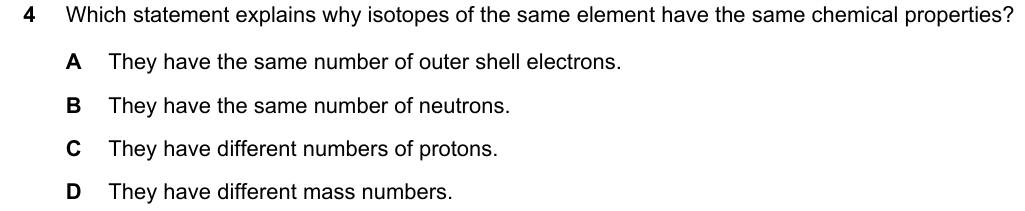
Chemical properties depend on the electrons. Isotopes have the same number of electrons and therefore the same number of outer-shell electrons. B is false (isotopes differ in neutrons); C is false (same protons); D is true of isotopes but does not explain their identical chemistry.
C3 Answer C
(2n + 54 × 6 + 56 × 92) ÷ 100 = 55.9 → 2n = 5590 − 324 − 5152 = 114 → n = 57. Option A (53) was a common wrong answer; it would give an average that is too low.
C4 Answer A
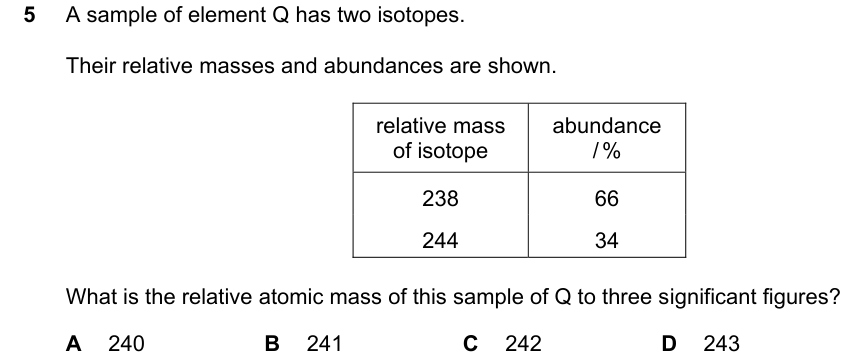
(238 × 66 + 244 × 34) ÷ 100 = (15 708 + 8296) ÷ 100 = 240.04 → 240 to three significant figures. Check: nearer 238, the more abundant isotope.
C5 [6]
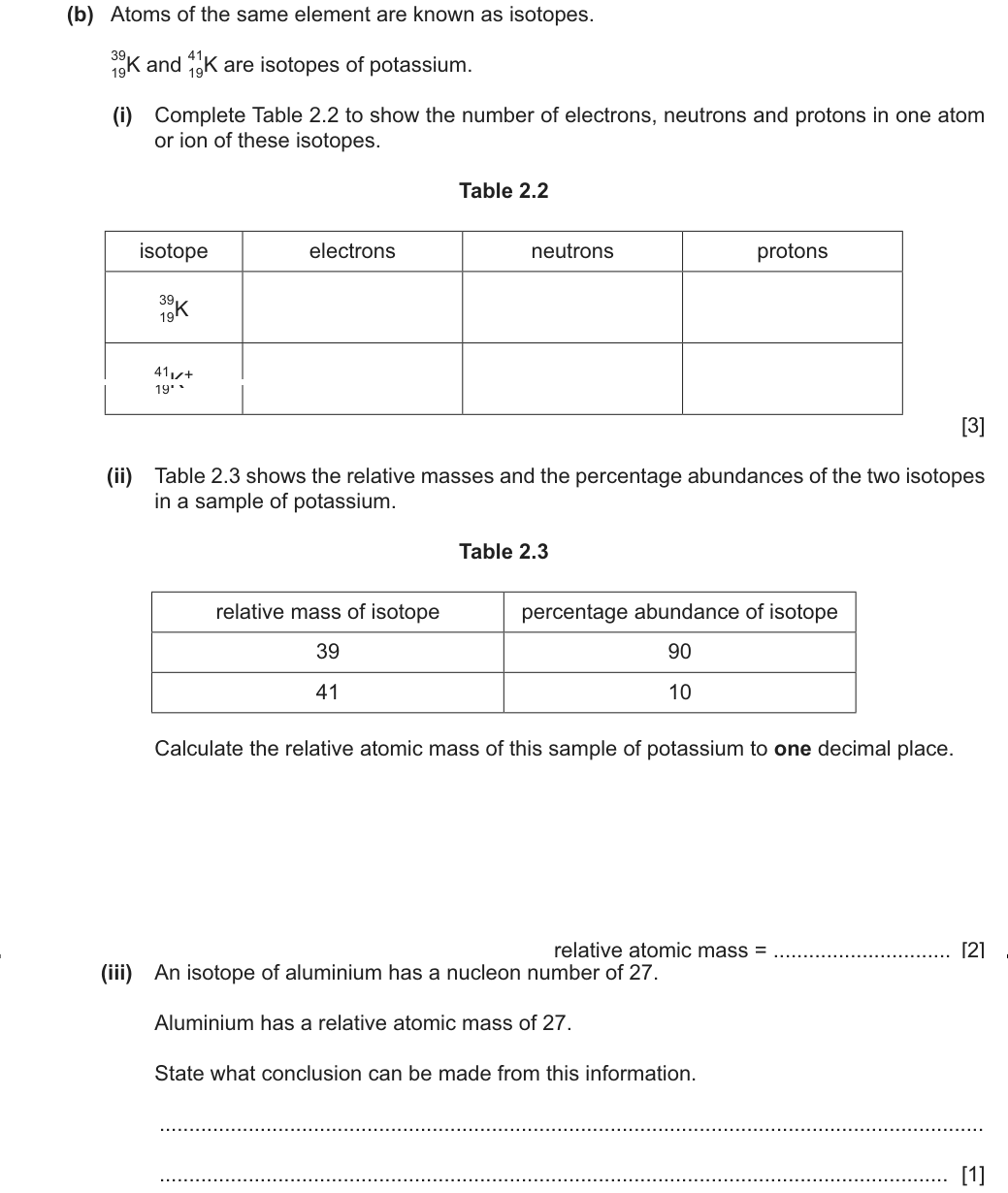
(i) 3919K: 19 electrons, 20 neutrons, 19 protons. 4119K+: 18 electrons, 22 neutrons, 19 protons. One mark per correct column ✓✓✓.
(ii) (39 × 90) + (41 × 10) = 3920 ✓; 3920 ÷ 100 = 39.2 ✓.
(iii) Aluminium has only one isotope, with nucleon number 27 ✓.
Examiner feedback: (i) and (ii) were answered very well; errors in (i) were 19 or 20 electrons for the ion. (iii) was poorly answered — many restated the information or described the particles; very few concluded that aluminium has only one isotope.
C6 [7]
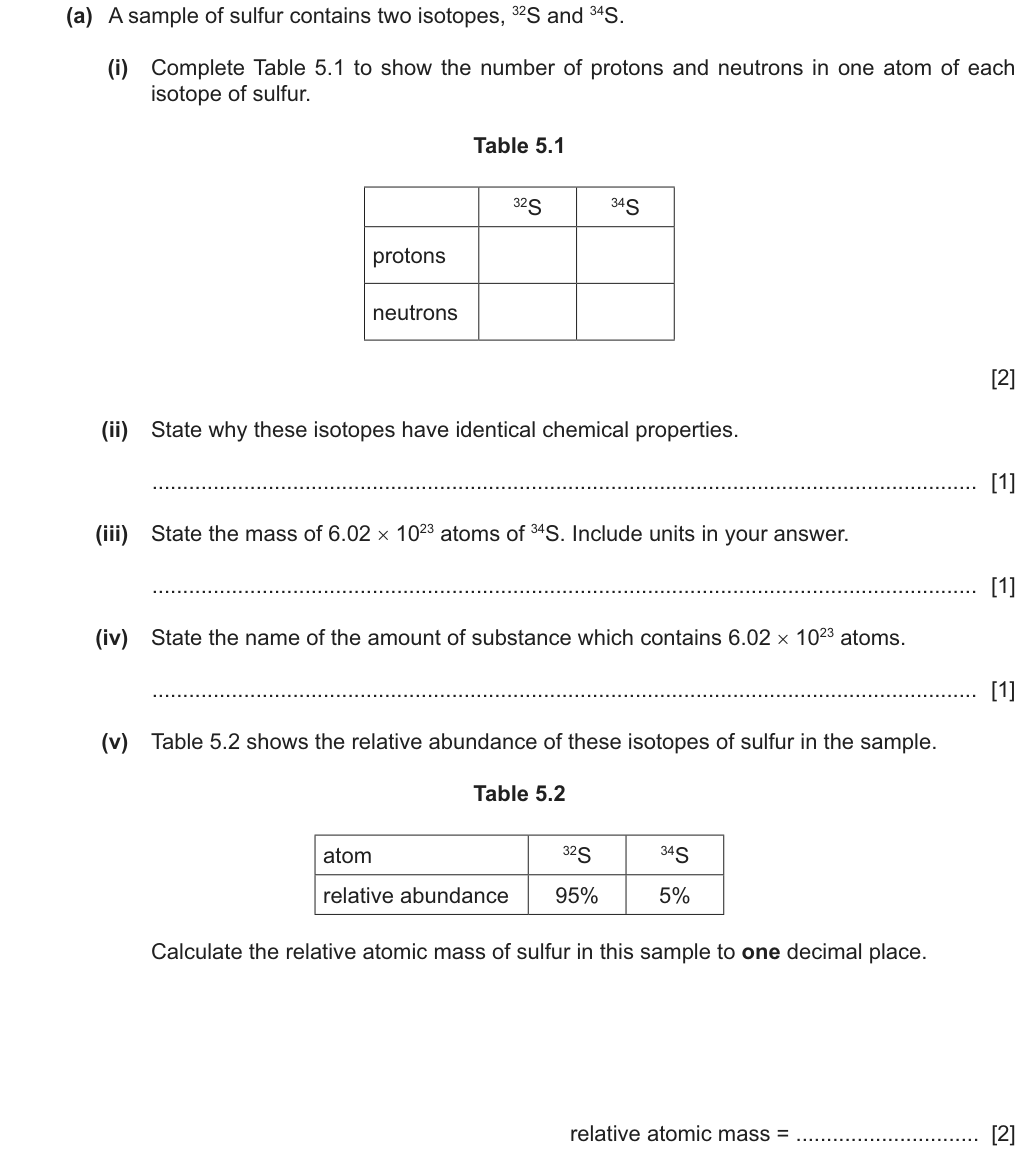
(i) protons 16 and 16; neutrons 16 and 18 ✓✓. (ii) They have the same electronic configuration (same number of electrons) ✓. (iii) 34 g ✓ — 6.02 × 10²³ atoms is one mole, whose mass in grams equals the relative mass. (iv) one mole ✓. (v) (32 × 95) + (34 × 5) = 3210 ✓; 3210 ÷ 100 = 32.1 ✓.
Examiner feedback: in (iii) most tried to multiply 6.02 × 1023 by 34; only stronger candidates gave 34 g. In (iv) “mole” or “mol” was accepted, “moles” was not.
2.4 · Ions and ionic bonds
7Forming positive and negative ions 2.4.1 Core
An ion is an atom (or group of atoms) that carries an electric charge because it has lost or gained electrons. Atoms of metals, with one, two or three outer electrons, lose them to form positive ions, called cations. Atoms of non-metals in Groups V, VI and VII gain electrons to form negative ions, called anions. In each case the ion formed has a full outer shell — the electronic configuration of a noble gas.
| Group | I | II | III | V | VI | VII |
|---|---|---|---|---|---|---|
| Outer electrons | 1 | 2 | 3 | 5 | 6 | 7 |
| Change | lose 1 | lose 2 | lose 3 | gain 3 | gain 2 | gain 1 |
| Ion charge | 1+ | 2+ | 3+ | 3− | 2− | 1− |
| Examples | Li+, Na+, K+ | Mg2+, Ca2+ | Al3+ | N3− | O2−, S2− | F−, Cl−, Br− |
A positive ion has more protons than electrons: Na+ has 11 protons and 10 electrons (2,8). A negative ion has more electrons than protons: Cl− has 17 protons and 18 electrons (2,8,8). The number of protons never changes when an ion forms — only the electrons.
8The ionic bond: Group I with Group VII 2.4.2–2.4.3 Core
An ionic bond is a strong electrostatic attraction between oppositely charged ions.
When sodium reacts with chlorine, each sodium atom transfers its single outer electron to a chlorine atom. Both form ions with full outer shells, and the oppositely charged ions attract. The dot-and-cross diagram uses crosses for electrons that came from one atom and dots for electrons that came from the other, so the transfer can be followed. Only the outer shells need be drawn unless the question asks for all the electrons.
Group I and Group VII atoms do not share electrons: electrons are transferred from the Group I atom to the Group VII atom. Choosing “shared” describes covalent bonding; choosing “from Group VII to Group I” reverses the transfer.
9Properties of ionic compounds 2.4.4 Core
Ionic compounds such as sodium chloride and magnesium oxide are crystalline solids at room temperature with:
- high melting points and boiling points: NaCl melts at 801 °C, MgO at 2852 °C;
- good electrical conductivity when molten or dissolved in water (aqueous), but poor conductivity when solid;
- usually solubility in water (though not in organic solvents).
10The giant ionic lattice 2.4.5 Supplement
The attraction between ions acts equally in all directions, so each ion attracts every oppositely charged ion around it. The ions therefore build up a giant lattice: a regular arrangement of alternating positive and negative ions repeated in three dimensions. In sodium chloride each Na+ ion is surrounded by six Cl− ions and each Cl− by six Na+. There are no separate NaCl molecules; the formula gives only the ratio of ions, 1 : 1.
11Ionic bonds between other metals and non-metals 2.4.6 Supplement
The same method works for any metal and non-metal. The numbers of ions must make the compound electrically neutral: total positive charge = total negative charge.
Deduce the formula of aluminium oxide.
| Ions | Al (Group III) → Al3+; O (Group VI) → O2− |
| Balance charges | lowest common multiple of 3 and 2 is 6: 2 Al3+ = +6, 3 O2− = −6 |
| Formula | Al2O3 |
| Check | two Al atoms lose 2 × 3 = 6 electrons; three O atoms gain 3 × 2 = 6 electrons — the numbers match |
In dot-and-cross diagrams of ions, the commonest errors are drawing the atoms instead of the ions, showing an oxide ion with only 7 outer electrons (forgetting that two sodium atoms each give one electron), using all dots or all crosses, and drawing an extra shell on a fluoride ion. Charges are usually correct. A formula begins with a symbol, not a number, and must not show charges.
12Explaining the properties of ionic compounds 2.4.7 Supplement
High melting and boiling points. In the giant lattice every ion is held by strong electrostatic attractions to the oppositely charged ions around it. Melting requires many of these strong attractions to be overcome, which needs a large amount of energy. Magnesium oxide melts at a far higher temperature than sodium chloride because its ions carry charges of 2+ and 2−, so the attraction between them is much stronger.
Electrical conductivity. An electric current is a flow of charged particles. In the solid the ions are held in fixed positions in the lattice and cannot move, so the solid does not conduct. When the compound is melted or dissolved, the lattice breaks down and the ions are free to move, so the liquid or solution conducts. The charge carriers are ions, not electrons.
For conductivity write that the ions are mobile / ions can move. “Free ions”, “ions carry the charge” and anything about electrons have not been credited. For melting point write “strong (electrostatic) attraction between oppositely charged ions” or “ionic bonds are strong”.
Ionic compounds have no molecules, so they have no intermolecular forces. Answers that say ionic compounds have high melting points because of “strong intermolecular forces”, or that mention atoms or molecules alongside ions, contradict themselves and lose the mark.
Attempt these before opening the solutions. Each reference gives the component, session and question number of the original examination; the answers follow the published mark scheme.
Solutions and mark-scheme guidance · set D
D1 Answer D
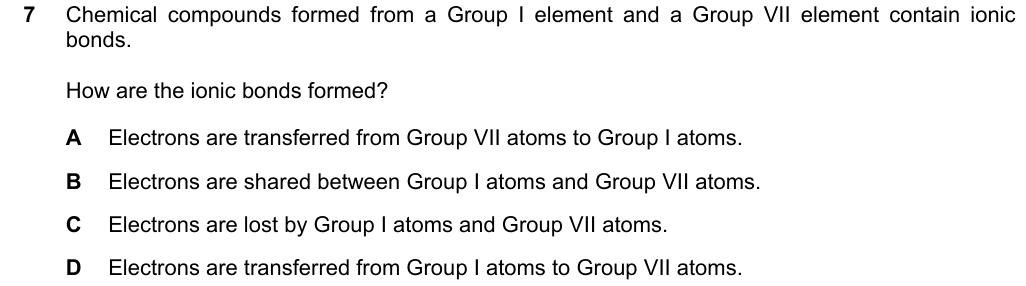
Group I atoms have one outer electron to lose; Group VII atoms need one to fill their outer shell. Electrons are transferred from the Group I atoms to the Group VII atoms. Option B (sharing) describes covalent bonding and was a common wrong choice.
D2 Answer C
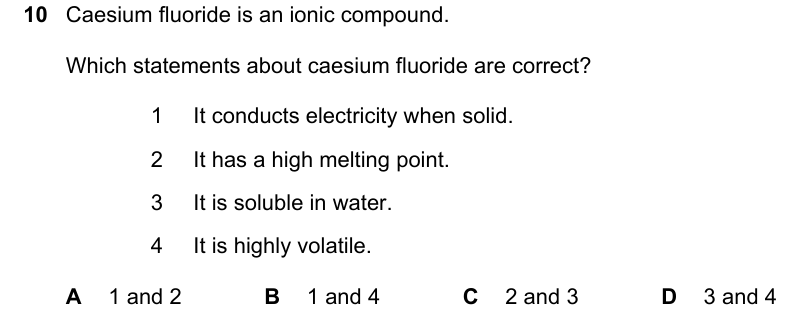
An ionic compound has a high melting point (2) and is usually soluble in water (3). It does not conduct when solid because the ions cannot move (1 is wrong), and it is not volatile (4 is wrong). Option A was the most common incorrect answer.
D3 Answer A
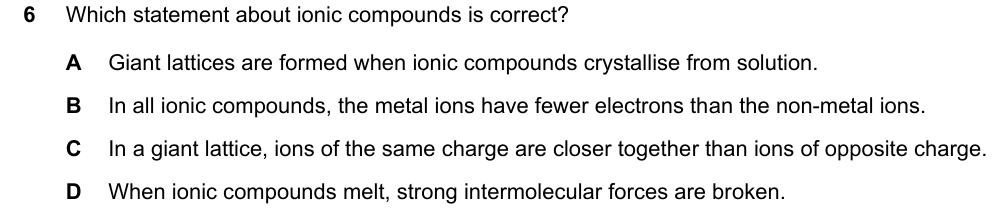
A is correct: an ionic compound crystallising from solution forms a giant lattice. B is false (Na+ and Cl− have 10 and 18 electrons, but Mg2+ and O2− both have 10). C is false: oppositely charged ions are nearest neighbours. D is false and was the most common response: ionic compounds have no molecules, so no intermolecular forces are broken when they melt.
D4 Answer D
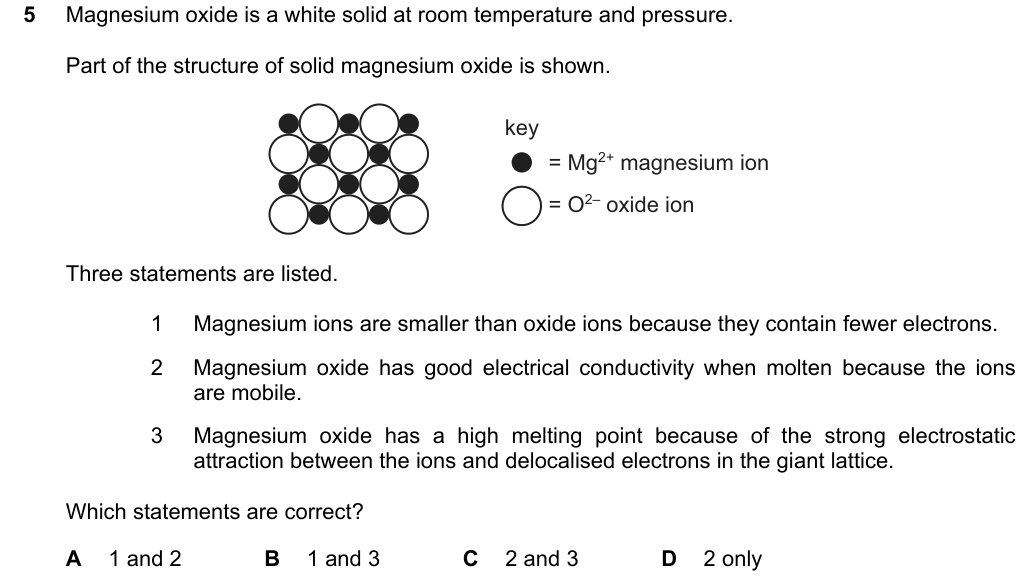
Statement 2 is correct: molten MgO conducts because the ions are mobile. Statement 1 is false: Mg2+ and O2− both have 10 electrons (2,8); Mg2+ is smaller because it has more protons attracting the same number of electrons. Statement 3 is false: MgO has no delocalised electrons — that describes a metal. Most candidates chose C, confusing ionic with metallic bonding.
D5 [4]
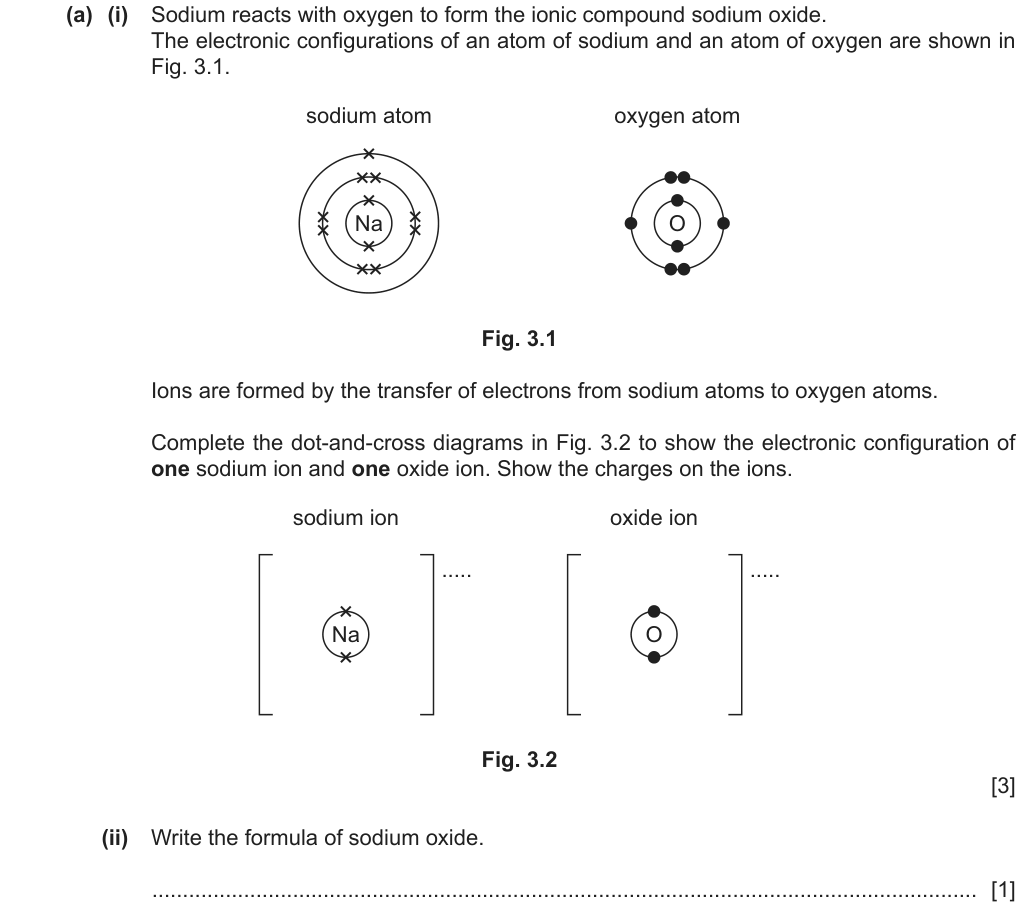
(i) Na+: 2,8 with all electrons shown as crosses ✓; O2−: 2,8 with 6 dots and 2 crosses in the outer shell ✓; charges + and 2− ✓. (ii) Na2O ✓.
Examiner feedback: the commonest error was an oxide ion with only 7 outer electrons — two sodium atoms each give one electron. Some gave an equation instead of a formula.
D6 [5]
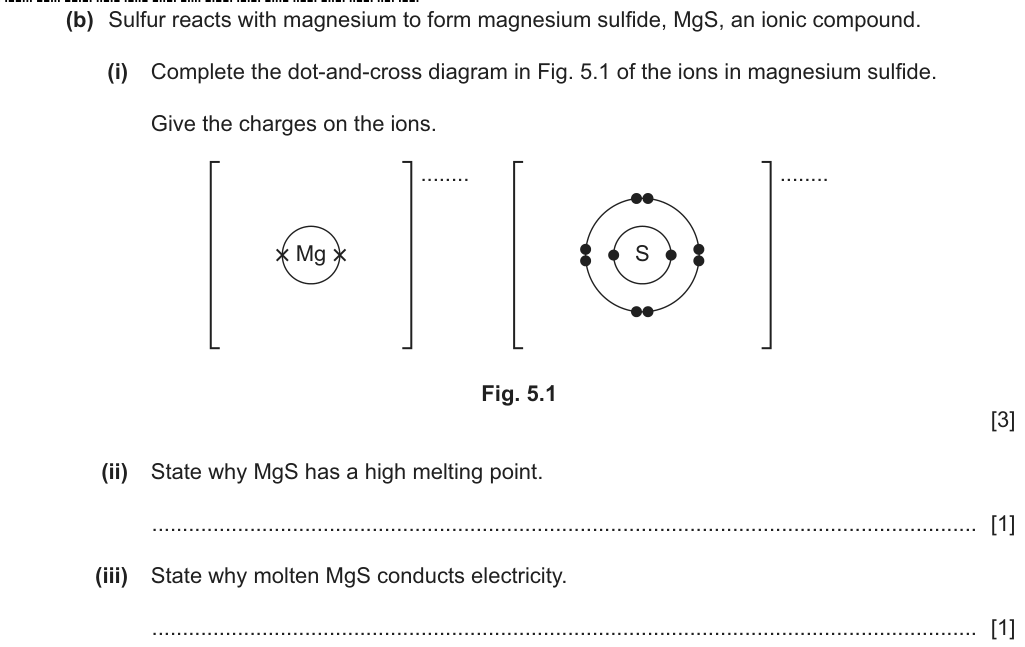
(i) Mg2+: eight crosses in its second (outer) shell ✓; S2−: 6 dots and 2 crosses in the third shell ✓; charges 2+ and 2− ✓. (ii) The ionic bonds are strong (strong attraction between oppositely charged ions) ✓. (iii) The ions are mobile ✓.
Examiner feedback: weaker answers used all dots or all crosses, or showed magnesium’s two outer electrons in two places. In (ii) “intermolecular forces” or “atoms” contradicted the answer; in (iii) many wrote about mobile electrons, or ions being “free”.
2.5 · Simple molecules and covalent bonds
13Covalent bonds in simple molecules 2.5.1–2.5.2 Core
A covalent bond is formed when a pair of electrons is shared between two atoms, leading to noble-gas electronic configurations.
When two non-metal atoms bond, neither can easily lose electrons, so each gains a full outer shell by sharing. Each shared pair — one electron from each atom — is one single covalent bond. The shared electrons are attracted to both nuclei, and this attraction holds the atoms together. A group of atoms held together by covalent bonds is a molecule.
In a dot-and-cross diagram of a molecule, the outer shells of bonded atoms overlap and the shared pairs sit in the overlap. Electrons that are not shared are drawn in pairs as non-bonding pairs (lone pairs). Count the electrons in each outer shell when you have finished: hydrogen must have 2, and every other atom 8.
| Molecule | Bonds from the central atom | Non-bonding pairs on the central atom | Outer electrons round the central atom |
|---|---|---|---|
| H2O | 2 single | 2 | 2 × 2 + 2 × 2 = 8 |
| NH3 | 3 single | 1 | 3 × 2 + 2 = 8 |
| CH4 | 4 single | 0 | 4 × 2 = 8 |
| HCl | 1 single | 3 (on Cl) | 2 + 6 = 8 |
14Double and triple bonds; further molecules 2.5.4 Supplement
Some atoms share more than one pair. Two shared pairs make a double bond (O=O, C=C, C=O); three make a triple bond (N≡N). Oxygen needs two more electrons, so two oxygen atoms share two pairs; nitrogen needs three, so two nitrogen atoms share three pairs. In carbon dioxide the carbon atom forms a double bond to each oxygen.
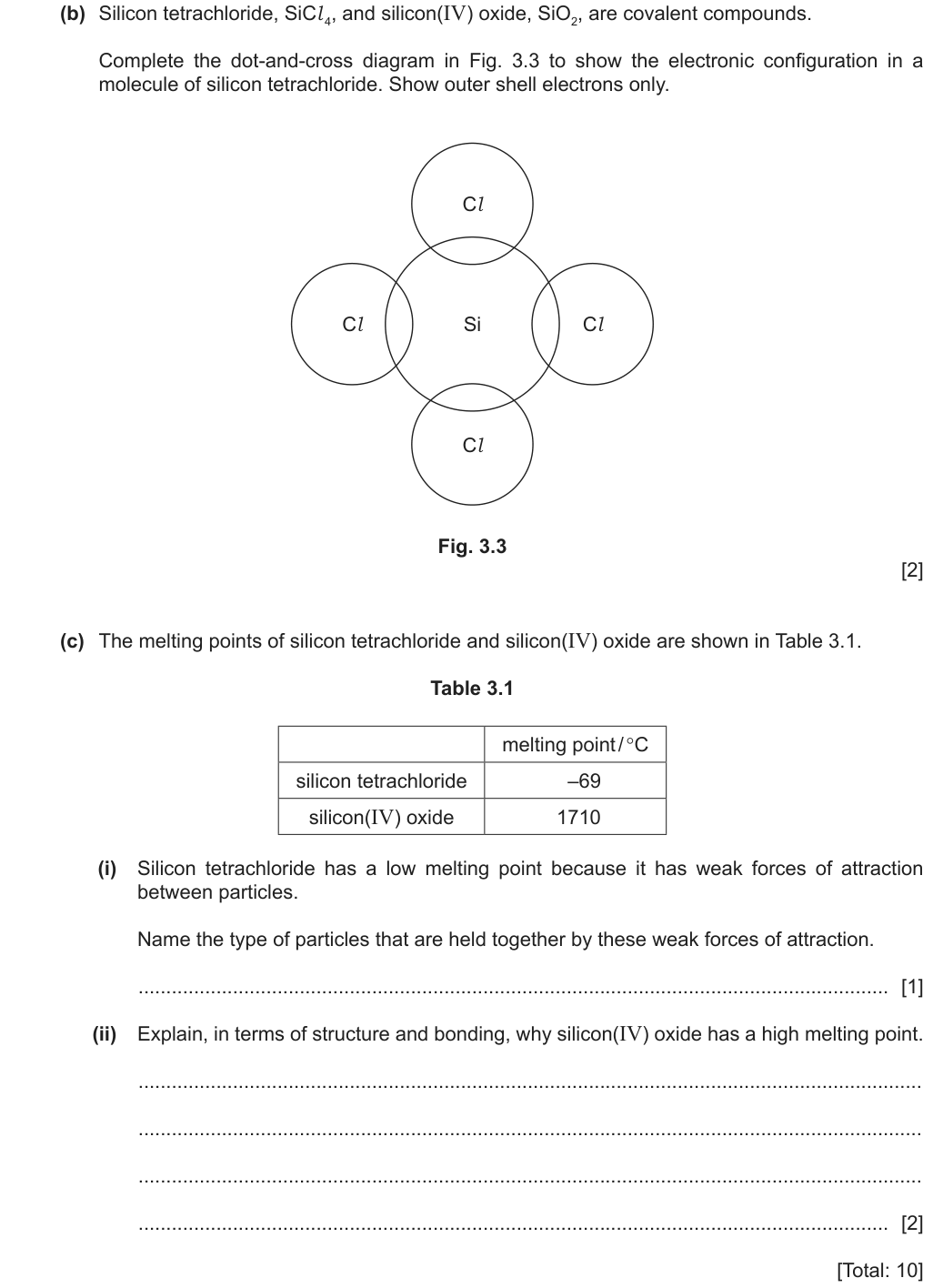
The usual errors in covalent dot-and-cross diagrams are too many or too few non-bonding electrons on one of the outer atoms, and non-bonding electrons placed on a carbon atom that has used all four electrons in bonds (as in CO2 or SiCl4). Drawing non-bonding electrons in pairs makes it much easier to check that every atom has 8.
15Properties of simple molecular substances 2.5.3, 2.5.5 CoreSupplement
Substances made of small molecules — water, carbon dioxide, methane, chlorine, ethanol — have low melting points and boiling points (many are gases or liquids at room temperature) and poor electrical conductivity in every state.
Supplement Two different attractions are present. Inside each molecule the atoms are joined by strong covalent bonds. Between neighbouring molecules there are only weak intermolecular forces. Melting or boiling separates the molecules from each other; it overcomes the weak intermolecular forces and does not break the covalent bonds, so little energy is needed. Larger molecules generally have stronger intermolecular forces and higher boiling points. Simple molecular substances do not conduct because the molecules are neutral: there are no ions and no electrons free to move.
“Water boils when its covalent bonds break.” Boiling separates whole H2O molecules; the O–H bonds are untouched. When asked for the forces that cause a low melting point, the answer is intermolecular forces — “covalent bonding” was given just as often as the correct answer, and is wrong.
Attempt these before opening the solutions. Each reference gives the component, session and question number of the original examination; the answers follow the published mark scheme.
Solutions and mark-scheme guidance · set E
E1 Answer C
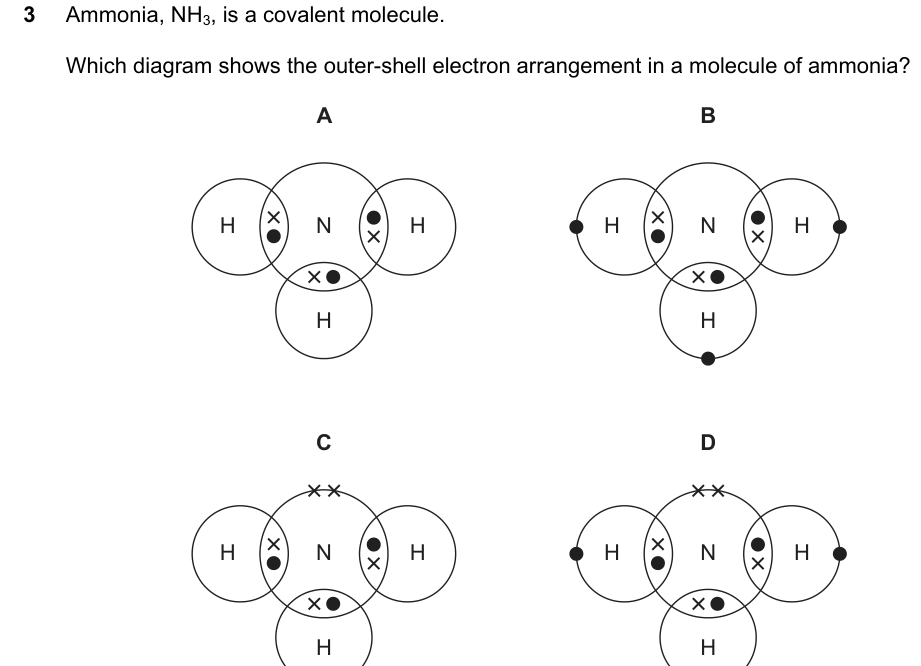
Nitrogen (5 outer electrons) shares three pairs with three hydrogen atoms and keeps one non-bonding pair, giving 8 around N and 2 around each H. Check each diagram by counting: the correct one has three shared pairs and one lone pair on N.
E2 Answer B
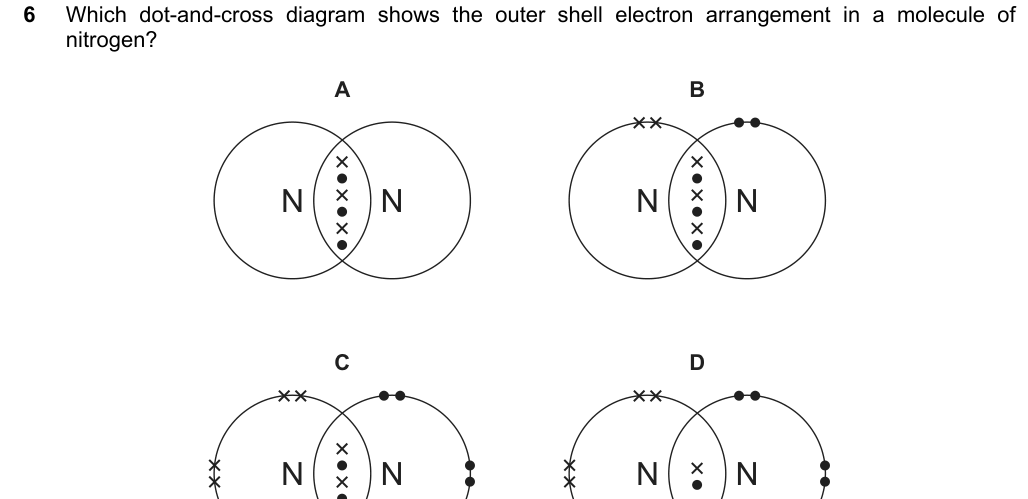
N2 has a triple bond: three shared pairs (three dots and three crosses) in the overlap, plus one non-bonding pair on each nitrogen. Each N then has 6 + 2 = 8 outer electrons. Diagram B shows this.
E3 [5]
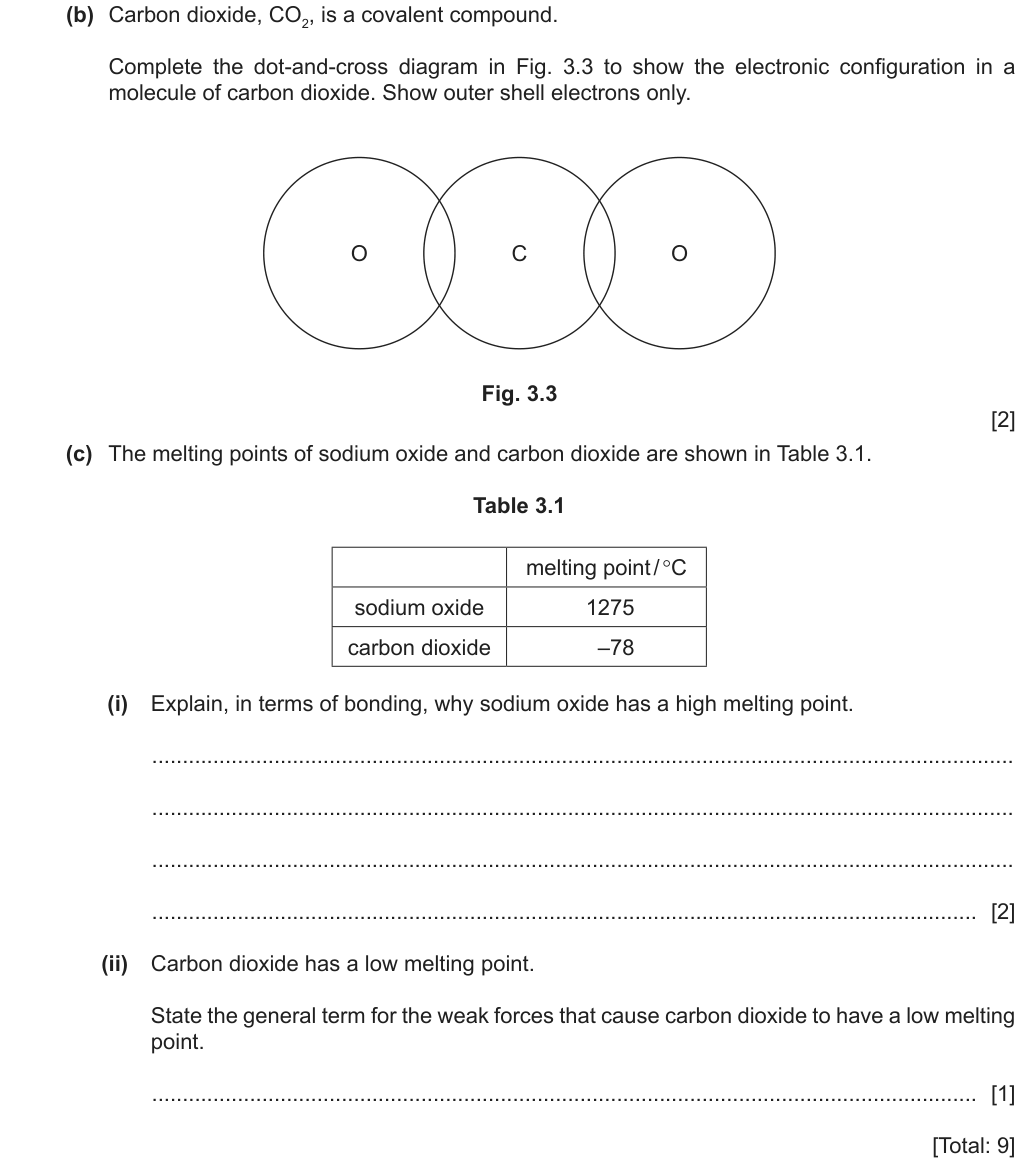
(b) Two double bonds, each with 2 dots and 2 crosses ✓; two non-bonding pairs on each O and none on C, completing three octets ✓.
(c)(i) Sodium oxide contains positive and negative ions ✓ with strong attraction between them (strong ionic bonds) ✓. (ii) Intermolecular forces ✓.
Examiner feedback: in (b) the errors were extra non-bonding electrons on O and non-bonding electrons on C. In (c)(i) many contradicted “ionic bonding” with atoms or molecules. In (c)(ii) “covalent bonding” appeared as often as the correct answer.
E4 [5]
(b) Four single dot-and-cross bonds ✓; three non-bonding pairs on each Cl and none on Si ✓.
(c)(i) Molecules ✓. (ii) Covalent bonds ✓ that are strong, in a giant (covalent) structure ✓.
Examiner feedback: very few knew that the particles held by weak forces are molecules (atoms, ions and “intermolecular forces” were common). In (ii) many named covalent bonding and strength but did not describe the structure as giant.
2.6 · Giant covalent structures
16Diamond and graphite 2.6.1–2.6.2 Core
Some covalently bonded substances do not form small molecules. Instead, every atom is covalently bonded to its neighbours in a network that extends throughout the whole crystal: a giant covalent structure (macromolecule). Diamond and graphite are both pure carbon, but their atoms are bonded in different ways, which gives them very different properties.
| Diamond | Graphite | |
|---|---|---|
| Bonding | each C covalently bonded to 4 other C atoms | each C covalently bonded to 3 other C atoms, in layers of hexagons |
| Between layers | —(one continuous 3-D network) | weak forces; the layers can slide over each other |
| Free electrons? | none: all four outer electrons are in bonds | one electron per C atom is delocalised and can move along the layers |
| Properties | very hard; very high melting point; does not conduct | soft and slippery; very high melting point; conducts electricity |
| Uses (syllabus) | cutting tools (drill bits, saws) | lubricant; electrodes |
Relating structure to use. Diamond is used in cutting tools because it is extremely hard: cutting it would require breaking many strong covalent bonds in all three directions. Graphite is used as a lubricant because its layers are held together only by weak forces and slide easily over each other. It is used for electrodes because it conducts electricity — its delocalised electrons are mobile — and, having a very high melting point, it is not easily damaged; it is also relatively unreactive.
The structure of diamond is “giant covalent” — “giant” or “giant lattice” alone is not enough. Graphite conducts because of mobile (delocalised) electrons; “free electrons” has not been credited. For the arrangement of atoms in graphite, give both layers and hexagonal rings.
17Silicon(IV) oxide and its similarity to diamond 2.6.3–2.6.4 Supplement
Silicon(IV) oxide, SiO2, found in sand and quartz, has a giant covalent structure like that of diamond: each silicon atom is covalently bonded to four oxygen atoms, and each oxygen atom to two silicon atoms, in a three-dimensional network. The ratio of Si to O atoms is 1 : 2, which is where the formula comes from; there are no SiO2 molecules.
Because of this similar structure, silicon(IV) oxide and diamond have similar properties: both are very hard, have very high melting points (SiO2 1710 °C), do not conduct electricity (no mobile electrons or ions) and are insoluble in water. Each property follows from the many strong covalent bonds that must be broken to disrupt the structure.
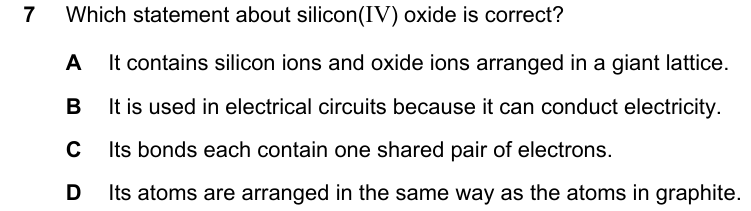
Silicon(IV) oxide is not ionic. It is a compound of two non-metals with covalent bonds, each bond one shared pair. Over half of candidates in one session chose “silicon ions and oxide ions in a giant lattice”.
Attempt these before opening the solutions. Each reference gives the component, session and question number of the original examination; the answers follow the published mark scheme.
Solutions and mark-scheme guidance · set F
F1 Answer B
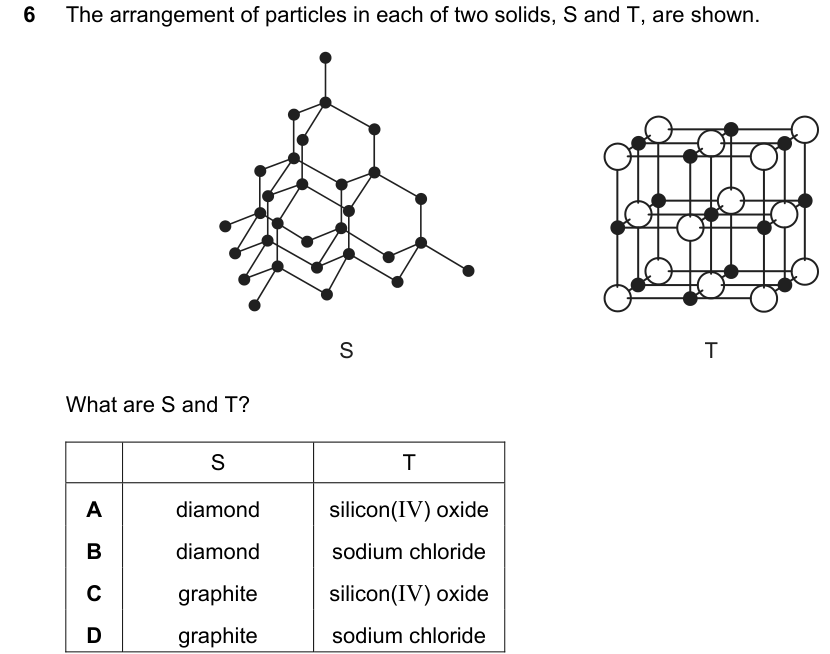
S is a three-dimensional network in which every atom is bonded to four others — diamond (graphite would be layers). T is a cubic lattice of two alternating kinds of particle of different sizes — sodium chloride. Options A and C, with silicon(IV) oxide, suggest confusion over SiO2, which would show two kinds of atom in a diamond-like network.
F2 Answer D
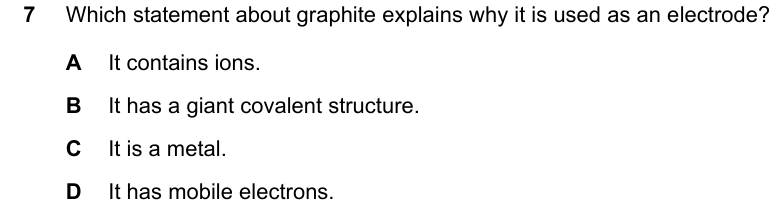
An electrode must conduct: graphite has mobile (delocalised) electrons. Option B is true but does not explain the use — a giant covalent structure alone does not conduct (diamond is also giant covalent).
F3 Answer C
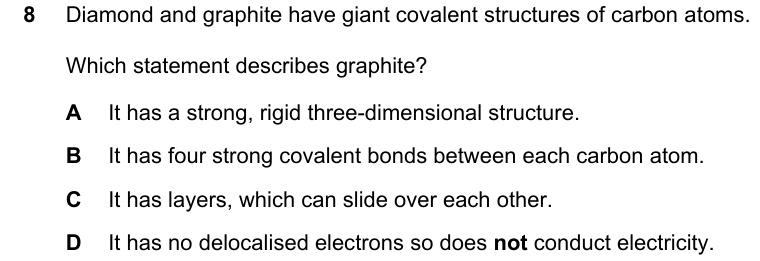
Graphite has layers that can slide over each other. A (rigid 3-D) and B (four bonds per carbon) describe diamond; D is false because graphite has delocalised electrons and conducts.
F4 Answer C
Each Si–O bond is a single covalent bond, containing one shared pair of electrons. A was chosen by over half of candidates: SiO2 is giant covalent, not ionic. It does not conduct (B), and its structure resembles diamond, not graphite (D).
F5 [6]
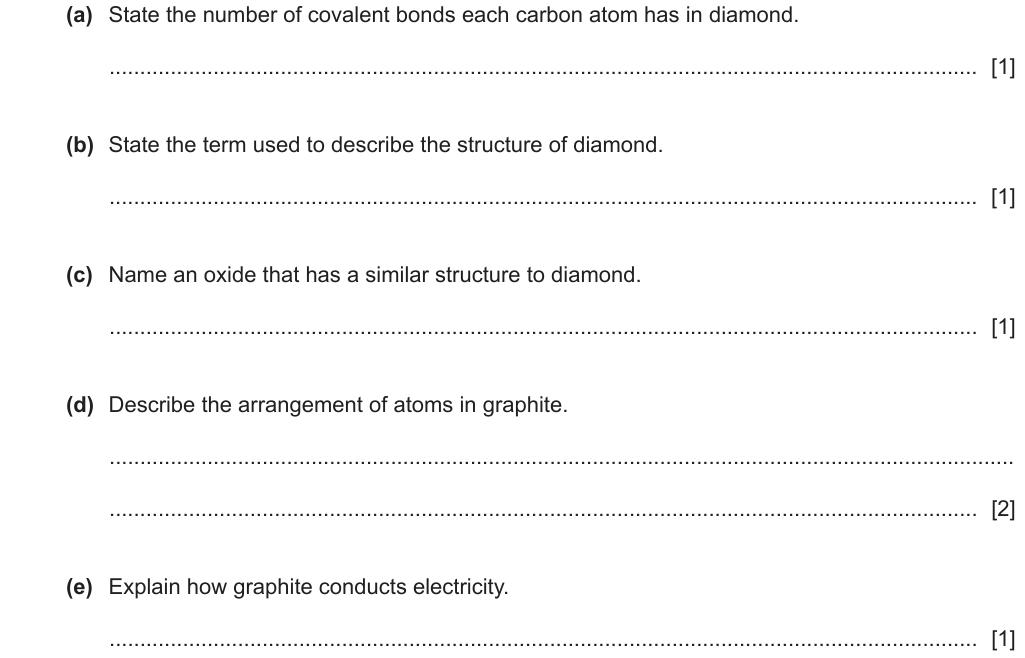
(a) 4 ✓. (b) giant covalent ✓. (c) silicon dioxide / silicon(IV) oxide ✓. (d) layers ✓ of hexagonal rings of carbon atoms ✓. (e) mobile electrons ✓.
Examiner feedback: “giant” and “giant lattice” did not include the covalent nature; some described properties (“hard”) instead of structure. The hexagonal arrangement was less well known than the layers. “Free electrons” gained no credit.
2.7 · Metallic bonding
18Metallic bonding and the properties of metals 2.7.1–2.7.2 Supplement
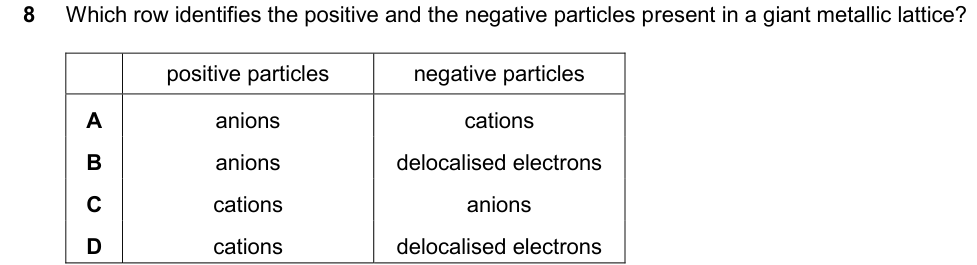
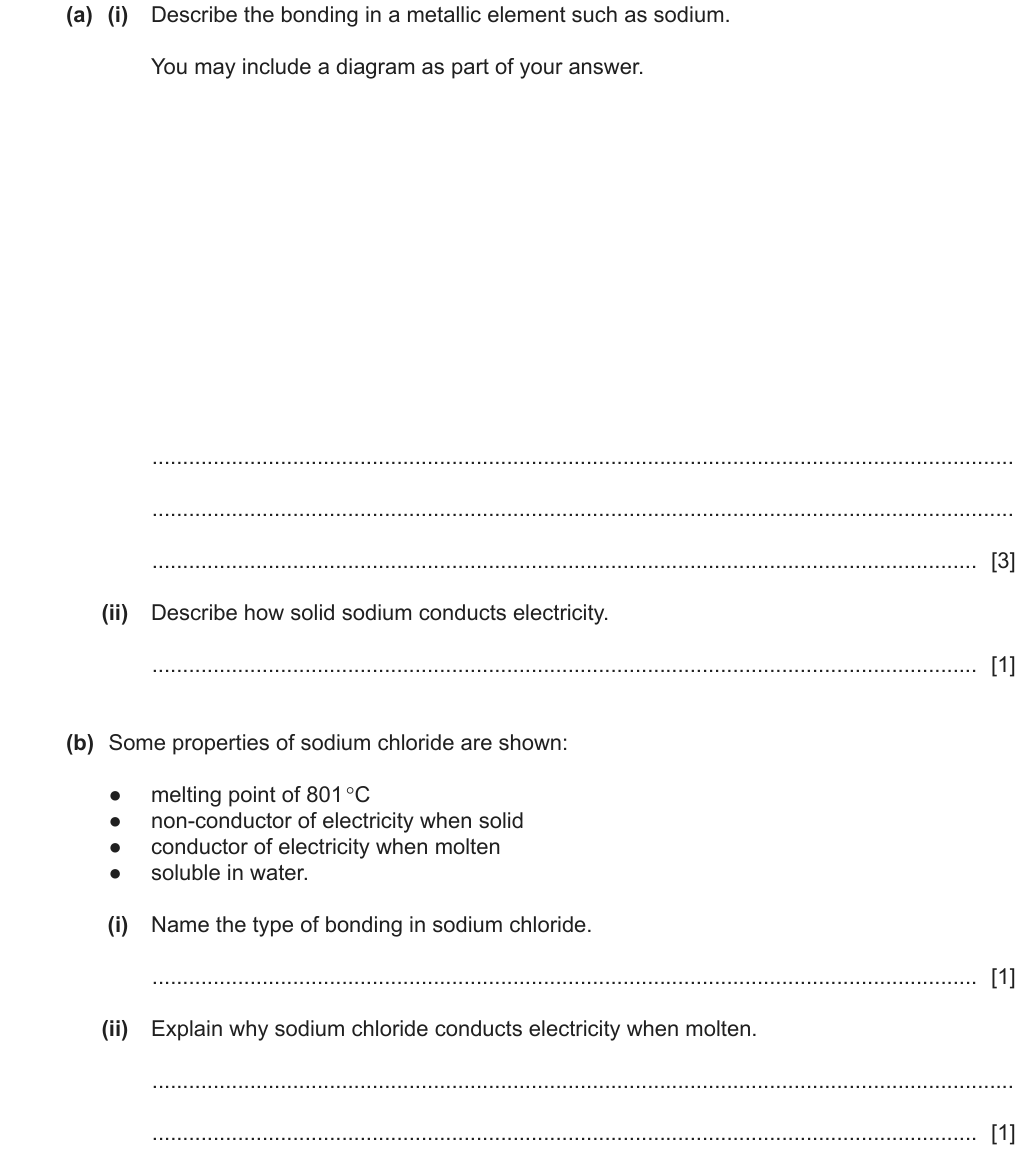
Metallic bonding is the electrostatic attraction between the positive ions in a giant metallic lattice and a ‘sea’ of delocalised electrons.
In a metal, each atom releases its outer-shell electrons. The atoms become positive ions packed in a regular lattice, and the released electrons are shared by the whole structure: they are delocalised — not attached to any one ion — and move freely between the ions. The attraction between the positive ions and the delocalised electrons holds the lattice together.
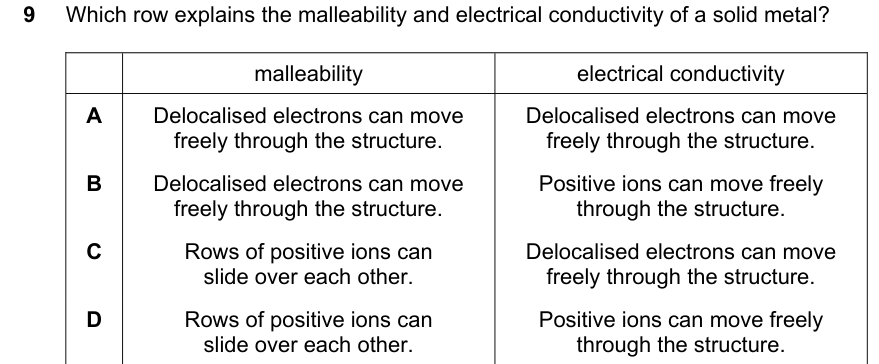
Good electrical conductivity. When a potential difference is applied, the delocalised electrons move through the lattice, carrying the current. This happens in the solid and in the liquid metal. The positive ions do not move.
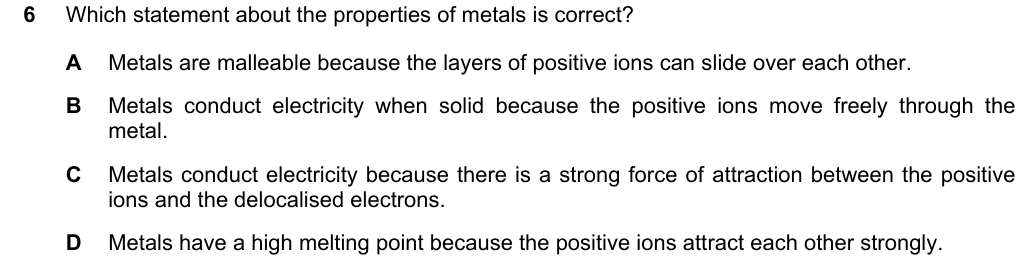
Malleability and ductility. A metal can be hammered into shape (malleable) and drawn into wires (ductile) because the layers of positive ions can slide over each other. The delocalised electrons move with them and the attraction between ions and electrons is maintained in the new positions, so the metal does not shatter.
A full description of metallic bonding needs three ideas: positive ions (not atoms, not protons); a sea of delocalised (mobile) electrons; and the attraction between them. For conduction, say the electrons move or are mobile; “free electrons” and “electrons carry charge” have not been credited.
Metallic bonding is often confused with ionic bonding: chloride ions or negative ions appear in descriptions of sodium metal. The only negative particles in a metal are the delocalised electrons. A statement that metals conduct “because there is a strong attraction between ions and delocalised electrons” is true of metals but is not the explanation of conduction.
Attempt these before opening the solutions. Each reference gives the component, session and question number of the original examination; the answers follow the published mark scheme.
Solutions and mark-scheme guidance · set G
G1 Answer D
A metallic lattice contains positive metal ions — cations — and the negative particles are the delocalised electrons. There are no anions in a metal.
G2 Answer A
A is correct: layers of positive ions slide over each other. B is false (electrons, not ions, move); D is false (positive ions repel each other — the lattice is held by attraction to the electrons). C states a true fact but does not explain conduction; some candidates chose it.
G3 Answer C
Malleability: rows of positive ions slide over each other. Conductivity: delocalised electrons move freely. Only C pairs these correctly.
G4 [6]
(a)(i) positive ions ✓, a sea of delocalised (mobile) electrons ✓, and attraction between the positive ions and the electrons ✓. (ii) The electrons move (are mobile) ✓.
(b)(i) Ionic ✓. (ii) The ions move (are mobile) ✓.
Examiner feedback: many confused metallic with ionic bonding, bringing chloride ions into sodium metal, or left out the attraction; protons were given for positive ions. “Free” instead of mobile, and “carry charge”, gained no credit. In (b)(ii) electrons were often given instead of ions.
Review · Topic 2
19Bonding and structure compared
| Structure | Particles | Attraction overcome on melting | Melting point | Conducts? | Examples |
|---|---|---|---|---|---|
| Giant ionic | positive and negative ions | strong electrostatic attraction between ions | high | only molten or aqueous (ions move) | NaCl, MgO |
| Simple molecular | small molecules | weak intermolecular forces | low | no | H2O, CO2, CH4 |
| Giant covalent | atoms | strong covalent bonds | very high | no (except graphite) | diamond, graphite, SiO2 |
| Metallic | positive ions + delocalised electrons | attraction between ions and electrons | usually high | yes, solid and liquid (electrons move) | Cu, Fe, Na |
20Misconceptions and the examiner’s view
- “Ionic compounds conduct when solid because they contain ions.” The ions must be able to move: only in the molten or aqueous state.
- “Molten sodium chloride conducts because electrons move.” In ionic compounds the charge carriers are ions.
- “Ionic compounds have strong intermolecular forces.” They contain no molecules; the attraction is between oppositely charged ions throughout a lattice.
- “Boiling water breaks the O–H bonds.” Boiling overcomes the weak forces between molecules.
- “Silicon(IV) oxide is ionic.” It is giant covalent, like diamond.
- “Metals contain negative ions.” The only negative particles in a metal are the delocalised electrons.
- “Isotopes have different chemical properties.” Same electrons, same configuration, same chemistry.
Candidates handle the particle counts well: relative charges and masses, numbers of protons, neutrons and electrons in atoms and ions, and relative atomic mass calculations are usually answered correctly, although signs are omitted from relative charges and the number of electrons in an ion is sometimes miscounted. Questions that ask for a conclusion, such as recognising that an element with Ar equal to its nucleon number has only one isotope, are poorly answered. Dot-and-cross diagrams lose marks for the wrong number of outer electrons on an ion, for drawing atoms instead of ions, for using only dots or only crosses, and for extra or missing non-bonding pairs in molecules. The most persistent weakness is the language of structure and bonding: ionic compounds are described with “molecules” or “intermolecular forces”, metallic bonding is confused with ionic bonding, silicon(IV) oxide is treated as ionic, and conductivity is explained with “free” particles or with the wrong particle altogether. Strong answers name the particles precisely — ions, molecules, atoms or delocalised electrons — say that the relevant attraction is strong or weak, describe giant structures as “giant”, and state that charge carriers are mobile.
21Summary and knowledge organiser
Essential knowledge
- Element: one type of atom. Compound: elements chemically combined in a fixed ratio. Mixture: substances not chemically combined.
- Proton (+1, 1), neutron (0, 1), electron (−1, 1/1840). Proton number = protons; mass number = protons + neutrons.
- Shells hold 2, 8, 8, 2 for Z = 1–20. Shells occupied = period; outer electrons = group (I–VII); noble gases have full outer shells.
- Isotopes: same protons, different neutrons; same chemical properties (same electronic configuration). Ar = Σ(mass × %) ÷ 100.
- Metals lose electrons → cations; non-metals gain electrons → anions. Ionic bond: strong electrostatic attraction between oppositely charged ions, in a giant lattice.
- Covalent bond: a shared pair of electrons. Simple molecules: strong bonds inside, weak intermolecular forces between.
- Diamond (4 bonds, hard, insulator), graphite (3 bonds, layers, conducts), SiO2 (like diamond).
- Metallic bonding: positive ions attracted to delocalised electrons; conducts (electrons move), malleable (layers slide).
Examination checklist
- Include signs in relative charges; relative mass of a neutron is 1.
- For an ion, electrons = protons − charge.
- Use crosses for one atom’s electrons and dots for the other’s; bracket ions and show their charges; count to 8 (2 for H).
- Name the particles: ions (ionic), molecules (simple molecular), atoms (giant covalent), positive ions and delocalised electrons (metals).
- Explain conductivity with mobile ions or mobile electrons, never “free”.
- Say “giant covalent” for diamond, graphite and SiO2.
Knowledge organiser · atoms, elements and compounds
| Idea | What to know | Must-remember distinctions and common errors |
|---|---|---|
| Atomic structure 2.2 | Nucleus (p, n) + electrons in shells. Z = protons; A = p + n. Configuration 2,8,8,2. | Neutron relative mass 1, charge 0. Period = shells; group = outer electrons. |
| Isotopes 2.3 | Same Z, different neutrons. Ar = Σ(mass × %) ÷ 100. | Same chemistry because same electrons. Ar between isotope masses. |
| Ionic 2.4 | Electron transfer metal → non-metal. Giant lattice of alternating ions. High m.p.; conducts molten/aqueous. | No molecules, no intermolecular forces. Charge carriers are ions. |
| Covalent (simple) 2.5 | Shared pairs; single, double (O2, CO2, C2H4), triple (N2). Low m.p.; no conduction. | Melting overcomes intermolecular forces, not covalent bonds. |
| Giant covalent 2.6 | Diamond (4 bonds, cutting), graphite (3 bonds, layers, lubricant, electrodes), SiO2 (like diamond). | “Giant covalent”, not “giant”. SiO2 is not ionic. |
| Metallic 2.7 | Positive ions + sea of delocalised electrons. Conducts; malleable, ductile. | Electrons move, ions do not. No anions in metals. |