
Topic 9 has six sub-topics: 9.1 Properties of metals, 9.2 Uses of metals, 9.3 Alloys and their properties, 9.4 Reactivity series, 9.5 Corrosion of metals and 9.6 Extraction of metals. Core statements cover physical and chemical properties, uses, alloys, the reactivity series, rusting and barrier methods, and the blast furnace in words. Supplement statements add the structure of alloys, displacement of metal ions and the oxide layer on aluminium, sacrificial protection, the blast-furnace equations and the electrolytic extraction of aluminium.
Central idea: metals differ in how readily their atoms give up electrons. That single tendency — the reactivity series — explains how they react with water and acids, which displaces which, why iron rusts and zinc protects it, and why iron is made with carbon while aluminium needs electricity.
Before you start
- Metallic bonding: positive ions in a sea of delocalised electrons (Topic 2).
- Oxidation and reduction; oxidising and reducing agents (Topic 6).
- Electrolysis of molten compounds and ionic half-equations (Topic 4).
- Reactions of acids with metals; basic and acidic oxides (Topic 7).
Learning objectives
- Compare the physical properties of metals and non-metals; describe the reactions of metals with acids, water, steam and oxygen.
- Describe uses of aluminium and copper, and of alloys, in terms of their properties; Supplement explain why alloys are harder and stronger.
- State the reactivity series; deduce an order of reactivity from results; Supplement describe displacement of metal ions and explain the unreactivity of aluminium.
- State the conditions for rusting and barrier methods; Supplement explain galvanising and sacrificial protection.
- Describe the extraction of iron and aluminium; Supplement state the blast-furnace equations and electrode half-equations.
Introduction: gold, iron and aluminium
Gold is found as the shiny metal in rocks; iron is extracted from its ore by heating with carbon; aluminium, although very common in the Earth's crust, can only be extracted using large amounts of electricity. The difference is not rarity but reactivity. The more reactive a metal, the more tightly it holds on to other elements in its compounds, and the more energy it takes to extract it. The same property decides how a metal corrodes and how we protect it.
9.1 · Properties of metals
1Physical properties of metals and non-metals 9.1.1 Core
| Property | Metals | Non-metals |
|---|---|---|
| thermal conductivity | good | poor (insulators) |
| electrical conductivity | good | poor (graphite is the exception) |
| malleability and ductility | malleable (can be hammered into shape) and ductile (drawn into wires) | brittle when solid |
| melting and boiling points | usually high | usually low (many are gases); diamond and graphite are exceptions |
| appearance | shiny, often dense | dull; low density |
These properties come from metallic bonding (Topic 2). Delocalised electrons move freely through the lattice, carrying charge and thermal energy, so metals conduct. The layers of positive ions can slide over each other without breaking the bonding, because the sea of electrons holds them in any position — so metals are malleable and ductile. The strong attraction between the positive ions and the delocalised electrons gives high melting points.
2Chemical properties of metals 9.1.2 Core
Metals react with:
- dilute acids, giving a salt and hydrogen: Zn + 2HCl → ZnCl2 + H2 (metals above hydrogen only);
- cold water (the most reactive metals), giving the metal hydroxide and hydrogen: 2Na + 2H2O → 2NaOH + H2; or steam (less reactive metals), giving the metal oxide and hydrogen: Mg + H2O → MgO + H2;
- oxygen, forming basic metal oxides: 2Mg + O2 → 2MgO (bright white flame), 2Cu + O2 → 2CuO (the surface blackens on heating).
How vigorously a metal reacts depends on its position in the reactivity series (section 9.4).
Attempt these before opening the solutions. Each reference gives the component, session and question number of the original examination; the answers follow the published mark scheme.
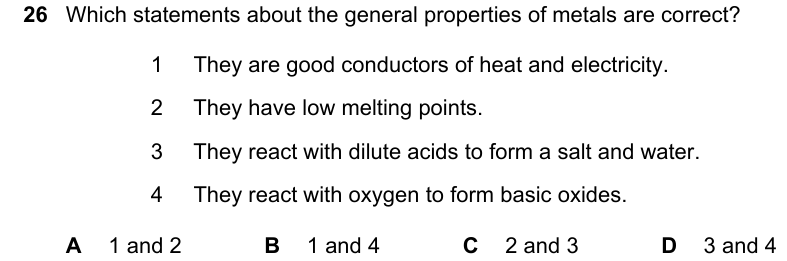
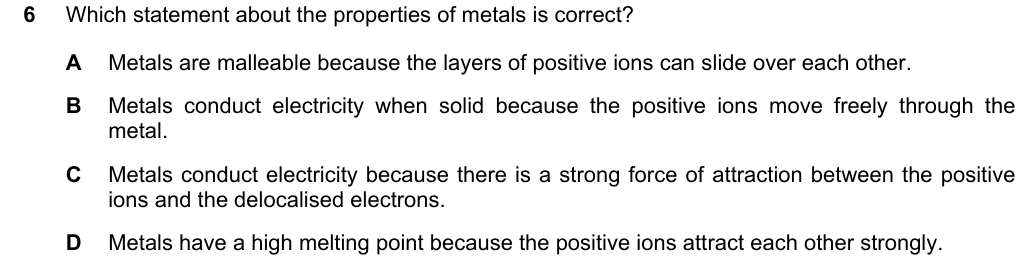
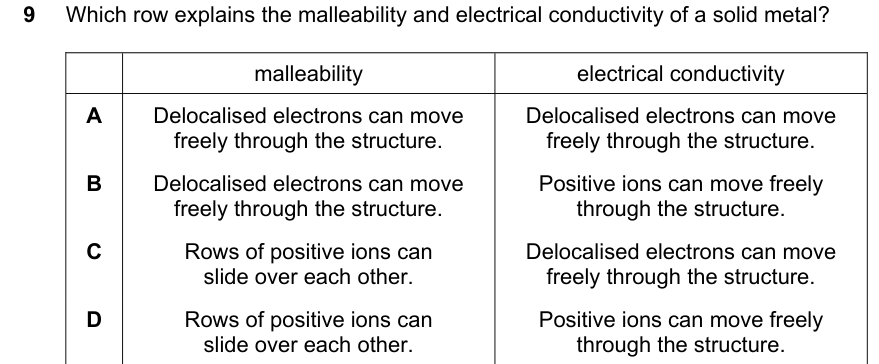
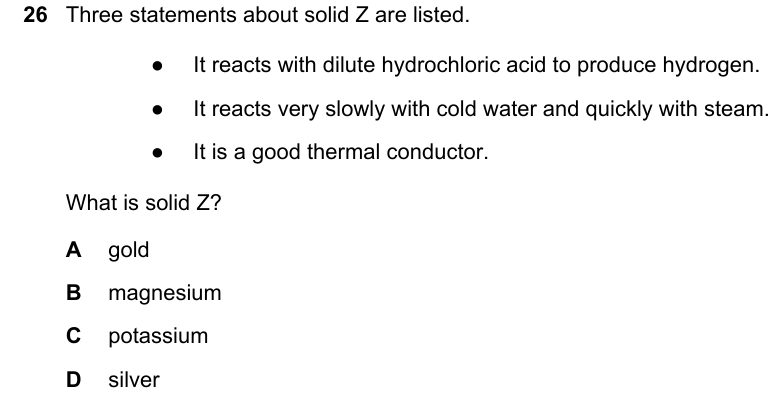
Solutions and mark-scheme guidance · set A
A1 Answer B
Metals are good conductors (1) and form basic oxides (4). Many metals have high melting points, and metals with dilute acids give a salt and hydrogen, not water.
A2 Answer A
Malleability: layers of positive ions slide over each other. Conduction is by the delocalised electrons, not the ions. Option C contains true information but does not explain conductivity; some candidates chose it.
A3 Answer C
Malleability: rows of positive ions slide; conductivity: delocalised electrons move through the structure.
A4 Answer B
Reacts with acid to give hydrogen, reacts very slowly with cold water but quickly with steam: magnesium. Potassium would react violently with cold water; silver and gold do not react with acids.
9.2 · Uses of metals
3Uses of metals 9.2.1 Core
A metal is chosen for a job because of a particular property. The syllabus examples:
| Metal | Use | Property |
|---|---|---|
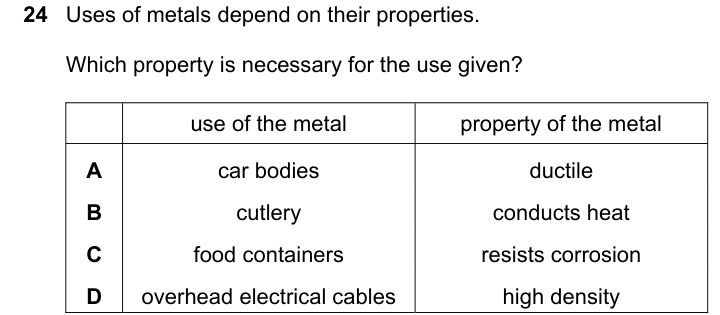
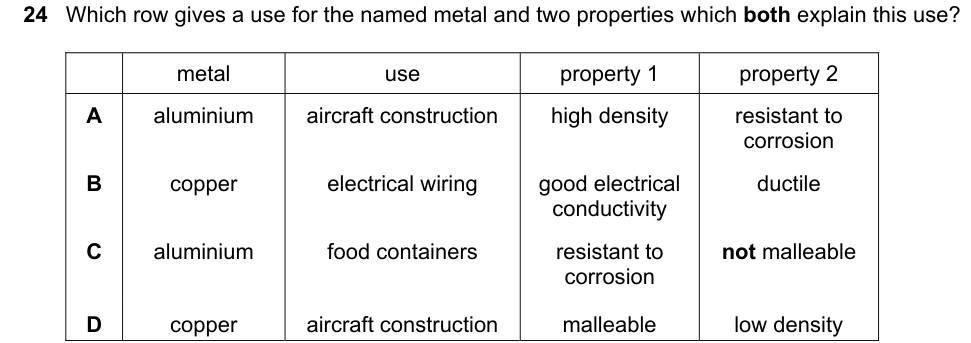
| aluminium | manufacture of aircraft | low density (and strength, as an alloy) |
| aluminium | overhead electrical cables (with a steel core for strength) | low density and good electrical conductivity |
| aluminium | food containers and foil | resistance to corrosion |
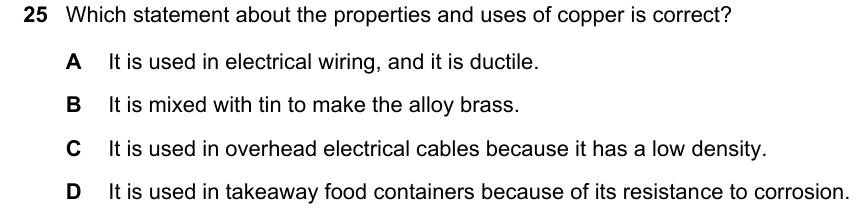
| copper | electrical wiring | good electrical conductivity and ductility |
Copper is not used for overhead cables: it is much denser than aluminium, so the cables would be too heavy for the pylons. Aluminium's resistance to corrosion comes from its thin, unreactive oxide layer (section 9.4).
Match the property to the use: “aluminium is used in aircraft because it is a good conductor” gives a true property that does not explain the use. Aluminium has a low density — answers giving “high density” or “light” for a metal in general lose the mark.
Attempt these before opening the solutions. Each reference gives the component, session and question number of the original examination; the answers follow the published mark scheme.

Solutions and mark-scheme guidance · set B
B1 Answer A
Aircraft are made of aluminium, Al, because of its low density.
B2 Answer C
Food containers must resist corrosion. Car bodies need malleability, cutlery hardness and resistance to rusting, and overhead cables low density.
B3 Answer B
Copper wiring: good electrical conductivity and ductile. Aluminium in aircraft is for low density, and a food container must be malleable.
B4 Answer A
Copper is used in electrical wiring and is ductile. Brass is copper with zinc (not tin); overhead cables use aluminium because of its low density.
9.3 · Alloys and their properties
4Alloys 9.3.1–9.3.5 CoreSupplement
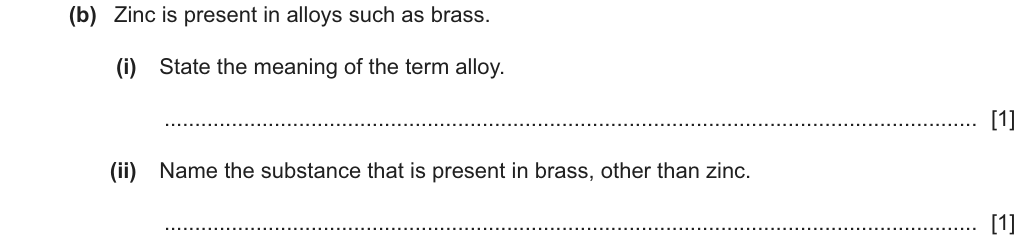
An alloy is a mixture of a metal with other elements. Brass is a mixture of copper and zinc. Stainless steel is a mixture of iron with other elements such as chromium, nickel and carbon.
An alloy is a mixture, not a compound: its composition can vary, and the elements keep their own atoms in a metallic lattice. Alloys can be harder and stronger than the pure metals and so are more useful. Stainless steel is used for cutlery because it is hard and resistant to rusting; brass is harder than copper and does not corrode, so it is used for fittings and musical instruments.
An alloy is recognised in a structure diagram by atoms of two (or more) different sizes mixed in a metallic lattice (Figure 9.1). A diagram with only one kind of atom is a pure metal; a regular alternating pattern of two kinds of particle drawn with charges is an ionic lattice.
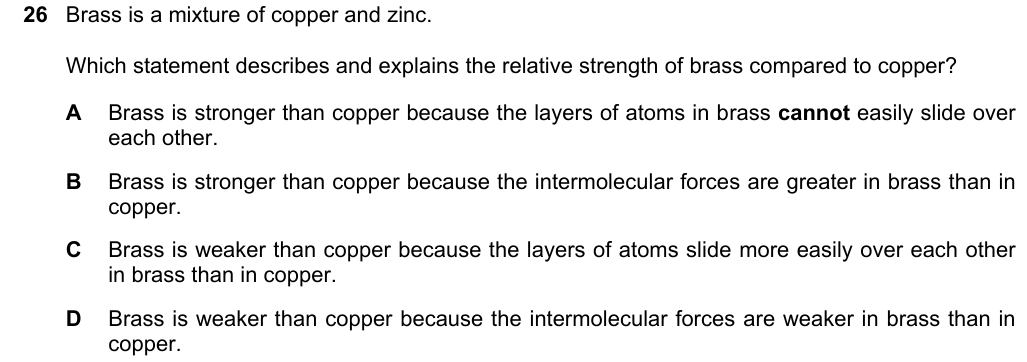
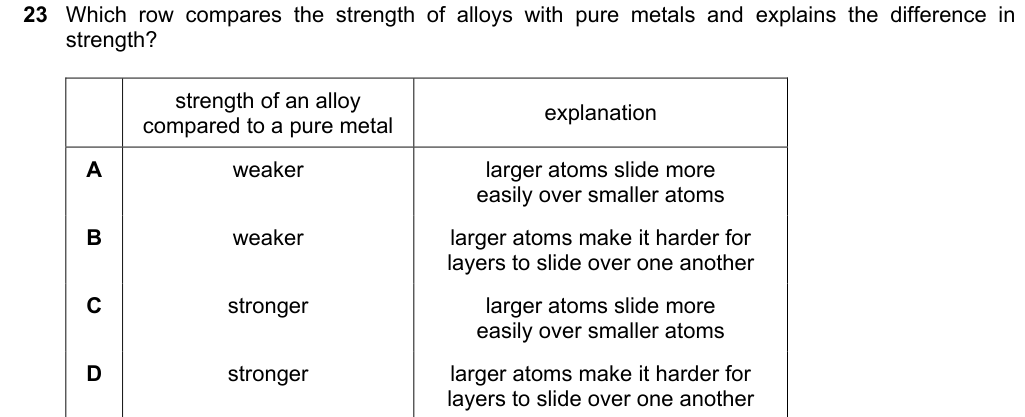
Supplement Why alloys are harder and stronger. In a pure metal the atoms are all the same size and are arranged in regular layers that can slide over one another when a force is applied. In an alloy, the different-sized atoms distort the layers, so the layers can no longer slide over each other easily. More force is needed to change the shape, so the alloy is harder and stronger.
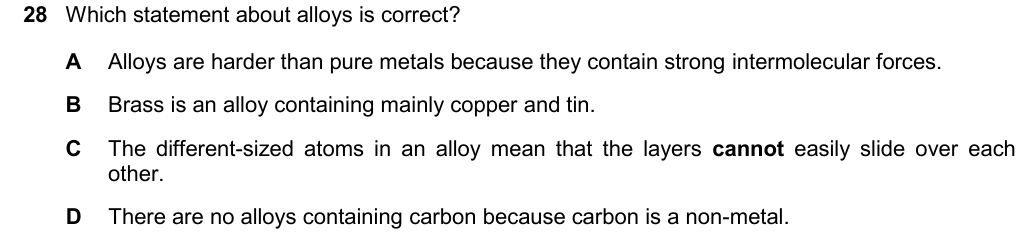
Explanations of alloy strength must refer to different-sized atoms and layers that cannot slide. Answers about “intermolecular forces” or “stronger bonds” are wrong — a metal has no molecules. The definition of an alloy often lacks the word “mixture” or the need for a metal; brass (copper and zinc) is confused with bronze (copper and tin).
Attempt these before opening the solutions. Each reference gives the component, session and question number of the original examination; the answers follow the published mark scheme.

Solutions and mark-scheme guidance · set C
C1 Answer D
An alloy has atoms of different sizes mixed in a metallic lattice.
C2 Answer A
Brass is stronger because the layers of atoms cannot easily slide. Many confused intermolecular forces with metallic bonding.
C3 Answer C
Different-sized atoms stop the layers sliding. Weaker candidates chose A (intermolecular forces) or B (brass is copper and zinc, not tin).
C4 Answer D
Alloys are stronger: larger atoms make it harder for the layers to slide over one another.
C5 [2]
(i) A mixture of a metal with other elements ✓. (ii) copper ✓.
Examiner feedback: “mixture” was often missing; many wrote “compound” or “combination of elements”, or left out the metal. Tin and iron were common wrong answers in (ii).
9.4 · Reactivity series
5The reactivity series 9.4.1–9.4.3 Core
Placing metals in order of how vigorously they react gives the reactivity series. Carbon and hydrogen are included because they are used to compare metals:
potassium > sodium > calcium > magnesium > aluminium > carbon > zinc > iron > hydrogen > copper > silver > gold
| Metal | Cold water | Steam | Dilute hydrochloric acid |
|---|---|---|---|
| potassium, sodium | vigorous: fizzing, float and move; hydroxide + H2 | — | (dangerously violent) |
| calcium | steady fizzing: Ca + 2H2O → Ca(OH)2 + H2 | — | (vigorous) |
| magnesium | very slow | reacts: Mg + H2O → MgO + H2 | rapid fizzing |
| zinc, iron | no reaction | react when heated | steady (zinc) / slow (iron) fizzing |
| copper, silver, gold | no reaction | no reaction | no reaction — below hydrogen |
Metals above hydrogen displace hydrogen from dilute acids; metals below hydrogen do not. The reactions with water, steam and acid are explained by position: the higher the metal, the more readily it forms positive ions, and the more vigorous the reaction.
Deducing an order from results. Compare how many reactions each metal takes part in, or how vigorously. A metal whose oxide can be reduced by heating with carbon is below carbon, so it is one of the less reactive metals; a metal whose oxide cannot be reduced by carbon is more reactive than carbon.
6Displacement of metal ions; the unreactivity of aluminium 9.4.4–9.4.5 Supplement
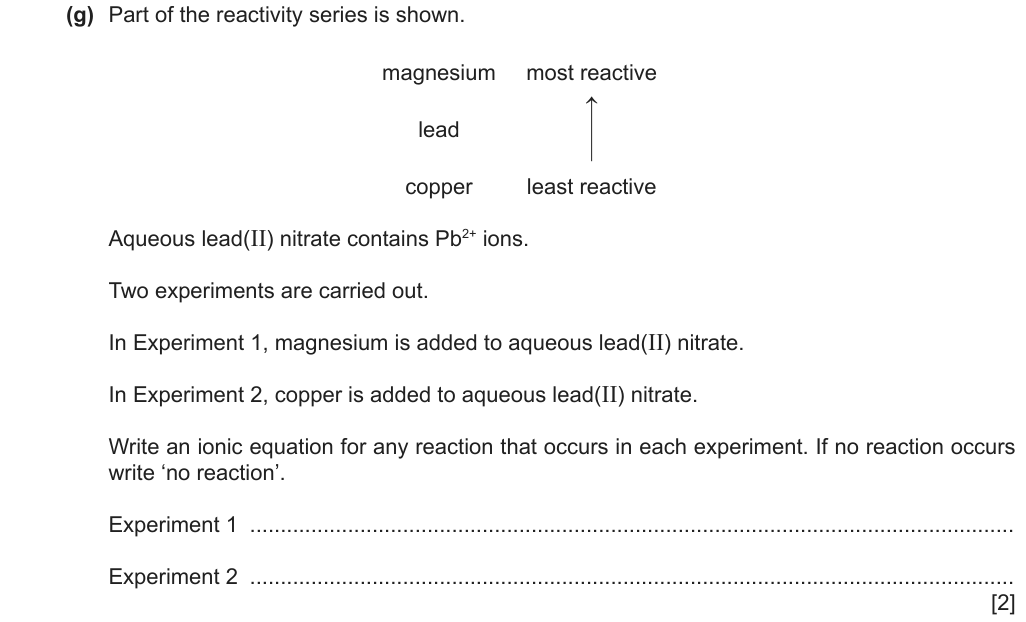
The reactivity of a metal is its tendency to form positive ions. A more reactive metal will displace a less reactive metal from an aqueous solution of its ions, because its atoms lose electrons more readily:
Mg(s) + Cu2+(aq) → Mg2+(aq) + Cu(s)
Zn(s) + 2Ag+(aq) → Zn2+(aq) + 2Ag(s)
Magnesium added to blue copper(II) sulfate solution becomes coated with pink-brown copper, the blue colour fades and the mixture warms up. Copper added to magnesium sulfate solution shows no change. These are redox reactions: the metal atom is oxidised and the metal ion is reduced; the sulfate or nitrate ion is a spectator. The number of solutions a metal can displace from among the ions of magnesium, zinc, iron, copper and silver places it in the series.
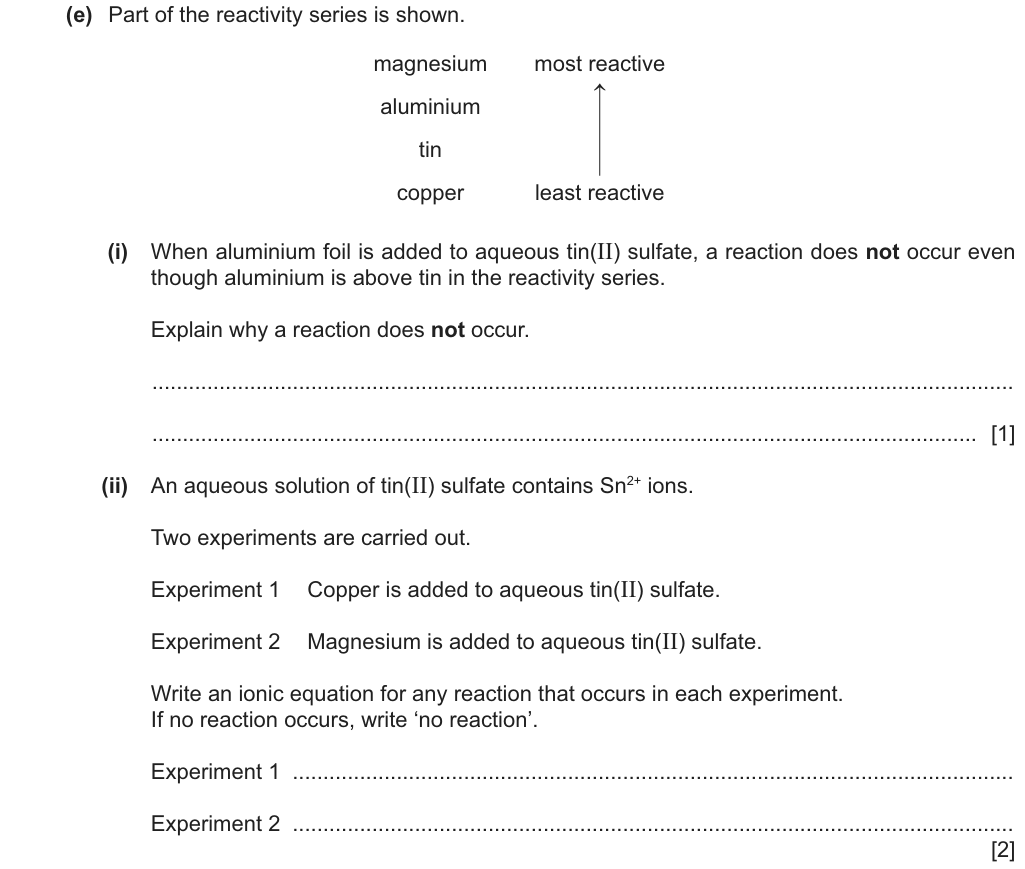
Aluminium is high in the reactivity series, yet aluminium saucepans do not react with water and aluminium foil shows no immediate reaction with copper(II) sulfate solution. The surface is covered with a thin, unreactive layer of aluminium oxide that sticks firmly to the metal and stops water, acids or solutions reaching the aluminium beneath. This is why aluminium resists corrosion.
“Aluminium does not react because it is unreactive” contradicts its position in the series. The mark is for an unreactive oxide layer (coating). In ionic equations for displacement, leave out the spectator ion: Mg + Pb2+ → Mg2+ + Pb, not Mg2+ + SO42− → MgSO4.
Attempt these before opening the solutions. Each reference gives the component, session and question number of the original examination; the answers follow the published mark scheme.
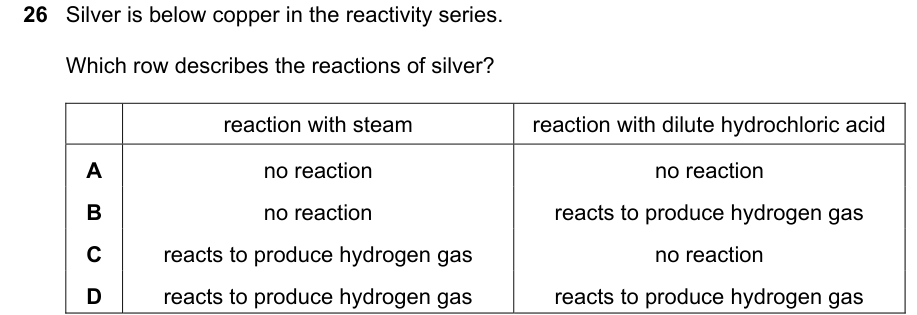
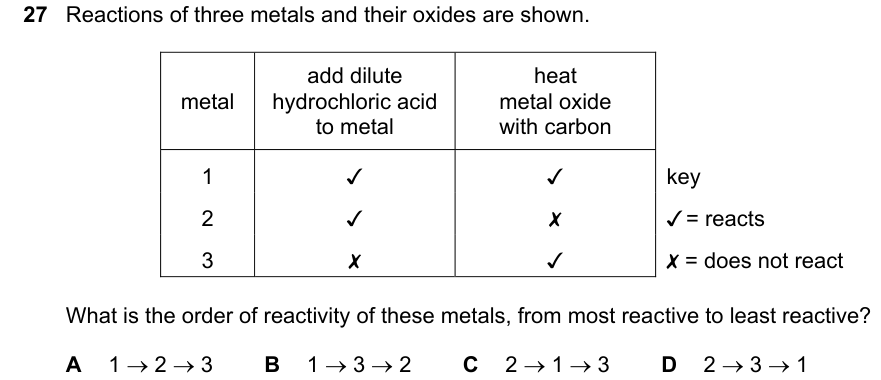
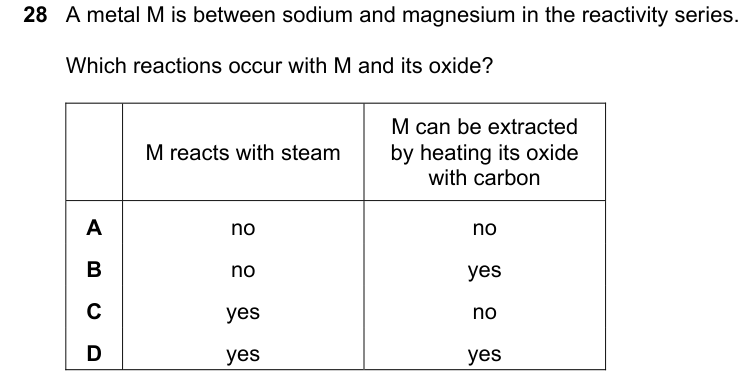
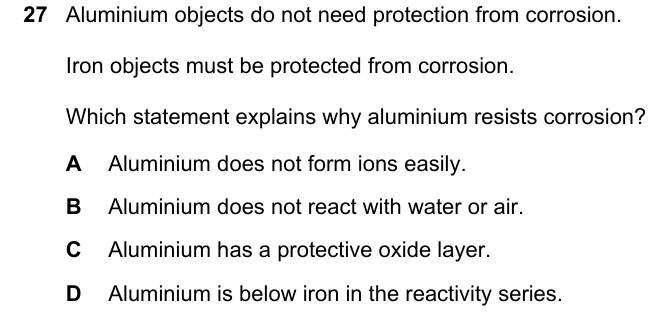
Solutions and mark-scheme guidance · set D
D1 Answer A
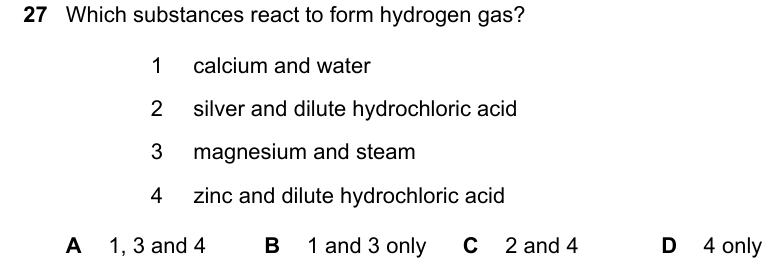
Calcium + water, magnesium + steam and zinc + acid all give hydrogen; silver is below hydrogen and does not react with dilute acid. About a quarter forgot calcium with water or magnesium with steam.
D2 Answer A
Silver is below hydrogen: no reaction with steam or dilute acid. Option B, a reaction with acid, was common.
D3 Answer C
The metal whose oxide is reduced by carbon is the least reactive; the one that reacts with acid but whose oxide is not reduced by carbon is the most reactive. Candidates should recall that only the less reactive metals are extracted from their oxides with carbon; A was often chosen.
D4 Answer C
Between sodium and magnesium means above carbon: not extracted with carbon, and it does react with steam.
D5 Answer C
Aluminium has a protective oxide layer. Option B, “does not react with water or air”, was a common wrong choice from assuming aluminium is unreactive.
D6 [2]
Experiment 1: Mg + Pb2+ → Mg2+ + Pb ✓. Experiment 2: no reaction — copper is below lead ✓.
Examiner feedback: very few wrote a correct ionic equation for Experiment 1; more practice with ionic equations is needed.
D7 [3]
(i) An unreactive coating of aluminium oxide ✓. (ii) Experiment 1: no reaction ✓; Experiment 2: Mg + Sn2+ → Mg2+ + Sn ✓.
Examiner feedback: many omitted that the oxide layer is unreactive, or said aluminium itself is unreactive. Mg2+ + SO42− → MgSO4 and Mg2+ as a reactant were common errors.
9.5 · Corrosion of metals
7Rusting and barrier methods 9.5.1–9.5.3 Core
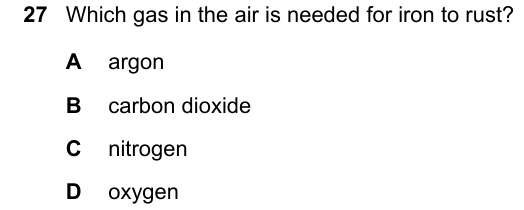
The corrosion of iron and steel is called rusting. Rust is hydrated iron(III) oxide. Iron rusts only when both water and oxygen are present:
iron + water + oxygen → hydrated iron(III) oxide
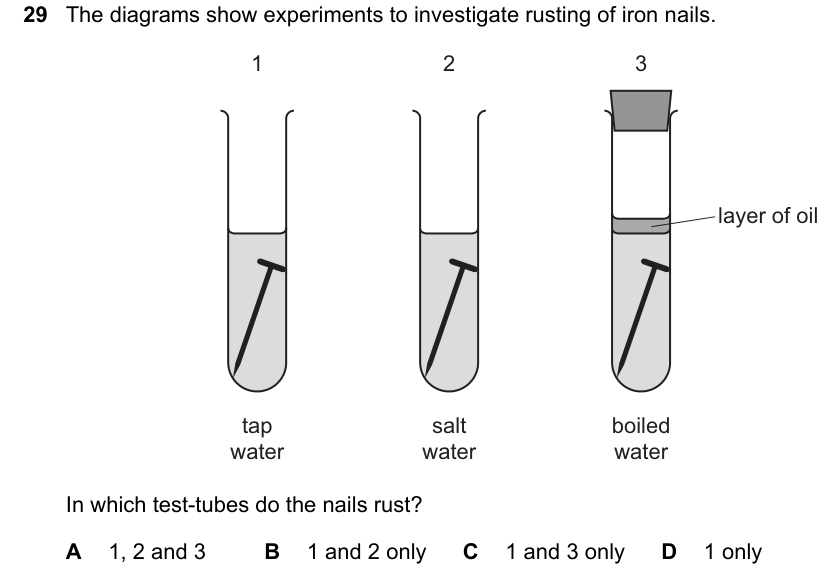
The classic investigation uses three nails: one in tap water open to the air (rusts); one in boiled water (air removed) under a layer of oil (no rust — no oxygen); one in dry air with anhydrous calcium chloride (no rust — no water). Dissolved salt speeds up rusting, which is why cars and ships corrode faster near the sea. Because oxygen and water are combined into the solid, rusting iron gains mass.
Barrier methods — painting, greasing (or oiling), coating with plastic — prevent rusting by excluding oxygen or water from the surface of the iron. They protect only while the barrier is intact: if paint is scratched, the exposed iron rusts.
8Galvanising and sacrificial protection 9.5.4–9.5.5 Supplement
Galvanising is coating iron or steel with a layer of zinc. It protects in two ways:
- as a barrier: the zinc keeps water and oxygen away from the iron;
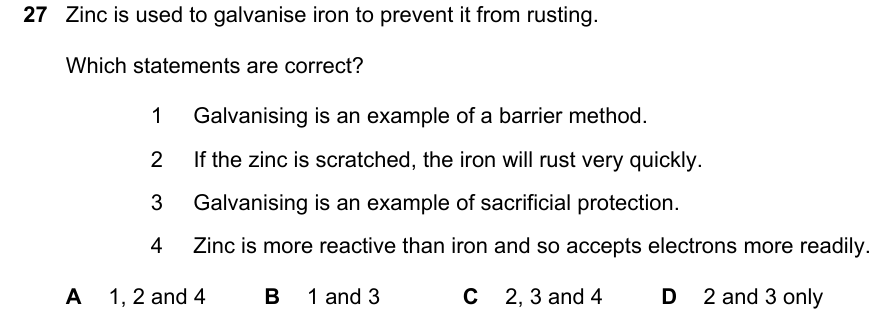
- by sacrificial protection: zinc is more reactive than iron, so if the coating is scratched and the iron exposed, the zinc loses electrons in preference to the iron — the zinc is oxidised (corrodes) instead of the iron: Zn → Zn2+ + 2e−. The iron stays unreacted.
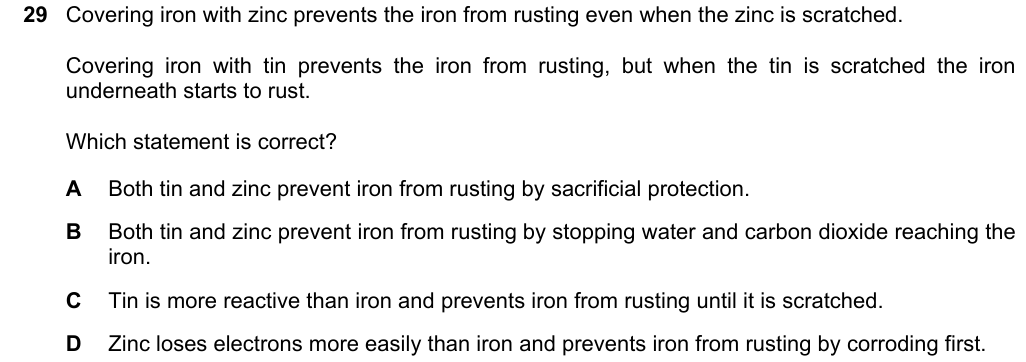
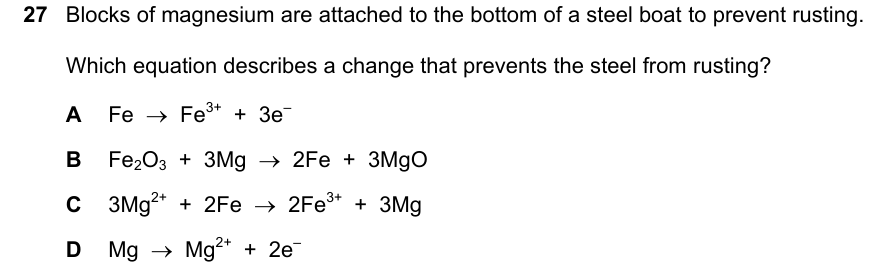
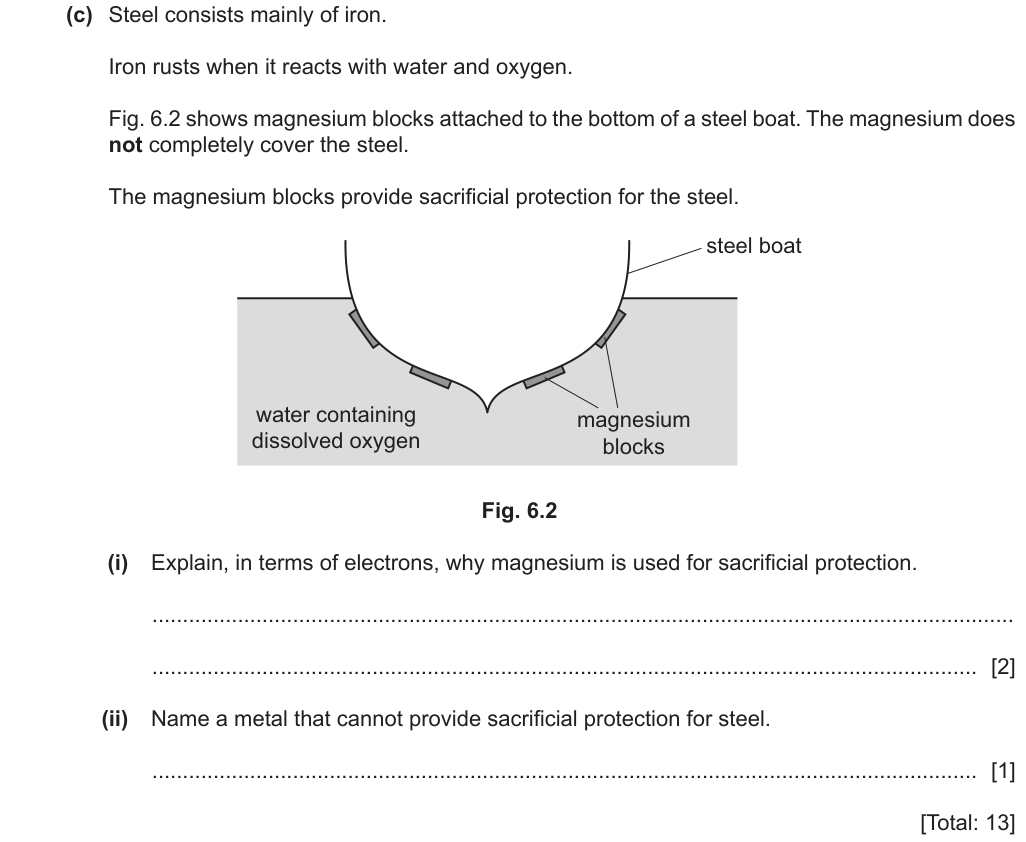
Blocks of magnesium or zinc bolted to the hull of a steel ship, or to underground pipes, protect by sacrificial protection alone: they need not cover the steel, and they are replaced when they have corroded away. A metal below iron in the series — tin, copper, silver — cannot give sacrificial protection. Tin-plated steel is protected only while the tin is unbroken; once scratched, the iron rusts.
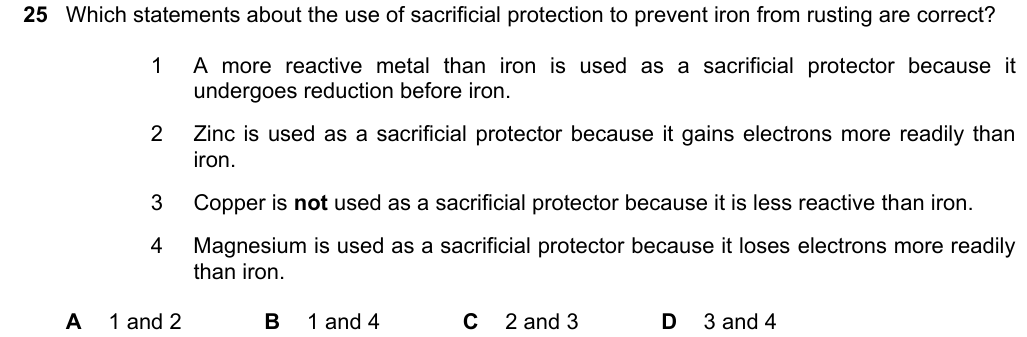
Sacrificial protection needs two ideas: the metal is more reactive than iron, and it loses electrons (is oxidised) more readily than / instead of iron. “Zinc rusts instead”, “zinc reacts” (with what?) and “zinc forms a barrier” (not true at a scratch) do not score. The sacrificial metal is oxidised, not reduced.
Attempt these before opening the solutions. Each reference gives the component, session and question number of the original examination; the answers follow the published mark scheme.
Solutions and mark-scheme guidance · set E
E1 Answer D
Rusting needs oxygen (and water).
E2 Answer B
Tube 1 (tap water, air) and tube 2 (salt water) contain water and oxygen. Boiled water under oil has no oxygen: no rust.
E3 Answer D
Zinc loses electrons more easily than iron and corrodes first; tin is less reactive than iron and protects only as a barrier. B, the commonest wrong answer, shows barrier methods are known better than sacrificial protection.
E4 Answer B
Galvanising is both a barrier method and sacrificial protection. If scratched, the iron is still protected; zinc loses electrons more readily. Distractor C was popular.
E5 Answer D
Copper is less reactive, so cannot protect (3); magnesium loses electrons more readily than iron (4). A sacrificial metal is oxidised, not reduced. Option A was the most common error.
E6 Answer D
The change that prevents rusting is magnesium being oxidised: Mg → Mg2+ + 2e−. More than half chose the reduction of iron(III) oxide — but if Fe2O3 has formed, rusting has already happened.
E7 Answer D
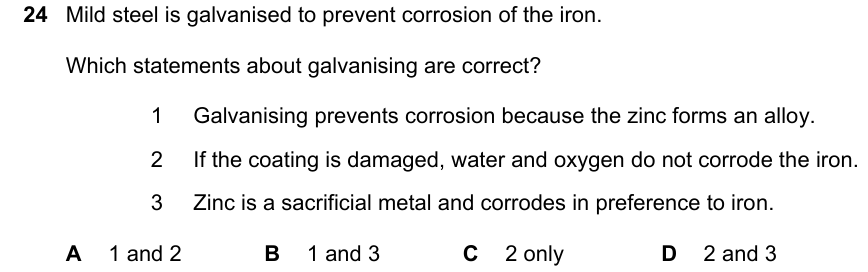
Galvanising is a coating, not an alloy. When damaged, zinc corrodes in preference to iron (3), so the iron is not corroded (2). Some chose B, confusing galvanising with alloying.
E8 [3]
(i) Magnesium loses electrons more readily than (in preference to) iron ✓; magnesium is more reactive than iron ✓. (ii) Any metal below iron, e.g. copper, silver or gold ✓.
Examiner feedback: most knew magnesium is more reactive but did not explain in terms of losing electrons in preference to iron. “Magnesium has more electrons”, “gains electrons” and “rusts instead” were common. Iron itself, or metals more reactive than iron, did not score in (ii).
E9 [3]
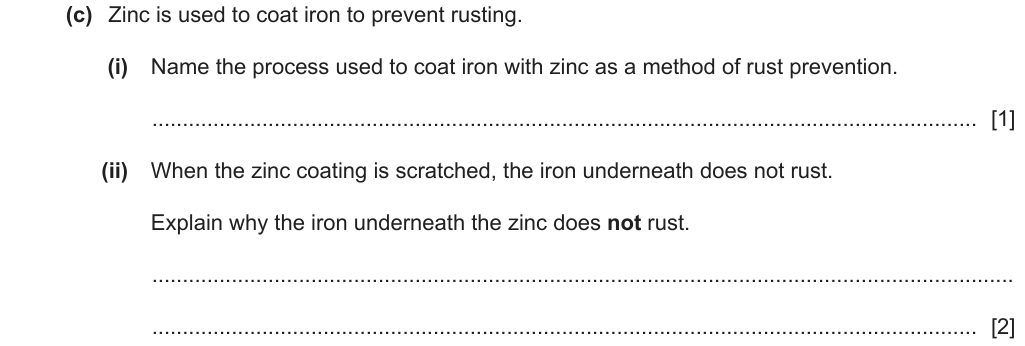
(i) galvanising ✓. (ii) Zinc is more reactive than iron ✓ and is oxidised / loses electrons instead ✓.
Examiner feedback: electroplating and “sacrificial protection” were given as the process name. “Zinc rusts”, “zinc reacts” and “zinc forms a barrier” did not score.
E10 [6]
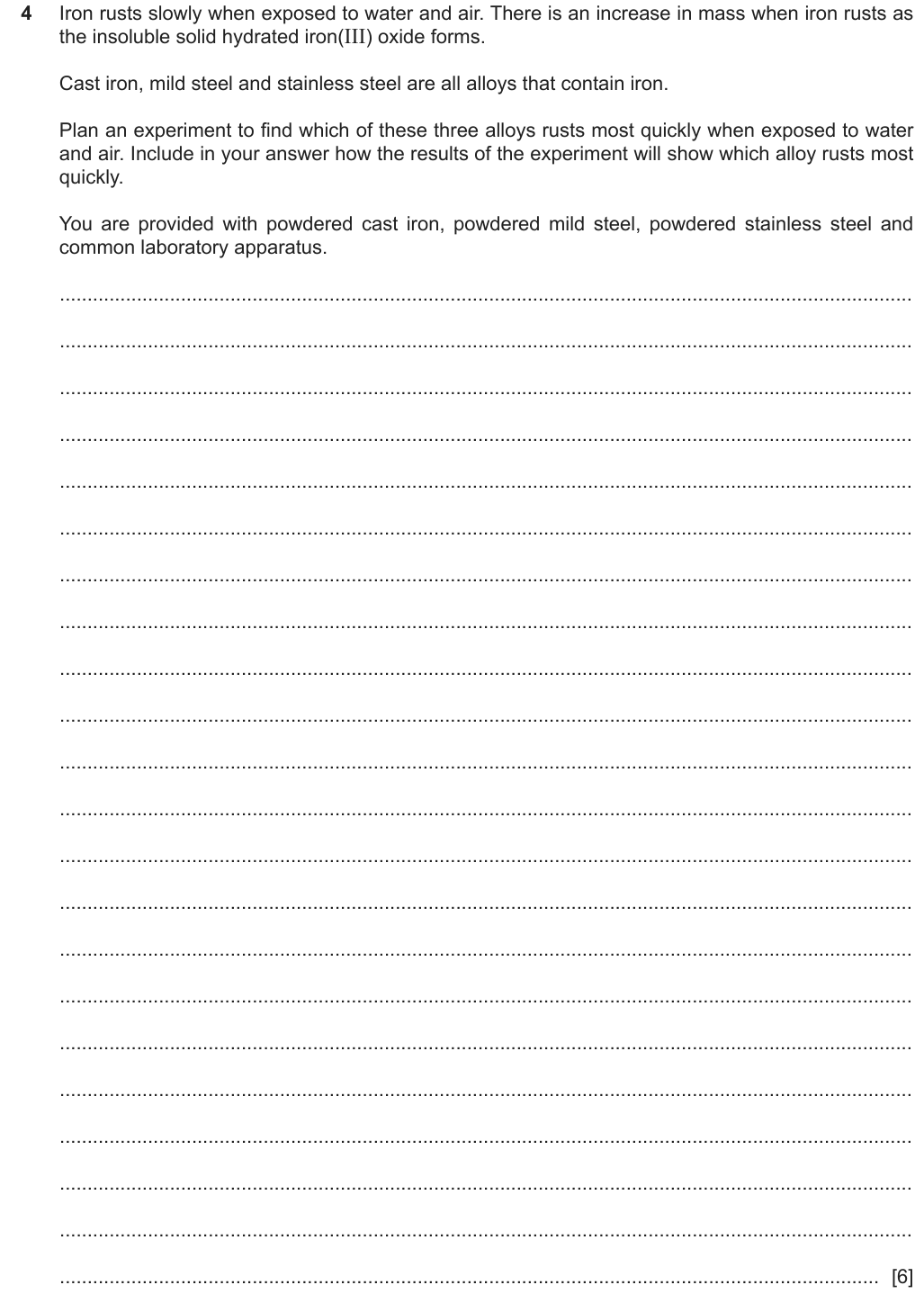
Any six of: use a known / the same mass of each powdered alloy ✓; place each in a suitable container with water ✓ (open to air); leave for a suitable time (hours or days) ✓; filter out the solid ✓; dry the solid ✓; weigh it again ✓; the largest increase in mass shows the alloy that rusts most quickly ✓.
Examiner feedback: a common error was to time how long the alloys took to rust, or to leave them for only a few minutes. Better answers filtered and dried the solid before weighing. Use “mass”, not “amount”, for solids; lists of apparatus earn no credit.
9.6 · Extraction of metals
9Extraction and the reactivity series 9.6.1 Core
Most metals occur in ores as compounds (often oxides or sulfides). Extraction is reduction: the metal ions must gain electrons. The more reactive the metal, the more stable its compounds and the harder it is to extract:
- above carbon (K, Na, Ca, Mg, Al): extracted by electrolysis of a molten compound — carbon cannot reduce their oxides;
- below carbon (Zn, Fe, and less reactive metals): extracted by heating the oxide with carbon (or carbon monoxide), which removes the oxygen;
- very unreactive (gold, and some silver): found uncombined (native).
10Extracting iron in the blast furnace 9.6.2, 9.6.4 CoreSupplement
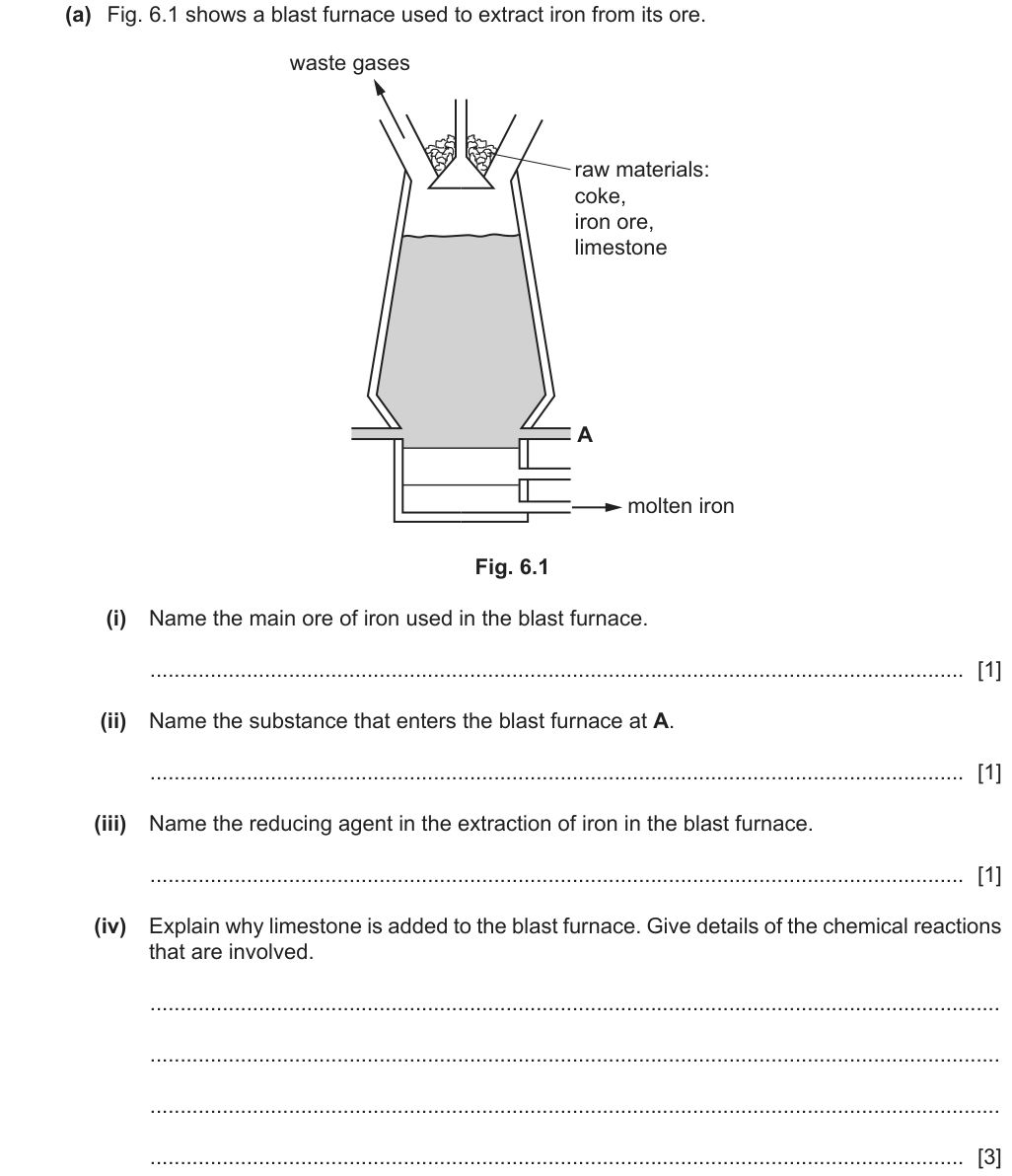
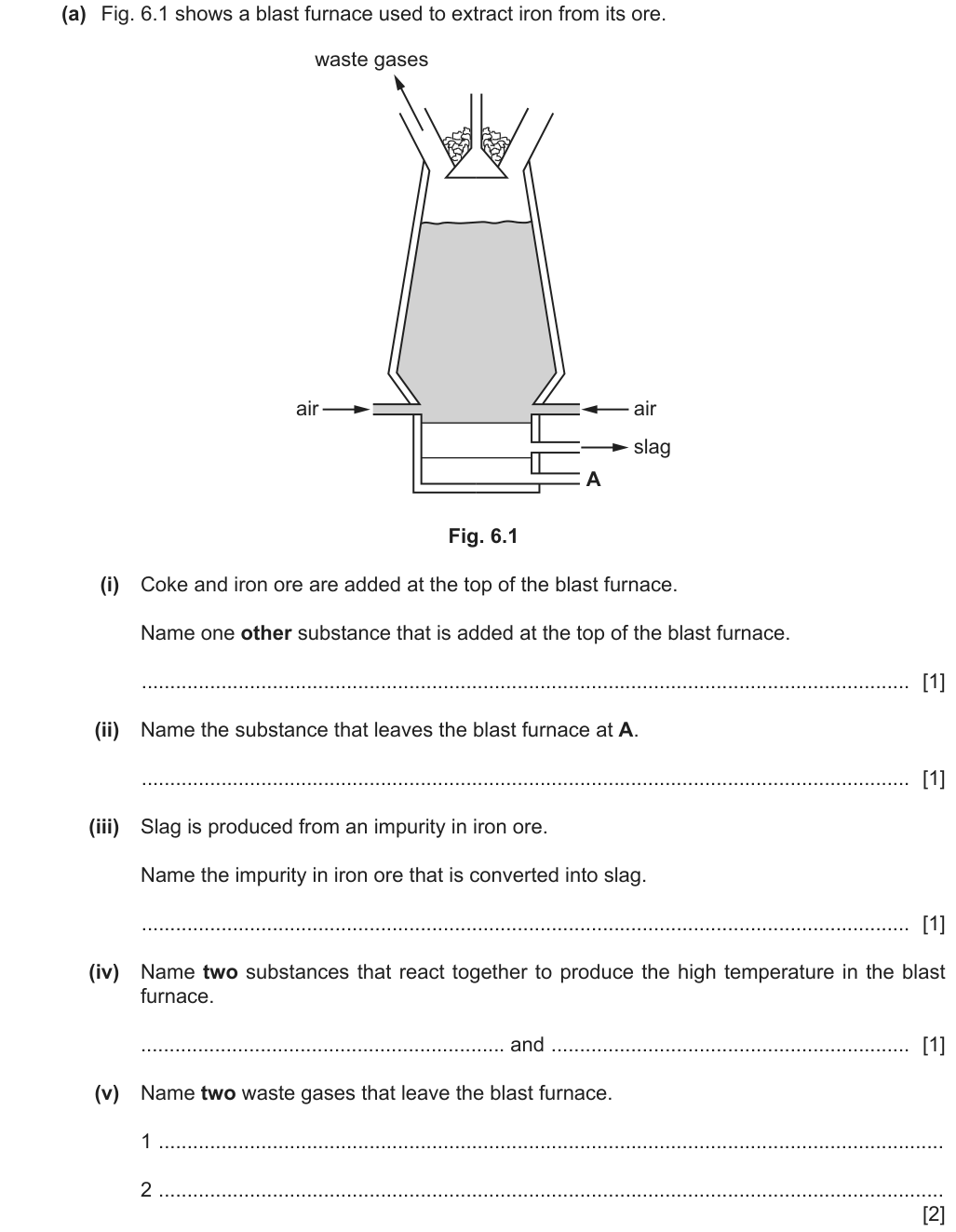
Iron is extracted from hematite (mainly iron(III) oxide, Fe2O3) in a blast furnace. The raw materials added at the top are iron ore (hematite), coke (carbon) and limestone (calcium carbonate); hot air is blown in near the bottom.
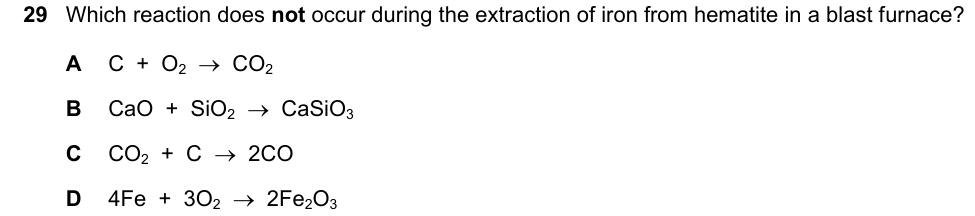
- Burning carbon (coke) provides heat and produces carbon dioxide: C + O2 → CO2.
- Carbon dioxide is reduced to carbon monoxide by more coke: C + CO2 → 2CO.
- Iron(III) oxide is reduced by carbon monoxide: Fe2O3 + 3CO → 2Fe + 3CO2. Carbon monoxide is the reducing agent. Molten iron runs to the bottom.
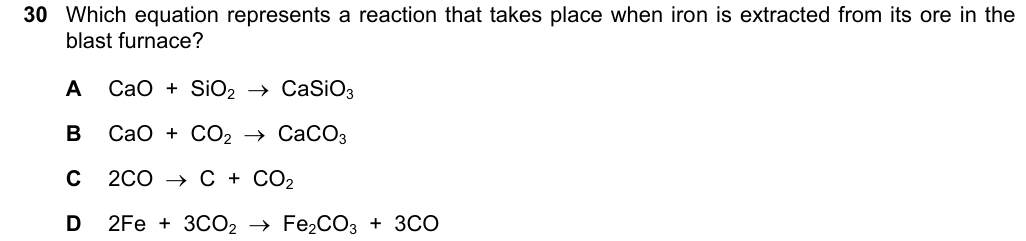
- Limestone is thermally decomposed: CaCO3 → CaO + CO2.
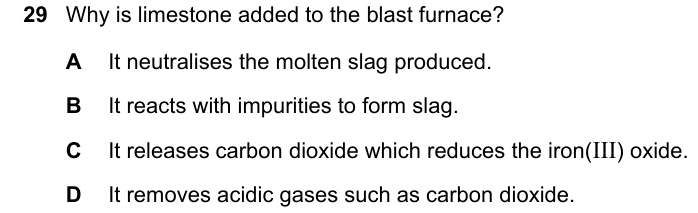
- Slag forms: calcium oxide (basic) reacts with the main impurity, silicon(IV) oxide (acidic, sand): CaO + SiO2 → CaSiO3. Molten calcium silicate (slag) floats on the iron and is removed.
Core candidates describe these steps in words; the symbol equations are Supplement (9.6.4).
“Limestone decomposes” needs the word thermal; the role of limestone is to remove the silicon(IV) oxide impurity as slag — not to act as a catalyst, heat the furnace or lower the temperature (the role of cryolite in aluminium extraction). The substance blown in is air, not oxygen. The heat comes from the burning (combustion) of coke, not “hot air”. The reducing agent is carbon monoxide.
11Extracting aluminium by electrolysis 9.6.3, 9.6.5 CoreSupplement
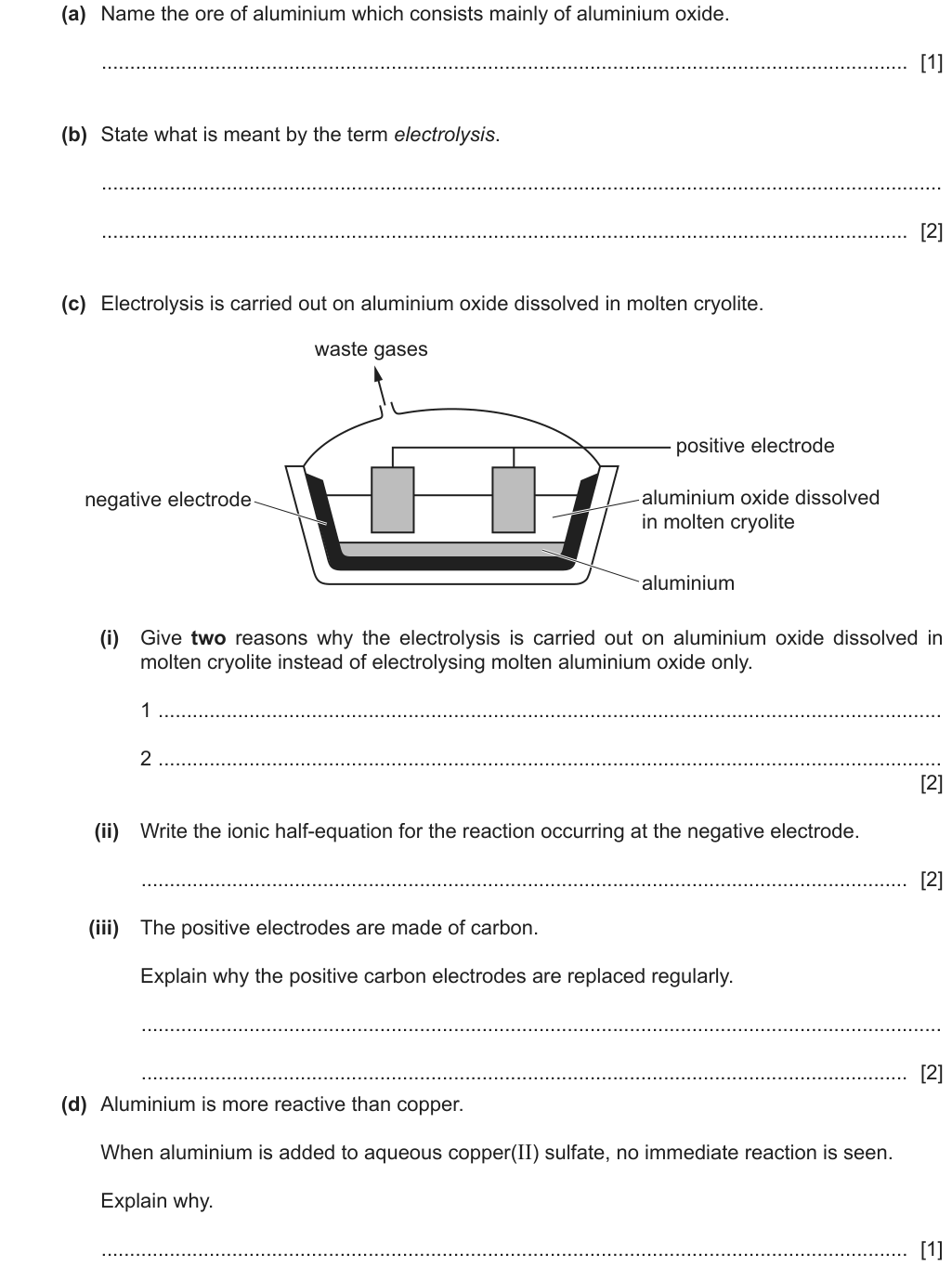
The main ore of aluminium is bauxite, which is purified to aluminium oxide. Aluminium is above carbon in the reactivity series, so it is extracted by electrolysis.
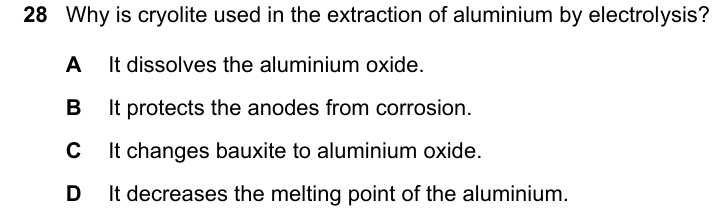
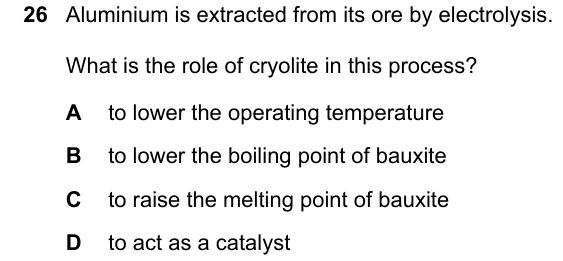
Supplement The purified aluminium oxide is dissolved in molten cryolite. Aluminium oxide has a very high melting point; dissolving it in cryolite gives an electrolyte that is liquid at a much lower operating temperature (saving energy) and is a better conductor than molten aluminium oxide alone. Both electrodes are graphite (carbon); the steel case lined with carbon is the cathode.
| Electrode | Ions attracted | Half-equation | Product |
|---|---|---|---|
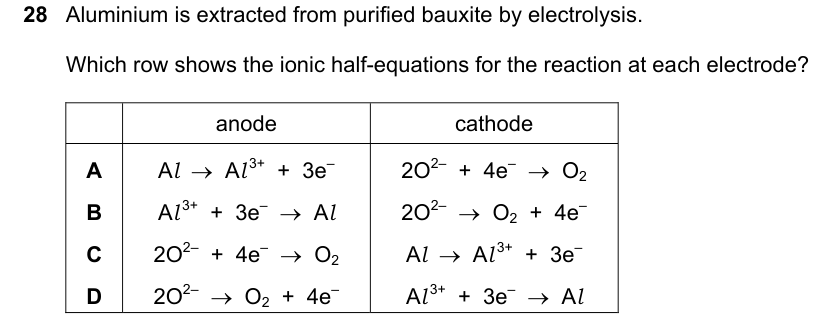
| cathode (−) | Al3+ | Al3+ + 3e− → Al (reduction) | molten aluminium, collected at the bottom |
| anode (+) | O2− | 2O2− → O2 + 4e− (oxidation) | oxygen |
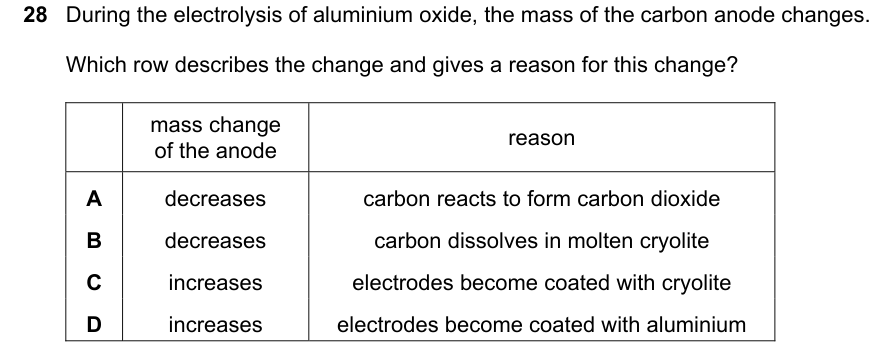
At the high temperature the oxygen produced reacts with the carbon anodes: C + O2 → CO2. The anodes burn away and must be regularly replaced.
Cryolite lowers the operating temperature by acting as a solvent for aluminium oxide — it does not lower the melting point of aluminium, it is not a catalyst, and it does not convert bauxite to aluminium oxide. Anodes are replaced because the carbon reacts with oxygen to form carbon dioxide, not because they “corrode” or “dissolve”. Positive aluminium ions go to the cathode.
Attempt these before opening the solutions. Each reference gives the component, session and question number of the original examination; the answers follow the published mark scheme.
Solutions and mark-scheme guidance · set F
F1 Answer D
Iron is not oxidised to Fe2O3 in the furnace — that is the opposite of extraction. The other three reactions all occur. The weakest candidates tended to choose C.
F2 Answer A
CaO + SiO2 → CaSiO3 forms slag. D, a common answer, is a reaction of iron, not its extraction; carbonates decompose rather than form in the furnace.
F3 Answer B
Limestone (via CaO) reacts with impurities to form slag.
F4 Answer A
Cryolite dissolves the aluminium oxide, at a lower temperature than aluminium oxide's melting point. D confuses this with lowering the melting point of aluminium.
F5 Answer A
Cryolite is used to lower the operating temperature. B and D were the most common wrong answers.
F6 Answer D
Anode: 2O2− → O2 + 4e−; cathode: Al3+ + 3e− → Al. The most strongly discriminating question on the paper; most wrong answers swapped anode and cathode.
F7 Answer A
The anode mass decreases because carbon reacts (with oxygen) to form carbon dioxide.
F8 [6]
(i) hematite ✓. (ii) air ✓. (iii) carbon monoxide ✓. (iv) Limestone thermally decomposes (to calcium oxide and carbon dioxide) ✓; calcium oxide reacts with silicon(IV) oxide ✓; forming slag ✓.
Examiner feedback: bauxite and limestone appeared as wrong answers; oxygen instead of air did not score. Many thought limestone is a catalyst, reduces the ore or lowers the temperature; few described the CaO + SiO2 reaction.
F9 [6]
(i) limestone ✓. (ii) molten iron ✓. (iii) silicon(IV) oxide ✓. (iv) coke (carbon) and oxygen ✓. (v) Two of nitrogen, carbon dioxide, argon ✓✓.
Examiner feedback: silicon oxide or silicon(II) oxide lost the mark; air was given instead of oxygen in (iv). Nitrogen was rarely given as a waste gas; toxic gases such as CO and SO2 were often wrongly suggested.
F10 [10]
(a) bauxite ✓. (b) Breakdown by electricity ✓ of an ionic compound in the molten or aqueous state ✓.
(c)(i) Improves the conductivity of the electrolyte ✓; lower operating temperature ✓. (ii) Al3+ + 3e− → Al ✓✓. (iii) The carbon anodes react with oxygen ✓ to form carbon dioxide ✓.
(d) An unreactive coating of aluminium oxide ✓.
Examiner feedback: cryolite was wrongly called a catalyst, or said to lower the melting point of aluminium. Electrons were placed on the wrong side of the half-equation. “The electrodes corrode” without the reaction did not score. In (d) many contradicted the stem by discussing reactivity.
Review · Topic 9
12Misconceptions and the examiner’s view
- “Metals conduct because the ions move.” Delocalised electrons carry the charge; ions only vibrate.
- “Alloys are strong because of strong intermolecular forces.” Different-sized atoms stop the layers sliding.
- “Aluminium is unreactive.” It is reactive but protected by an unreactive oxide layer.
- “The metal whose oxide is reduced by carbon is the most reactive.” Only the less reactive metals are extracted with carbon.
- “Zinc rusts instead of iron.” Only iron rusts; zinc is oxidised (loses electrons) in preference.
- “Galvanising stops working when scratched.” That is tin-plating; zinc protects sacrificially.
- “Cryolite lowers the melting point of aluminium / is a catalyst.” It dissolves aluminium oxide, lowering the operating temperature and improving conductivity.
Knowledge of the reactivity series is generally sound, but candidates often do not apply it: silver is expected to react with acid, calcium with water and magnesium with steam are forgotten, and the metal whose oxide is reduced by carbon is mistaken for the most reactive. Explanations of metallic properties and alloy strength are weakened by references to molecules, intermolecular forces or moving ions. Ionic equations for displacement are rarely correct — spectator ions are retained and the product ion is put on the wrong side. The oxide layer on aluminium is described without saying it is unreactive. In corrosion, barrier methods are well known but sacrificial protection is not: answers state that zinc “rusts” or “reacts”, or that the more reactive metal gains electrons or is reduced, instead of saying it loses electrons in preference to iron. In extraction, the role of limestone is poorly understood and often confused with the role of cryolite; air, not oxygen, is blown into the blast furnace; the anode and cathode reactions in aluminium extraction are frequently interchanged. Planning answers for rusting should measure the increase in mass over a suitable time, filtering and drying the solid. Strong answers link every observation to the position of the metal in the reactivity series and describe electron transfer explicitly.
13Summary and knowledge organiser
Essential knowledge
- Metals: conduct heat and electricity, malleable, ductile, high melting points; react with acids (H2), water/steam and oxygen.
- Uses: Al aircraft (low density), cables (low density + conductivity), food containers (corrosion resistance); Cu wiring (conductivity + ductility).
- Alloy = mixture of a metal with other elements; brass Cu + Zn; stainless steel Fe + Cr, Ni, C. Different-sized atoms stop layers sliding.
- Series: K, Na, Ca, Mg, Al, (C), Zn, Fe, (H), Cu, Ag, Au.
- Rust = hydrated iron(III) oxide; needs water and oxygen. Barriers exclude them; zinc/magnesium protect sacrificially.
- Blast furnace: C + O2 → CO2; C + CO2 → 2CO; Fe2O3 + 3CO → 2Fe + 3CO2; CaCO3 → CaO + CO2; CaO + SiO2 → CaSiO3.
- Aluminium: bauxite → Al2O3 in molten cryolite; cathode Al3+ + 3e− → Al; anode 2O2− → O2 + 4e−; anodes burn to CO2.
Examination checklist
- Give the property that explains the use.
- Alloy strength: “different-sized atoms”, “layers cannot slide”.
- Displacement ionic equation: metal + ion → ion + metal; no spectators.
- Sacrificial protection: more reactive + loses electrons in preference to iron.
- Limestone: thermal decomposition, CaO + SiO2 → slag.
- Cryolite: solvent, lower operating temperature, better conductivity.
Knowledge organiser · metals
| Idea | What to know | Must-remember distinctions and common errors |
|---|---|---|
| Properties 9.1.1–2 | Physical properties; acids, water/steam, oxygen. | Electrons conduct; ions slide. |
| Uses 9.2.1 | Al: aircraft, cables, containers. Cu: wiring. | Low density, conductivity, ductility, corrosion resistance. |
| Alloys 9.3.1–5 | Brass, stainless steel; harder and stronger. | Mixture, not compound; different-sized atoms. |
| Reactivity series 9.4.1–3 | Order; reactions with water, steam, acid; deducing order. | Below H: no reaction with acid. |
| Displacement, Al 9.4.4–5 | More reactive metal displaces less reactive ion. | Unreactive oxide layer on Al. |
| Rusting 9.5.1–3 | Water + oxygen → hydrated iron(III) oxide; barriers. | Mass increases. |
| Sacrificial protection 9.5.4–5 | Zn (galvanising), Mg blocks. | Loses electrons instead of iron. |
| Extraction 9.6.1–5 | Carbon for Zn, Fe; electrolysis for Al; blast furnace; cryolite. | Air blown in; CO reduces; anodes burn away. |