
Topic 8 has five sub-topics: 8.1 Arrangement of elements, 8.2 Group I properties, 8.3 Group VII properties, 8.4 Transition elements and 8.5 Noble gases. Almost everything is Core. Supplement statements add identifying trends from given information (8.1.6) and the variable oxidation numbers of transition elements, including iron(II) and iron(III) (8.4.2).
Central idea: the Periodic Table is arranged so that elements with the same number of outer-shell electrons fall in the same column. Because chemistry is decided by outer electrons, a group behaves as a family, and an element's position lets you predict its properties.
Before you start
- Proton number, electronic configuration of the first 20 elements, and the link between outer electrons and ions (Topic 2).
- Ionic and covalent bonding, and the properties of metals (Topic 2).
- Oxidation and reduction in terms of electrons (Topic 6).
Learning objectives
- Describe the Periodic Table as periods and groups in order of proton number, and the change from metallic to non-metallic character across a period.
- Relate group number to ion charge and to the number of outer-shell electrons; explain similar chemical properties in a group.
- Describe the trends in Group I (lithium, sodium, potassium) and Group VII (chlorine, bromine, iodine), and predict the properties of other members.
- Describe and explain halogen displacement reactions.
- Describe the properties of transition elements; Supplement their variable oxidation numbers.
- Describe and explain the unreactivity of the noble gases.
Introduction: a table that predicted the future
Because the Periodic Table groups elements into families, the properties of an element can be predicted from those of its neighbours. This reasoning is tested in every IGCSE paper: you are given an element you have never studied — rubidium, astatine, tennessine — and asked to predict how it behaves. The skill is not memorising more facts; it is using the pattern.
8.1 · Arrangement of elements
1Periods, groups and ion charges 8.1.1–8.1.3 Core
The Periodic Table arranges the elements in order of increasing proton number (atomic number). The horizontal rows are periods; the vertical columns are groups. For the elements in Groups I–VIII:
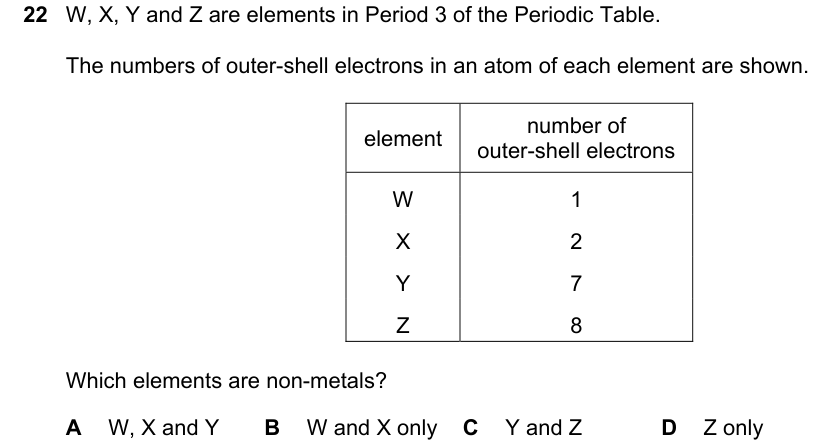
- the group number equals the number of outer-shell electrons (Group VIII has 8, except helium with 2);
- the period number equals the number of occupied electron shells.
Sodium, 2,8,1, has three shells and one outer electron: Period 3, Group I. Chlorine, 2,8,7, is Period 3, Group VII.
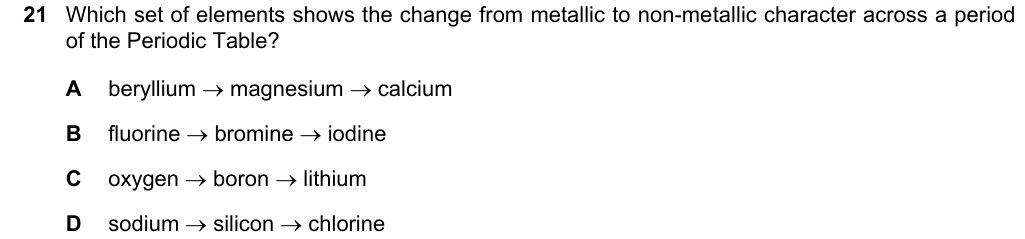
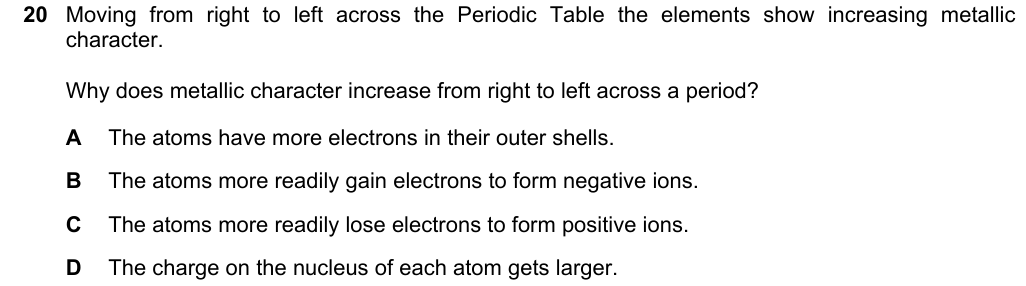
Across a period the elements change from metals on the left to non-metals on the right. In Period 3, sodium, magnesium and aluminium are metals, silicon is on the boundary, and phosphorus, sulfur, chlorine and argon are non-metals. The oxides change from basic, through amphoteric (aluminium oxide), to acidic (Topic 7). Metals on the left have few outer electrons that are readily lost to form positive ions; non-metals on the right gain electrons to form negative ions or share them.
| Group | I | II | III | IV | V | VI | VII | VIII |
|---|---|---|---|---|---|---|---|---|
| outer-shell electrons | 1 | 2 | 3 | 4 | 5 | 6 | 7 | 8 (full) |
| ion charge | +1 | +2 | +3 | usually none | −3 | −2 | −1 | none |
| examples | Na+ | Mg2+ | Al3+ | C, Si share electrons | N3− | O2− | Cl− | Ne, Ar |
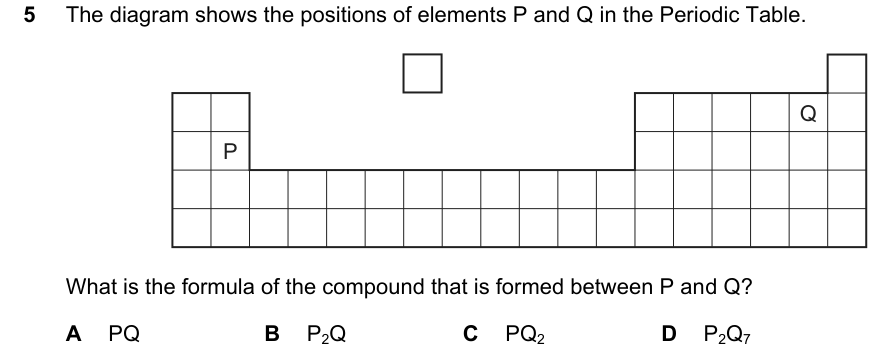
P is in Group II and Q in Group VII.
| Ions | P2+, Q− |
| Balance charge | one P2+ needs two Q− |
| Formula | PQ2 — not P2Q7, which uses group numbers as subscripts |
2Why groups behave as families 8.1.4–8.1.6 CoreSupplement
Chemical reactions involve the outer-shell electrons. Elements in the same group have the same number of outer-shell electrons, so they react in similar ways and form compounds with similar formulae: lithium, sodium and potassium all react with water to form a hydroxide and hydrogen and all form chlorides MCl. Down a group, the properties change gradually (a trend), so an element's position can be used to predict its properties from those of its neighbours.
Supplement When a question gives data — melting points, densities, reaction times — for elements in a group, identify the trend by reading the values in group order, then extend it for the unknown element. Check the data: a general trend can include an exception (potassium, for example, is less dense than sodium).
“Same number of outer-shell electrons” scores; “the same electrons in the outer shell” without the word number does not. When deducing formulae from positions, weaker candidates use the group numbers as subscripts instead of working out the ion charges.
Attempt these before opening the solutions. Each reference gives the component, session and question number of the original examination; the answers follow the published mark scheme.
Solutions and mark-scheme guidance · set A
A1 Answer D
Across Period 3: sodium (metal), silicon (metalloid), chlorine (non-metal) — left to right in the same period. The other sets are groups, or run the wrong way.
A2 Answer C
Towards the left, atoms have fewer outer electrons and more readily lose electrons to form positive ions — the defining behaviour of metals.
A3 Answer C
1 and 2 outer electrons are metals (Groups I and II); 7 and 8 are non-metals (Groups VII and VIII): Y and Z. Many chose B, selecting the metals.
A4 Answer C
P is in Group II → P2+; Q is in Group VII → Q−. Formula PQ2. The weakest candidates chose D, using group numbers as subscripts.
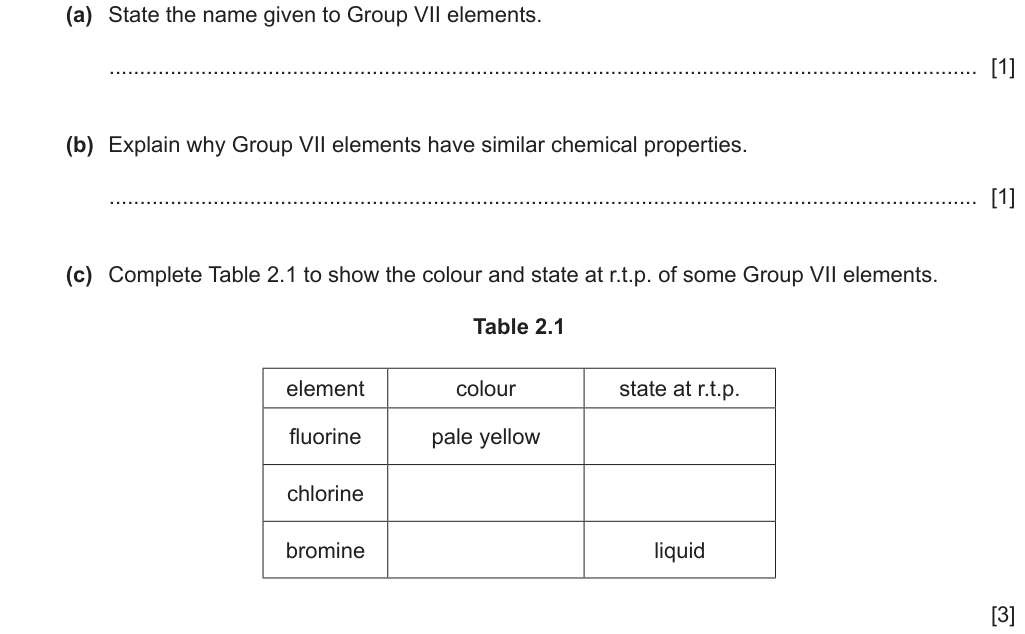
A5 [5]
(a) halogens ✓. (b) The same number of outer-shell electrons ✓. (c) Fluorine: gas; chlorine: pale yellow-green, gas ✓; bromine: red-brown ✓; both gases ✓.
Examiner feedback: “halide” was the commonest error in (a); in (b) many omitted the word “number”. Bromine was often described as orange — the colour of bromine water, not the element.
8.2 · Group I properties
3The Group I alkali metals 8.2.1–8.2.2 Core
Lithium, sodium and potassium are alkali metals. They are relatively soft metals — they can be cut with a knife to show a shiny surface that quickly tarnishes in air — with low densities and low melting points compared with most metals. They are stored under oil to keep out air and water.
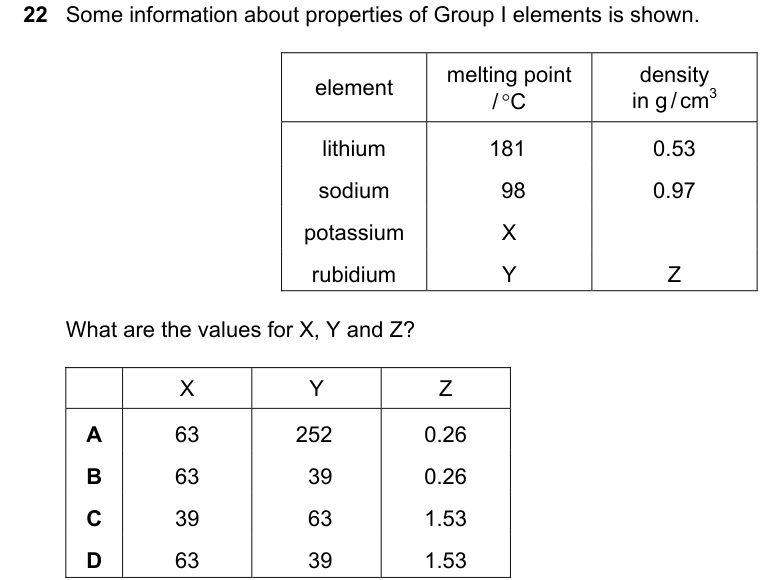
| Element | Electronic configuration | Melting point / °C | Density / g cm−3 | Reaction with cold water |
|---|---|---|---|---|
| lithium | 2,1 | 181 | 0.53 | floats, fizzes steadily, moves slowly, gradually disappears |
| sodium | 2,8,1 | 98 | 0.97 | floats, melts into a ball, fizzes rapidly, moves quickly on the surface |
| potassium | 2,8,8,1 | 63 | 0.86 | as sodium but more violent; the hydrogen ignites with a lilac flame |
| Trend down the group | one outer electron in each | decreases | increases in general (potassium is an exception) | reactivity increases |
Every Group I metal reacts with water to form an alkaline solution of the metal hydroxide and hydrogen:
2Na(s) + 2H2O(l) → 2NaOH(aq) + H2(g) 2Li(s) + 2H2O(l) → 2LiOH(aq) + H2(g)
The solution turns universal indicator blue or purple. Each metal loses its single outer electron to form a +1 ion. Down the group the outer electron is further from the nucleus, so it is lost more easily and the metal is more reactive — the same number of outer electrons explains the similar reactions, and the increasing size explains the trend.
Predicting. Rubidium and caesium lie below potassium: they are predicted to have lower melting points, higher densities and to react even more violently with water, forming RbOH or CsOH and hydrogen.
Observations must be things you can see — “fizzing”, “the solid floats and moves”, “the solid disappears” — not “hydrogen is produced” or “a gas is given off”. Two wordings of the same observation (fizzing and bubbling) score once. The product with water is the hydroxide, not the oxide. The trend in density in Group I is much less securely known than the trend in reactivity, and melting points are often thought to increase down the group.
Attempt these before opening the solutions. Each reference gives the component, session and question number of the original examination; the answers follow the published mark scheme.
Solutions and mark-scheme guidance · set B
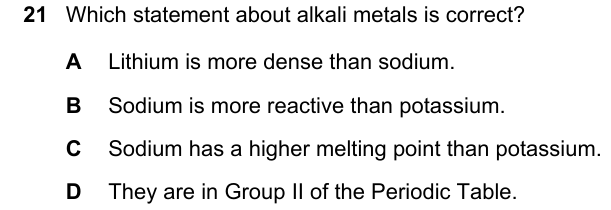
B1 Answer C
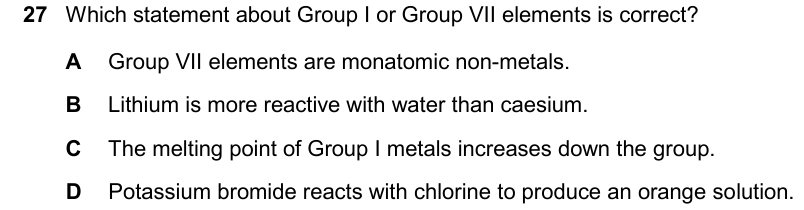
Melting point decreases down Group I, so sodium has a higher melting point than potassium. Lithium is less dense than sodium, potassium is more reactive than sodium, and the alkali metals are Group I.
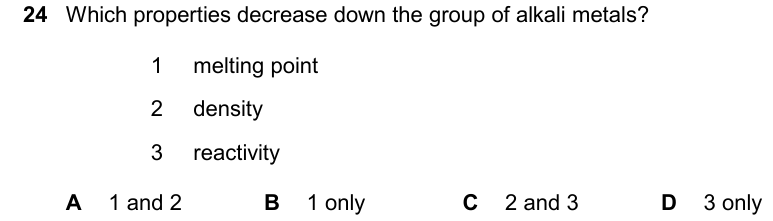
B2 Answer B
Only melting point decreases down Group I; density (generally) and reactivity increase. Many chose A or C.
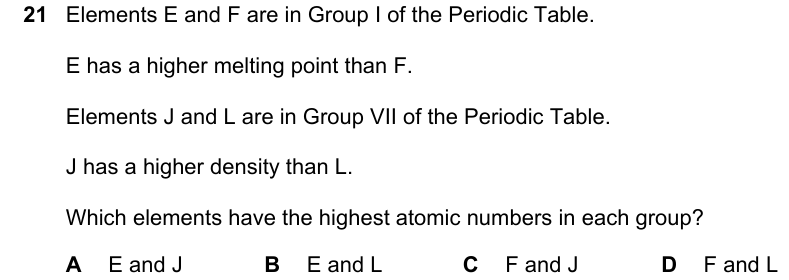
B3 Answer C
Lower melting point → further down Group I: F. Higher density → further down Group VII: J. Most chose A, recalling the Group VII density trend but not the Group I melting-point trend.
B4 Answer D
Melting points continue to fall (potassium 63, rubidium 39 °C); density rises to 1.53 g/cm3 for rubidium.
B5 Answer D
Chlorine displaces bromine from potassium bromide, giving an orange solution. Group VII elements are diatomic; caesium is more reactive than lithium; Group I melting points decrease — option C, the commonest error.
B6 [8]
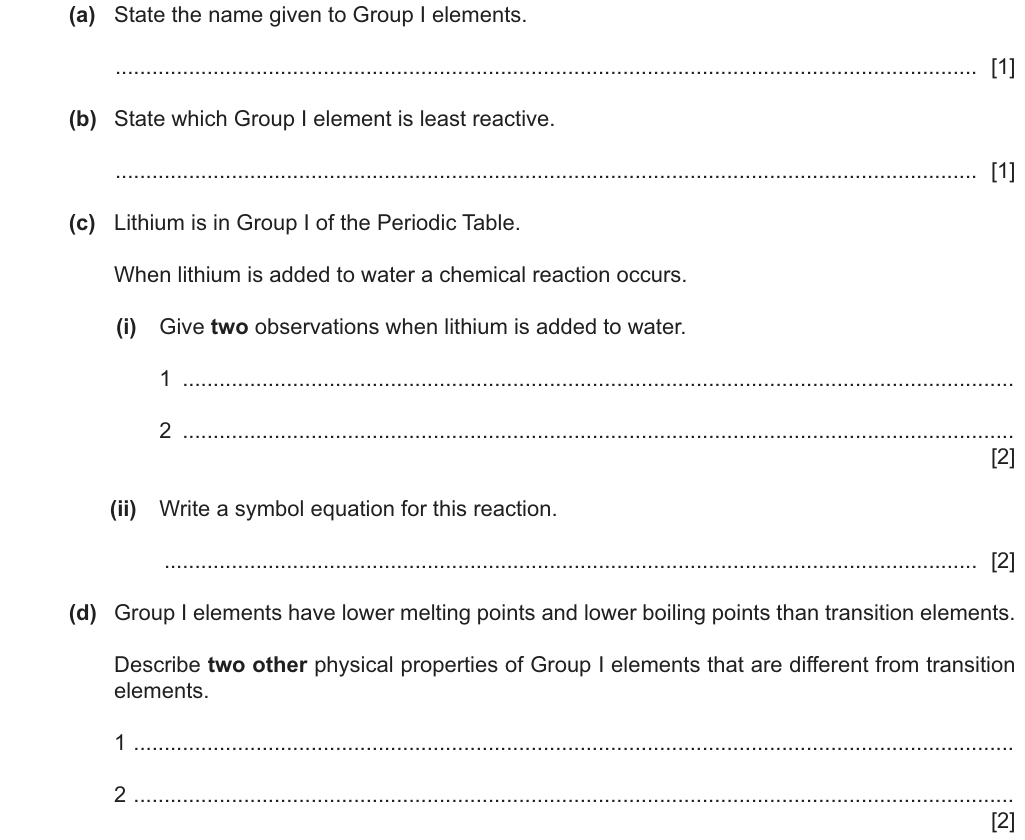
(a) alkali metals ✓. (b) lithium ✓.
(c)(i) Any two: fizzing; the solid floats; it moves on the surface; it disappears ✓✓. (ii) 2Li + 2H2O → 2LiOH + H2: LiOH ✓; balanced ✓.
(d) Group I metals are softer ✓ and have lower density ✓.
Examiner feedback: francium was a common wrong answer in (b). “A gas is produced” is not an observation. Lithium oxide was a very common wrong product. In (d) melting points (given in the question), chemical properties or properties shared by all metals did not score.
8.3 · Group VII properties
4The Group VII halogens 8.3.1–8.3.2, 8.3.4 Core
The halogens are non-metals that exist as diatomic molecules: F2, Cl2, Br2, I2. Each atom has seven outer-shell electrons and gains one to form a halide ion with a 1− charge (Cl−, Br−, I−).
| Halogen | Appearance at r.t.p. | Colour in aqueous solution |
|---|---|---|
| chlorine, Cl2 | pale yellow-green gas | very pale green (almost colourless) |
| bromine, Br2 | red-brown liquid | orange |
| iodine, I2 | grey-black solid | brown |
| Trend down the group | state gas → liquid → solid; colour darker; density increases | reactivity decreases |
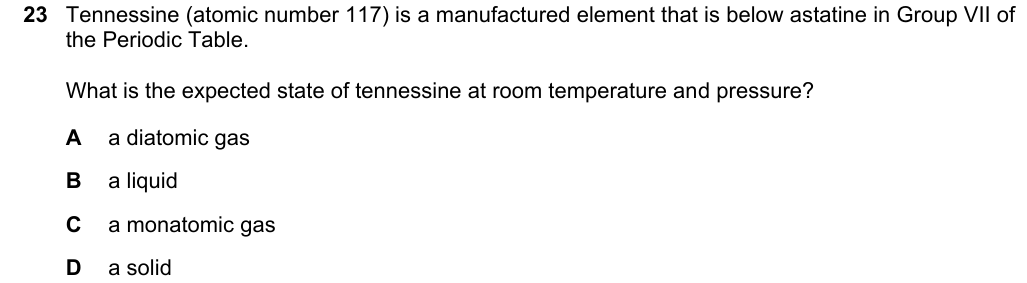
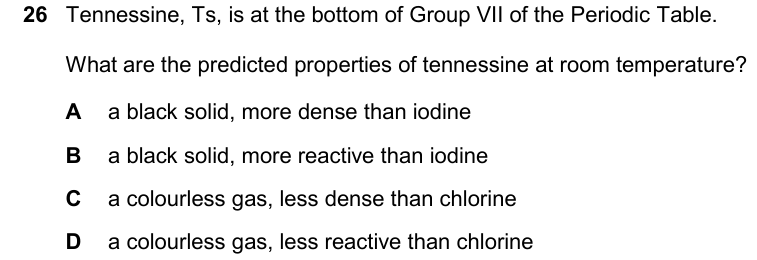
The melting and boiling points increase down the group because the molecules become larger and the forces between them stronger. Reactivity decreases because the atoms become larger, so an incoming electron is attracted less strongly by the nucleus. Fluorine, above chlorine, is the most reactive halogen and is predicted to be a gas paler than chlorine. Astatine and tennessine, at the bottom, are predicted to be dark, dense solids — still diatomic — and less reactive than iodine.
5Displacement reactions of the halogens 8.3.3 Core
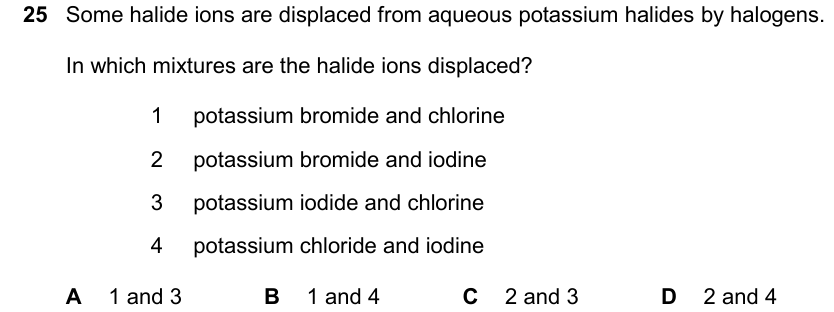
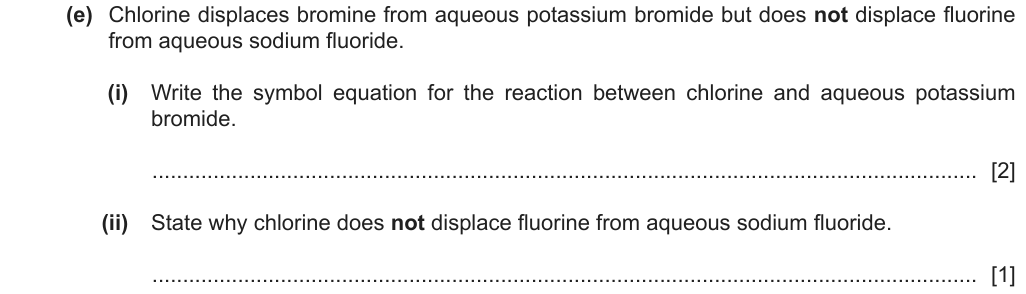
A more reactive halogen displaces a less reactive halogen from an aqueous solution of its halide. Chlorine added to colourless aqueous potassium bromide produces an orange solution of bromine:
Cl2(aq) + 2KBr(aq) → 2KCl(aq) + Br2(aq)
Cl2(aq) + 2Br−(aq) → 2Cl−(aq) + Br2(aq)
Chlorine or bromine added to colourless aqueous potassium iodide produces a brown solution of iodine. Iodine cannot displace chlorine or bromine, and bromine cannot displace chlorine.
| KCl(aq) | KBr(aq) | KI(aq) | |
|---|---|---|---|
| chlorine | — | ✓ orange (Br2) | ✓ brown (I2) |
| bromine | ✗ | — | ✓ brown (I2) |
| iodine | ✗ | ✗ | — |
These are redox reactions. In the ionic equation the halogen molecule gains electrons (Cl2 + 2e− → 2Cl−, reduction) and the halide ion loses them (2Br− → Br2 + 2e−, oxidation). The more reactive halogen is the oxidising agent. The potassium ions are spectators.
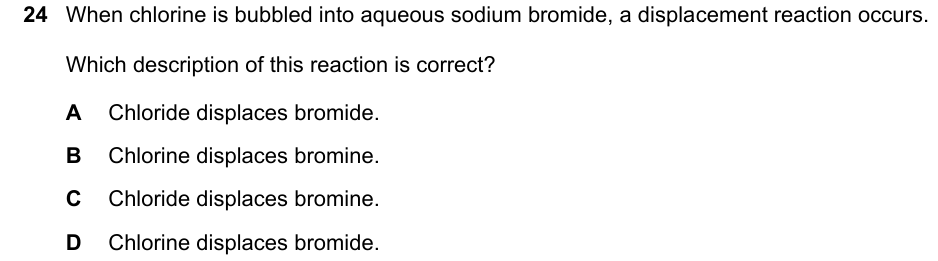
Say “chlorine displaces bromine” — the element displaces the element from its compound. “Chloride displaces bromide” describes ions, which do not react with each other. In an ionic equation, write the halogens as molecules (Br2, not Br) and the halides as ions (I−); K+ does not appear.
Attempt these before opening the solutions. Each reference gives the component, session and question number of the original examination; the answers follow the published mark scheme.
Solutions and mark-scheme guidance · set C
C1 Answer B
Chlorine displaces bromine: the more reactive element takes the place of the less reactive one in the compound, releasing bromine. Only a third of candidates answered correctly.
C2 Answer A
Chlorine displaces bromide (1) and iodide (3) ions. Iodine is the least reactive and displaces neither. The most reactive element ends up as ions.
C3 Answer D
Following the trend gas → liquid → solid, tennessine is predicted to be a solid. Weaker candidates chose “a diatomic gas”: it would be diatomic, but not a gas.
C4 Answer A
Down Group VII the elements get darker and denser: a black solid, more dense than iodine, and less reactive.
C5 [9]
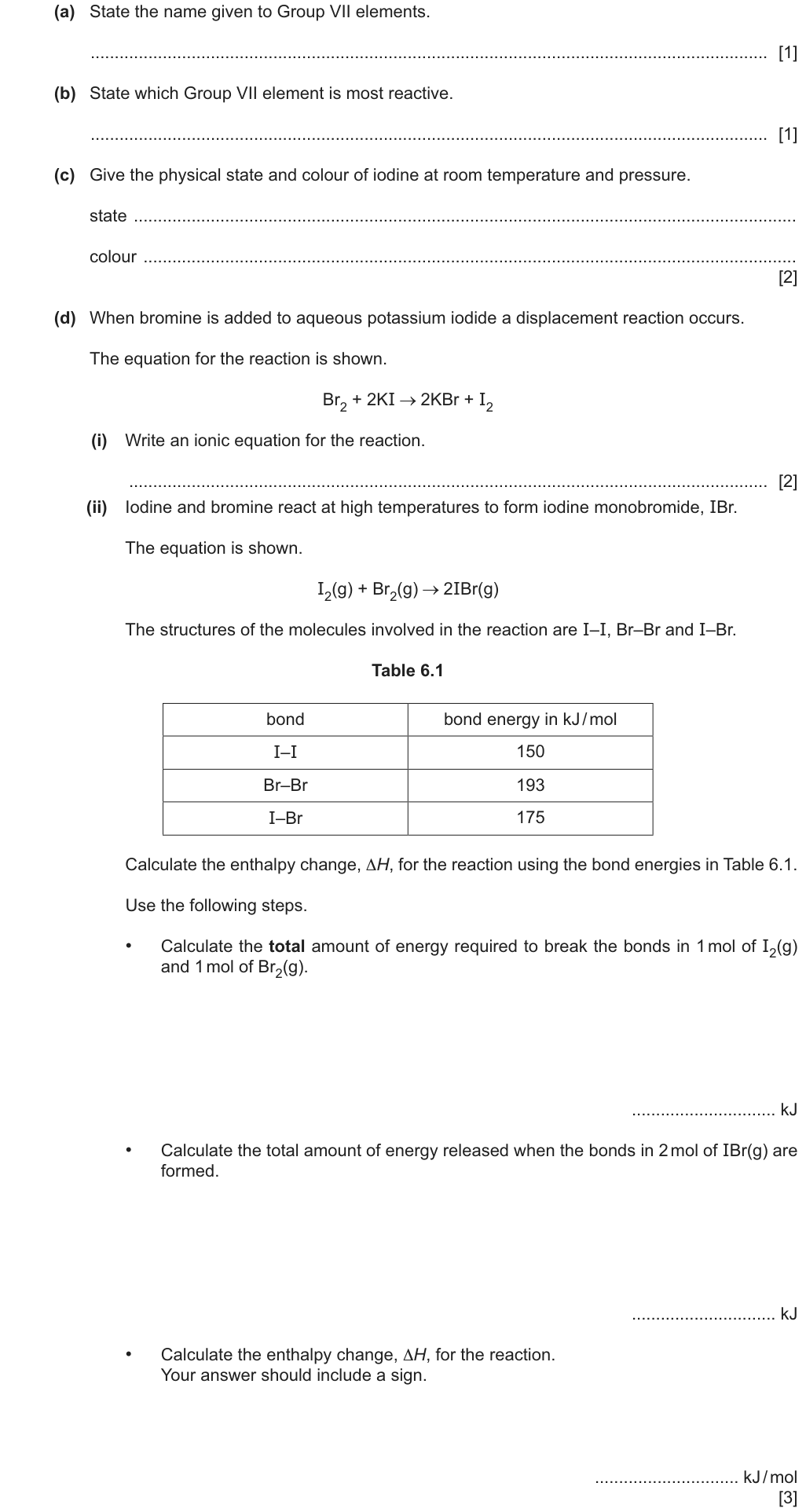
(a) halogens ✓. (b) fluorine ✓. (c) solid ✓, grey-black ✓.
(d)(i) Br2 + 2I− → 2Br− + I2: I− reactant and Br− product ✓; fully correct ✓.
(ii) Break: 150 + 193 = 343 kJ ✓. Make: 2 × 175 = 350 kJ ✓. ΔH = 343 − 350 = −7 kJ/mol ✓.
Examiner feedback: many gave the colour of iodine solution or vapour rather than the solid. The ionic equation was found extremely challenging: many wrote a precipitation equation, half-equations or the given equation again. Some ΔH values lacked a sign.
C6 [3]
(i) Cl2 + 2KBr → 2KCl + Br2: KCl ✓; balanced ✓. (ii) Chlorine is less reactive than fluorine ✓.
Examiner feedback: Br was often written instead of Br2.
8.4 · Transition elements
6Transition elements 8.4.1–8.4.2 CoreSupplement
The transition elements are the block of metals in the middle of the Periodic Table, between Groups II and III: for example iron, copper, nickel, chromium, cobalt, manganese and vanadium. Compared with the Group I metals they:
- have high densities;
- have high melting points (and are harder and stronger);
- form coloured compounds — copper(II) sulfate is blue, iron(II) compounds are pale green, iron(III) compounds are orange-brown, potassium manganate(VII) is purple;
- often act as catalysts, both as elements and in compounds: iron in the Haber process, vanadium(V) oxide in the Contact process, manganese(IV) oxide in the decomposition of hydrogen peroxide.
Group I compounds, by contrast, are white (colourless in solution), and Group I metals are not used as catalysts.
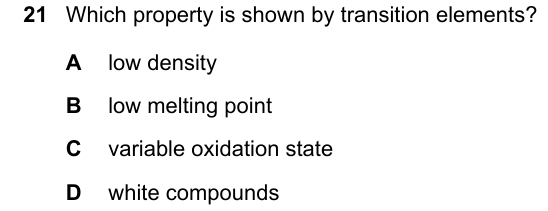
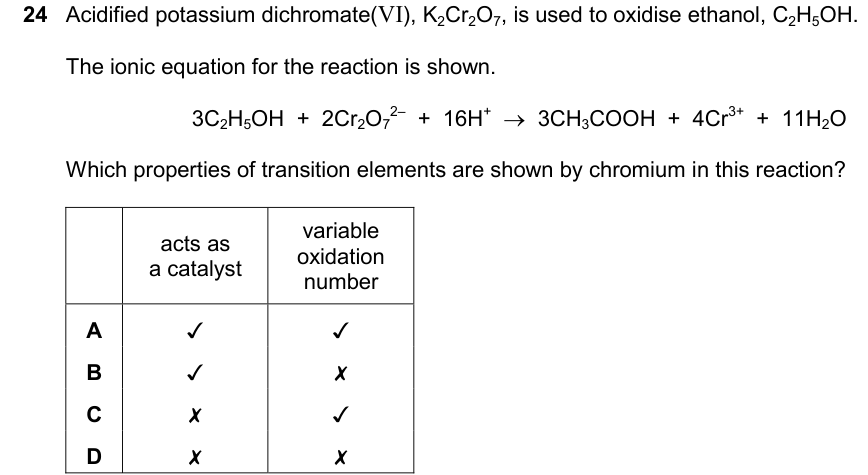
Supplement Transition elements form ions with variable oxidation numbers. Iron forms iron(II), Fe2+, and iron(III), Fe3+; copper forms copper(I) and copper(II); chromium forms Cr3+ and the chromium(VI) in dichromate. The Roman numeral in the name gives the oxidation number. Group I metals have a fixed oxidation number of +1.
| iron(II) | iron(III) | |
|---|---|---|
| ion, oxidation number | Fe2+, +2 | Fe3+, +3 |
| example compounds | FeO, FeCl2, FeSO4 | Fe2O3, FeCl3, Fe2(SO4)3 |
| with aqueous sodium hydroxide (Topic 12) | green precipitate | red-brown precipitate |
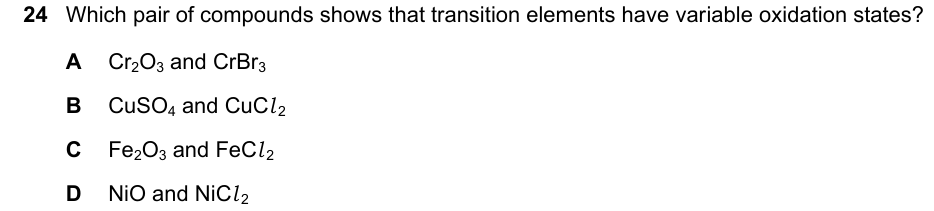
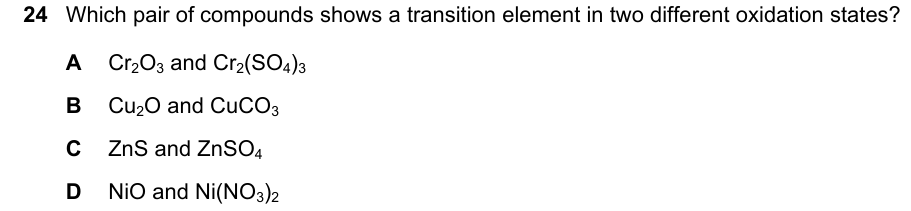
To show variable oxidation numbers, you need two compounds of the same element in which it has different oxidation numbers — Fe2O3 (+3) and FeCl2 (+2), or Cu2O (+1) and CuCO3 (+2). A change such as Cr2O72− → Cr3+ during a reaction shows variable oxidation number; it does not show catalysis, because a catalyst is unchanged at the end.
Attempt these before opening the solutions. Each reference gives the component, session and question number of the original examination; the answers follow the published mark scheme.
Solutions and mark-scheme guidance · set D
D1 Answer C
Transition elements show variable oxidation states; they have high density and melting point and coloured compounds. B (low melting point) describes Group I and was a common wrong answer.
D2 Answer C
Fe2O3 contains iron(III) and FeCl2 iron(II): the same element in two oxidation states. In each other pair the metal has the same oxidation number.
D3 Answer B
Cu2O: copper +1; CuCO3: copper +2. In each other pair the metal has the same oxidation number in both compounds.
D4 Answer C
Chromium changes from +6 in Cr2O72− to +3 in Cr3+: variable oxidation number, but not catalysis, because the chromium species is changed. Over a third chose A.
D5 [9]
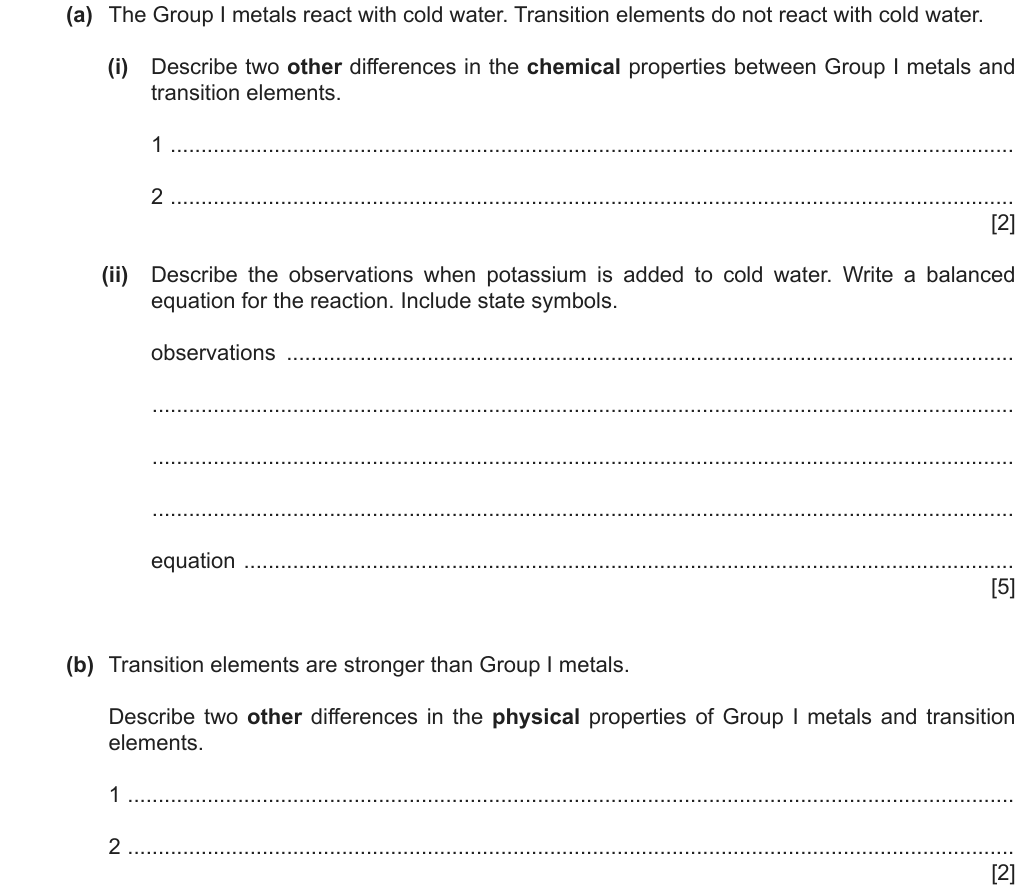
(a)(i) Two of: Group I metals do not act as catalysts; Group I metals have fixed oxidation states (transition elements variable) ✓✓.
(ii) Two observations from: floats/moves; fizzes; dissolves/disappears; lilac flame; melts into a ball ✓✓. 2K(s) + 2H2O(l) → 2KOH(aq) + H2(g): KOH or H2 ✓; balanced ✓; state symbols ✓.
(b) Transition elements have higher melting points ✓ and higher densities ✓.
Examiner feedback: some did not distinguish physical and chemical properties, and “it” or “they” must not replace the name of the group being described. Potassium oxide was a common wrong product; water was often given as (aq). General metal properties such as malleability were not comparisons.
8.5 · Noble gases
7The noble gases 8.5.1 Core
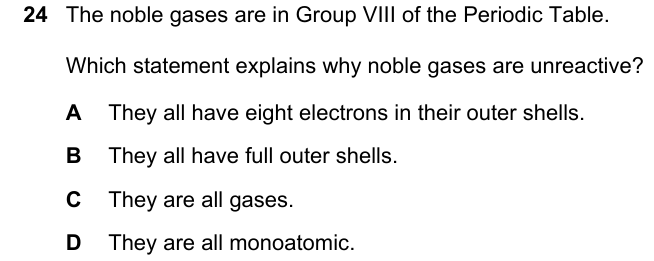
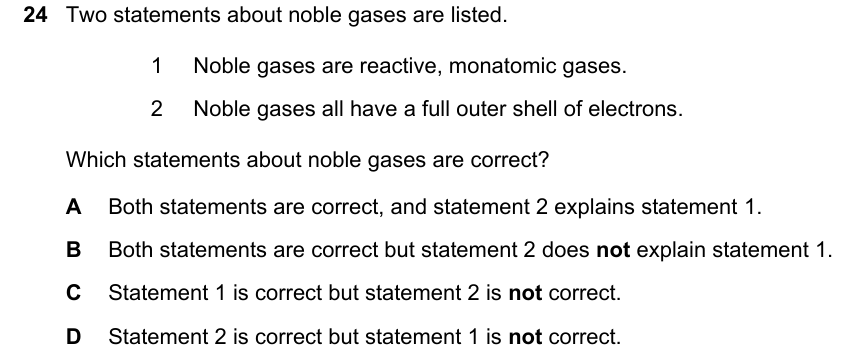
The Group VIII elements — helium, neon, argon, krypton, xenon, radon — are unreactive, monatomic gases. Their atoms have a full outer shell: 2 electrons for helium, 8 for the others (He 2; Ne 2,8; Ar 2,8,8). A full outer shell is a stable arrangement, so the atoms have no tendency to lose, gain or share electrons: they do not form bonds, even with each other, and so exist as single atoms. Other elements form ions or share electrons precisely to reach a noble-gas configuration.
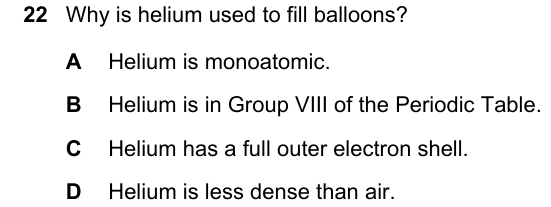
Their unreactivity makes them useful: argon fills light bulbs and provides an inert atmosphere for welding; helium, which is also much less dense than air, fills balloons.
“Noble gases have eight outer electrons” is not true for helium. The reason for unreactivity is a full outer shell. And the reason helium is used in balloons is that it is less dense than air (and unreactive) — having a full outer shell does not make a balloon rise.
Attempt these before opening the solutions. Each reference gives the component, session and question number of the original examination; the answers follow the published mark scheme.
Solutions and mark-scheme guidance · set E
E1 Answer B
The noble gases are unreactive because they all have full outer shells; helium has only two electrons, so A is not true for all of them.
E2 Answer D
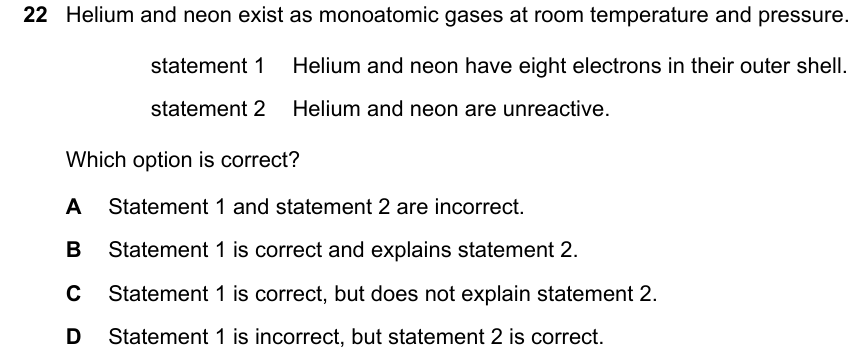
Statement 1 is incorrect — helium has 2 outer electrons — but statement 2 is correct. Most chose B, assuming helium has eight.
E3 Answer D
Noble gases are unreactive, so statement 1 is wrong; statement 2 (full outer shells) is correct.
E4 Answer D
A balloon rises because helium is less dense than air. Some chose C, a true statement that does not answer the question.
Review · Topic 8
8Misconceptions and the examiner’s view
- “Melting point increases down Group I.” It decreases; reactivity increases.
- “Group I metals form oxides with water.” They form hydroxides and hydrogen.
- “Bromine is orange.” The element is a red-brown liquid; orange is bromine water.
- “Chloride displaces bromide.” The halogen element displaces the other halogen element.
- “Astatine is a gas because it is a halogen.” Follow the trend: it is a dark solid, still diatomic.
- “A reaction in which a transition-metal ion changes shows catalysis.” It shows variable oxidation number; catalysts are unchanged.
- “All noble gases have eight outer electrons.” Helium has two; the key idea is a full outer shell.
Candidates recall the trend in reactivity in Group I and the trend in density in Group VII well, but the trends in melting point and density in Group I are much less secure, and it is common to see melting points said to increase down Group I. Explanations of similar chemical properties lose the mark when “number of” outer-shell electrons is omitted. Formulae deduced from positions in the table often use the group numbers directly as subscripts. The appearance of the halogens must be given at room temperature — iodine as a grey-black solid, bromine as a red-brown liquid — not as the colour of their solutions or vapour. Descriptions of displacement confuse halogens with halide ions, ionic equations for displacement are rarely correct (halogens written as atoms, precipitation equations invented, spectator ions retained), and observations of Group I metals with water are replaced by statements of products. In comparing Group I metals with transition elements, answers must compare the two named groups and separate physical from chemical properties. The unreactivity of noble gases is best explained by a full outer shell — not “eight electrons”, which fails for helium. Strong answers use the pattern: they state the trend, place the element in it and justify the prediction.
9Summary and knowledge organiser
Essential knowledge
- Order: increasing proton number. Group = outer electrons; period = shells. Metals → non-metals across a period.
- Group I: soft; down the group melting point ↓, density ↑ (generally), reactivity ↑; with water → MOH + H2.
- Group VII: diatomic non-metals; Cl2 pale yellow-green gas, Br2 red-brown liquid, I2 grey-black solid; density ↑, reactivity ↓ down the group.
- More reactive halogen displaces less reactive halogen from its halide.
- Transition elements: high density and melting point, coloured compounds, catalysts, variable oxidation numbers (Fe2+, Fe3+).
- Noble gases: unreactive, monatomic, full outer shell.
Examination checklist
- “Same number of outer-shell electrons.”
- Ion charges from group number, then balance charges for formulae.
- Observations are what you see: fizzing, floats, moves, disappears, colour changes.
- Ionic equation for displacement: X2 + 2Y− → 2X− + Y2.
- Predictions: state the trend and extend it.
Knowledge organiser · the Periodic Table
| Idea | What to know | Must-remember distinctions and common errors |
|---|---|---|
| Arrangement 8.1.1–3 | Periods, groups, proton number; ion charges from group. | PQ2, not P2Q7. |
| Families and predictions 8.1.4–6 | Same number of outer electrons → similar properties; trends. | Read supplied data in group order; spot exceptions. |
| Group I 8.2.1–2 | Li, Na, K: soft; mp ↓, density ↑, reactivity ↑. | Hydroxide + hydrogen, not oxide. |
| Group VII 8.3.1–2, 8.3.4 | Diatomic; colours and states; density ↑, reactivity ↓. | Br2 red-brown liquid; I2 grey-black solid. |
| Displacement 8.3.3 | Cl2 displaces Br2 and I2; Br2 displaces I2. | Element displaces element; orange (Br2), brown (I2). |
| Transition elements 8.4.1–2 | Dense, high mp, coloured, catalysts; Fe(II)/Fe(III). | Changing ion ≠ catalyst. |
| Noble gases 8.5.1 | Unreactive, monatomic; full outer shell. | He has 2 outer electrons. |