
Topic 6 has four sub-topics: 6.1 Physical and chemical changes, 6.2 Rate of reaction, 6.3 Reversible reactions and equilibrium and 6.4 Redox. Core statements cover identifying chemical changes, the factors that change the rate, measuring rates, hydrated salts and redox in terms of oxygen. Supplement statements add collision theory, dynamic equilibrium and Le Chatelier-style predictions, the Haber and Contact processes, and redox in terms of electrons and oxidation numbers.
Central idea: a reaction happens only when particles collide with enough energy. How often they collide, and how many collisions succeed, decides the rate; whether the products can turn back into reactants decides where a reaction settles; and following the electrons explains oxidation and reduction.
Before you start
- Particles in liquids and gases move randomly; raising the temperature increases their kinetic energy (Topic 1).
- Balanced symbol equations, moles and molar gas volume (Topic 3).
- Ions form by losing or gaining electrons; the charge on common ions (Topic 2).
- Exothermic and endothermic reactions, activation energy and pathway diagrams (Topic 5).
Learning objectives
- Identify physical and chemical changes and describe the differences between them.
- Describe the effect of concentration, pressure, surface area, temperature and catalysts on the rate, and practical methods for measuring rate; interpret rate graphs.
- Supplement Explain each effect using collision theory; evaluate practical methods; state that a catalyst lowers Ea.
- State that some reactions are reversible and describe how hydrated copper(II) sulfate and cobalt(II) chloride respond to heat and water.
- Supplement State the conditions for equilibrium; predict and explain shifts in the position of equilibrium; state and explain the conditions of the Haber and Contact processes.
- Define oxidation and reduction; Supplement deduce oxidation numbers and identify oxidising and reducing agents.
Introduction: feeding the world at 450 °C
Much of the world’s fertiliser begins in a Haber process plant. Nitrogen from the air and hydrogen from methane are forced together over iron at 450 °C and 200 atmospheres to make ammonia, which becomes fertiliser. Every one of those numbers is a compromise. A lower temperature would give more ammonia at equilibrium but would make it far too slowly; a higher pressure would give more ammonia and faster, but the plant would be dangerous and expensive to build. To understand the choice you need all three ideas in this topic: how fast reactions go, where reversible reactions settle, and — because nitrogen is reduced — what happens to the electrons.
6.1 · Physical and chemical changes
1Physical and chemical changes 6.1.1 Core
In a physical change no new substance is made. Melting ice gives liquid water: both are H2O molecules; only the arrangement and movement of the molecules have changed. Changes of state, dissolving and separating mixtures (filtration, distillation, crystallisation) are physical changes, and they are usually easy to reverse.
In a chemical change (a chemical reaction) one or more new substances are formed. Bonds in the reactants break and new bonds form, so the atoms are rearranged into products with different properties. Burning magnesium gives white magnesium oxide, which is nothing like the shiny metal or the colourless gas it came from. Atoms are neither created nor destroyed, so the total mass is conserved — if a balance reading falls, a gas has escaped from the container.
| Physical change | Chemical change | |
|---|---|---|
| New substance? | no — same particles, rearranged | yes — products have a different composition |
| Bonds | intermolecular forces overcome or formed (or ions separated when dissolving) | chemical bonds within the reactants broken and new ones made |
| Examples | melting, boiling, evaporating, condensing, freezing, dissolving, distilling a solution | burning, neutralising, fermenting, cracking, thermal decomposition, rusting, a metal reacting with water |
| Evidence | change of state or appearance only | often a colour change, a gas given off, a precipitate or an energy change — but each must be interpreted |
“Physical changes are reversible and chemical changes are not.” Many chemical reactions are reversible (section 6.3), and energy changes happen in both kinds of change. The test is always: has a new substance been formed? Evaporating water from salt solution to “produce” water is still a physical change — the water was there all along.
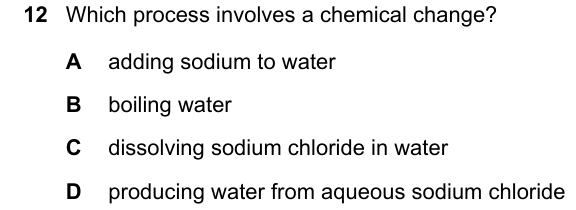
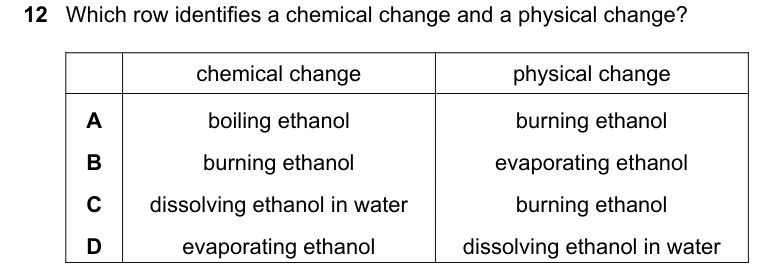
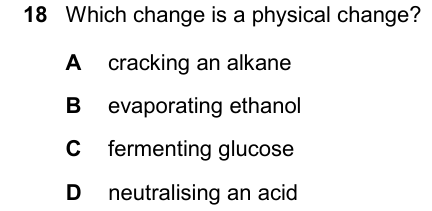
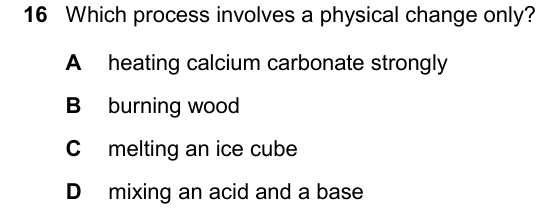
Attempt these before opening the solutions. Each reference gives the component, session and question number of the original examination; the answers follow the published mark scheme.
Solutions and mark-scheme guidance · set A
A1 Answer A
Sodium reacts with water to form new substances, sodium hydroxide and hydrogen: a chemical change. Boiling, dissolving and obtaining water from salt solution by distillation are physical. Nearly half of candidates chose D, apparently reading “producing water” as making a new substance.
A2 Answer B
Burning ethanol forms carbon dioxide and water (chemical); evaporating ethanol changes only its state (physical).
A3 Answer B
Evaporation changes state only. Cracking, fermentation and neutralisation all produce new substances.
A4 Answer C
Melting ice changes the arrangement of H2O molecules only. Heating calcium carbonate decomposes it into calcium oxide and carbon dioxide; burning and neutralisation form new products.
6.2 · Rate of reaction
2What changes the rate of a reaction? 6.2.1–6.2.2 Core
The rate of reaction is how quickly reactants are used up or products are formed: the change in the amount of a reactant or product per unit time. A fast reaction such as a precipitation is over in a fraction of a second; rusting takes weeks. Five factors change the rate.
| Change | Effect on rate | Example |
|---|---|---|
| increase the concentration of a solution | increases | magnesium fizzes faster in 2.0 mol/dm3 acid than in 0.5 mol/dm3 acid |
| increase the pressure of a gas | increases | gas reactions in industry (Haber and Contact processes) |
| increase the surface area of a solid (smaller pieces, powder) | increases | powdered calcium carbonate reacts faster than lumps; fine flour or coal dust can explode |
| increase the temperature | increases | food is kept in a refrigerator to slow decay |
| add a catalyst (including an enzyme) | increases | manganese(IV) oxide decomposes hydrogen peroxide; enzymes catalyse reactions in living cells |
A catalyst is a substance that increases the rate of a reaction and is unchanged at the end of the reaction. Its mass and chemical composition are the same afterwards, so a small amount can be used again and again. Enzymes are biological catalysts: proteins that speed up reactions in living organisms. Most work best near body temperature; at high temperatures they are denatured and stop working.
When asked what a catalyst is, most candidates know it increases the rate, but “it is not used up” did not earn the second mark: the mark-scheme idea is that the catalyst is unchanged (chemically and in mass) at the end of the reaction.
3Measuring the rate of a reaction 6.2.3, 6.2.8 CoreSupplement
A rate is measured by following something that changes as the reaction proceeds. For reactions that give off a gas there are two standard methods (Figure 6.1).
- Formation of a gas. Collect the gas in a gas syringe, or over water in an inverted measuring cylinder or burette, and record the volume at regular time intervals. Example: Mg(s) + 2HCl(aq) → MgCl2(aq) + H2(g).
- Change in mass. Stand the flask on a balance, with a loose cotton-wool plug, and record the mass at regular time intervals. The mass falls because gas escapes. Example: CaCO3(s) + 2HCl(aq) → CaCl2(aq) + H2O(l) + CO2(g).
- Time for a fixed change. Measure the time for a piece of magnesium ribbon to disappear, or for a cross under a beaker to be hidden by a precipitate. A shorter time means a faster reaction, so rate ∝ 1/time.
To make the comparison fair, change one variable only and keep the others the same: volume and concentration of acid, mass and particle size of the solid, temperature and apparatus. Start the stop-watch at the moment the reactants meet.
Supplement Evaluating the methods. A gas syringe measures volume directly but gas can escape while the bung is replaced, and the plunger can stick. Collecting over water is unsuitable for gases that dissolve in water, such as carbon dioxide (which is partly soluble) or ammonia. The mass-loss method is poor for hydrogen, because its mass is so small that the balance readings hardly change; it works well for carbon dioxide. Time intervals that are too far apart make it impossible to say exactly when the reaction stopped. Repeating each experiment allows results to be compared so that anomalous results can be identified.
4Interpreting rate graphs 6.2.4 Core
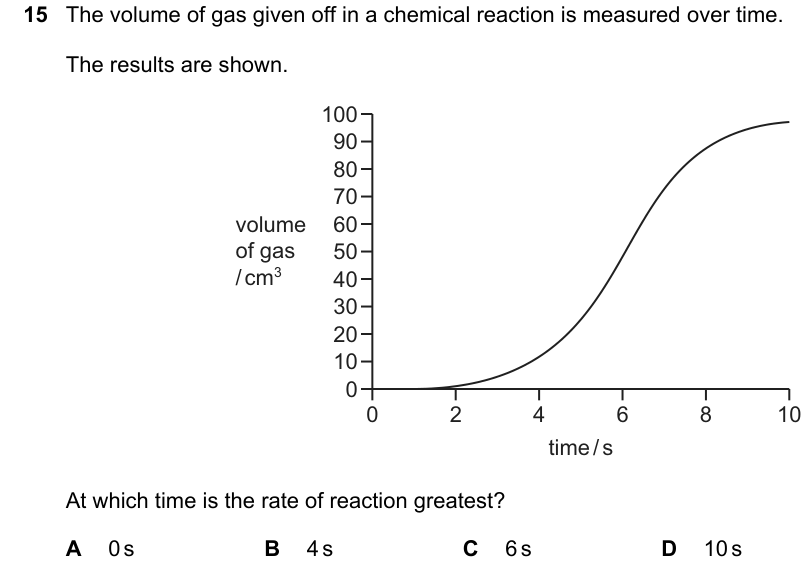
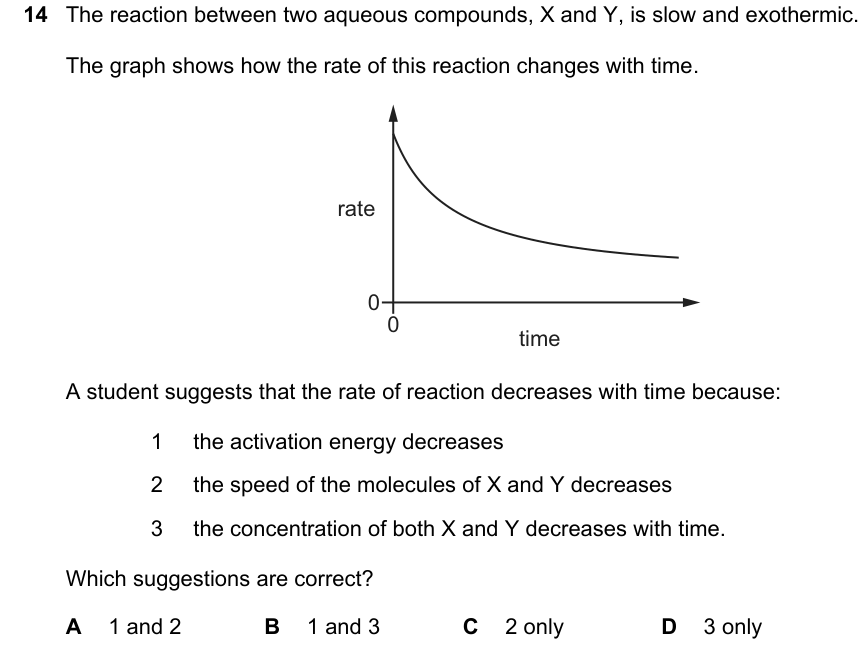
On a graph of volume of gas (or mass lost) against time, the gradient is the rate. The curve is steepest at the start, when the reactants are most concentrated, and becomes less steep as they are used up. When one reactant has been completely used up, the line becomes horizontal: the reaction has stopped. The final volume depends only on the amount of the limiting reactant, not on how fast the reaction went.
- A faster reaction: steeper at the start, and levels off earlier at the same final volume (if the amounts are unchanged).
- Less of the limiting reactant: a lower final volume.
- The time when the rate is greatest is where the curve is steepest — usually at the start — not where the volume is highest.
- Average rate over an interval = change in volume ÷ time taken, in cm3/s; a rate from a mass-loss graph is in g/s.
0.0500 mol of zinc reacts with excess dilute acid: Zn + 2HCl → ZnCl2 + H2. What final volume of hydrogen is expected at room temperature and pressure?
| Relationship | 1 mol Zn gives 1 mol H2; 1 mol of any gas occupies 24 dm3 at r.t.p. |
| Calculation | 0.0500 × 24 = 1.20 dm3 (1200 cm3) |
| Check | the final volume is fixed by the moles of the limiting reactant; changing temperature or particle size would change only how quickly this volume is reached |
5Collision theory 6.2.5–6.2.7 Supplement
Particles can react only if they collide. Most collisions, however, do not lead to reaction: the particles simply bounce apart. A collision is successful only if the colliding particles have at least a minimum amount of energy — the activation energy, Ea — between them. The rate therefore depends on two things:
- the frequency of collisions (how many collisions happen per second), which depends on the number of particles per unit volume and on how fast the particles move; and
- the proportion of collisions in which the particles have energy greater than or equal to Ea, which depends on their kinetic energy.
| Change | What happens to the particles | Collision frequency | Proportion of collisions with E ≥ Ea |
|---|---|---|---|
| higher concentration | more particles per unit volume | increases | no change |
| higher gas pressure | same particles squeezed into a smaller volume: more particles per unit volume | increases | no change |
| larger surface area | more particles of the solid exposed to the other reactant | increases | no change |
| higher temperature | particles gain kinetic energy and move faster | increases | increases — the main reason |
| catalyst | provides an alternative pathway with a lower activation energy | no change | increases |
A full explanation of the temperature effect has three parts: the kinetic energy of the particles increases; the frequency of collisions increases; a higher proportion of collisions (or of particles) have energy greater than or equal to the activation energy. “More collisions” without “per second” (frequency), or “more chance of collisions”, is not credited. Concentration changes collision frequency only — it does not give particles more energy and it does not change Ea.
A catalyst decreases the activation energy. On a reaction pathway diagram (Topic 5) the catalysed curve has a lower peak, but reactants and products are at the same levels, so ΔH is unchanged. A catalyst does not give particles more energy and does not make them collide more often; instead, at the same temperature, more of the collisions now have enough energy to react.
Attempt these before opening the solutions. Each reference gives the component, session and question number of the original examination; the answers follow the published mark scheme.
Solutions and mark-scheme guidance · set B
B1 Answer C
The rate is the gradient. The curve is steepest around 6 s. Many candidates chose D, 10 s, confusing the greatest volume with the greatest rate.
B2 Answer B
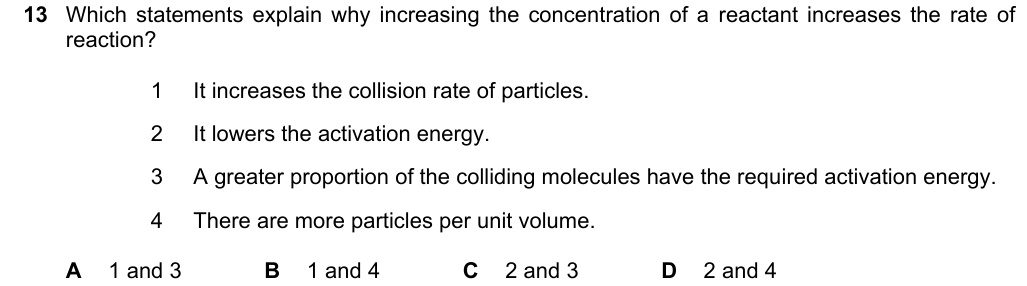
Higher concentration gives more particles per unit volume (4), so the collision rate increases (1). It does not change Ea or the proportion of collisions with enough energy. Many weaker candidates chose A, attributing an energy effect to concentration.
B3 Answer B
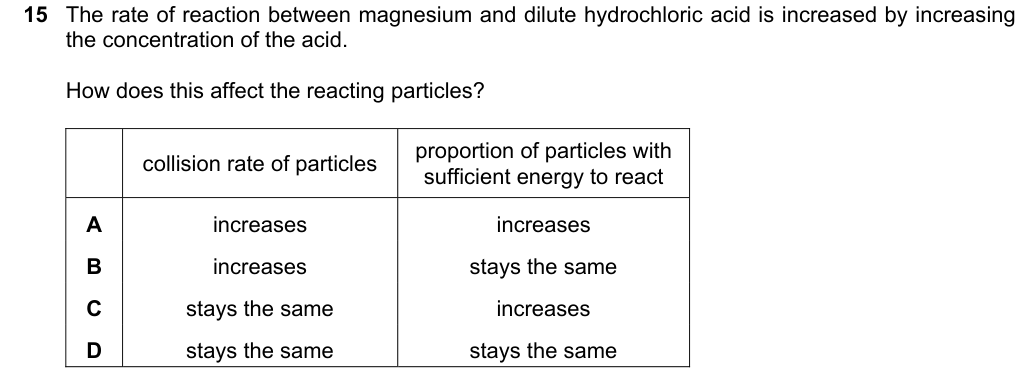
Collision rate increases; the proportion of particles with sufficient energy stays the same, because concentration does not change the energy of the particles. A was the most common wrong answer.
B4 Answer B
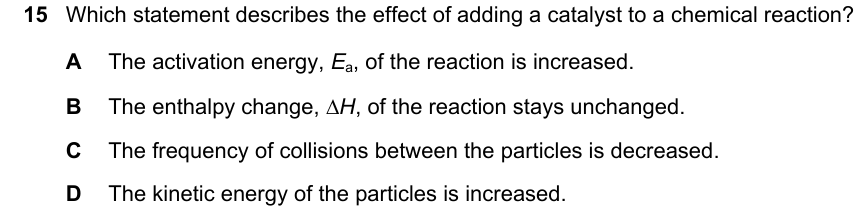
A catalyst lowers Ea; the enthalpy change of the reaction is unchanged. It does not change collision frequency or the kinetic energy of the particles. Weaker candidates chose A or D.
B5 Answer D
The rate falls because the concentrations of X and Y fall as they are used up. The activation energy does not change during a reaction, and the reaction is exothermic so the molecules do not slow down. A third of candidates chose A or B.
B6 [10]
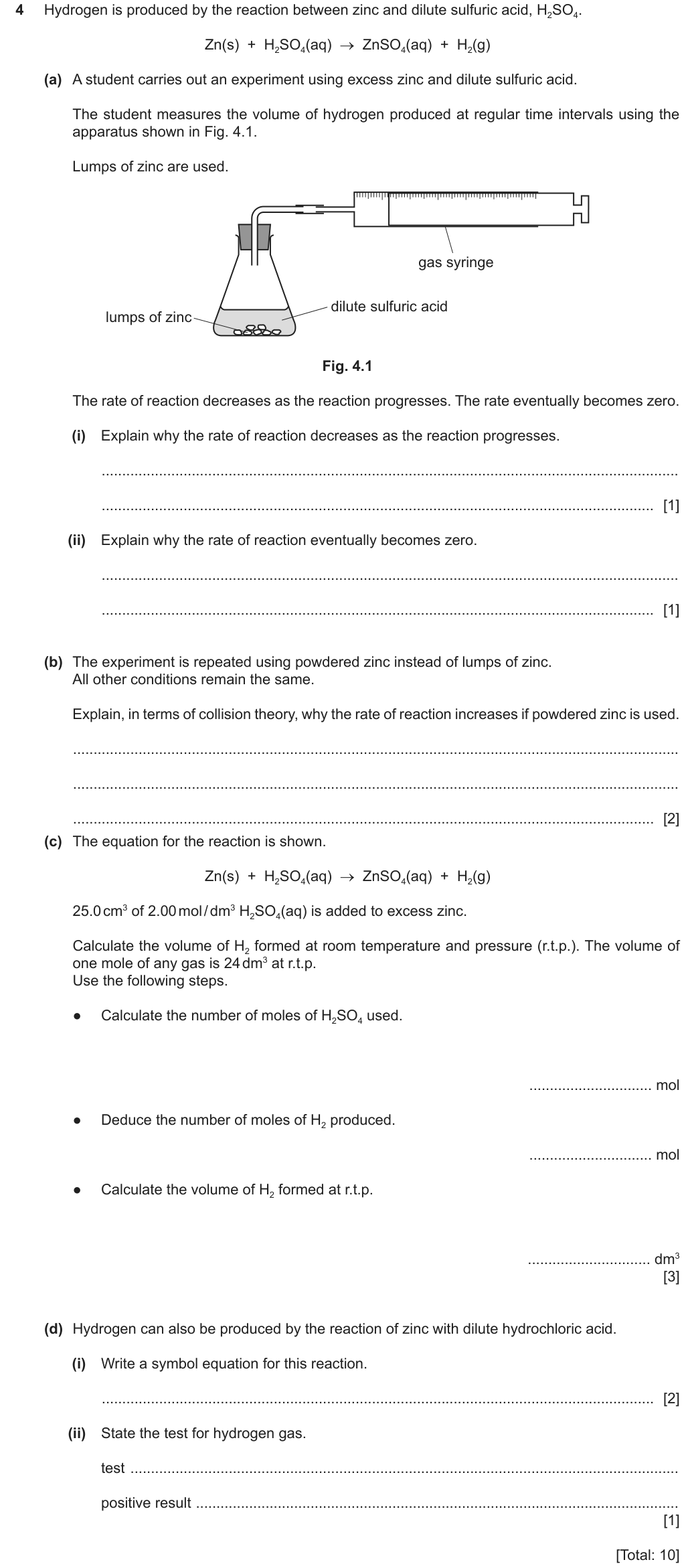
(a)(i) As the acid is used up its concentration decreases, so the frequency of collisions decreases ✓. (ii) All the sulfuric acid has reacted; zinc is in excess ✓.
(b) Powder has a greater surface area ✓, so the collision frequency increases ✓.
(c) Moles of the limiting reactant 0.0500 ✓ → 0.0500 mol H2 ✓ → 0.0500 × 24 = 1.20 dm3 ✓.
(d)(i) Zn + 2HCl → ZnCl2 + H2 ✓. (ii) A lighted splint gives a (squeaky) pop ✓.
Examiner feedback: “less chance of collisions” is not the same as a lower frequency of collisions. Many thought the zinc, not the acid, had been used up. In (c) many divided by 2 or used a relative formula mass instead of the mole ratio.
B7 [15]
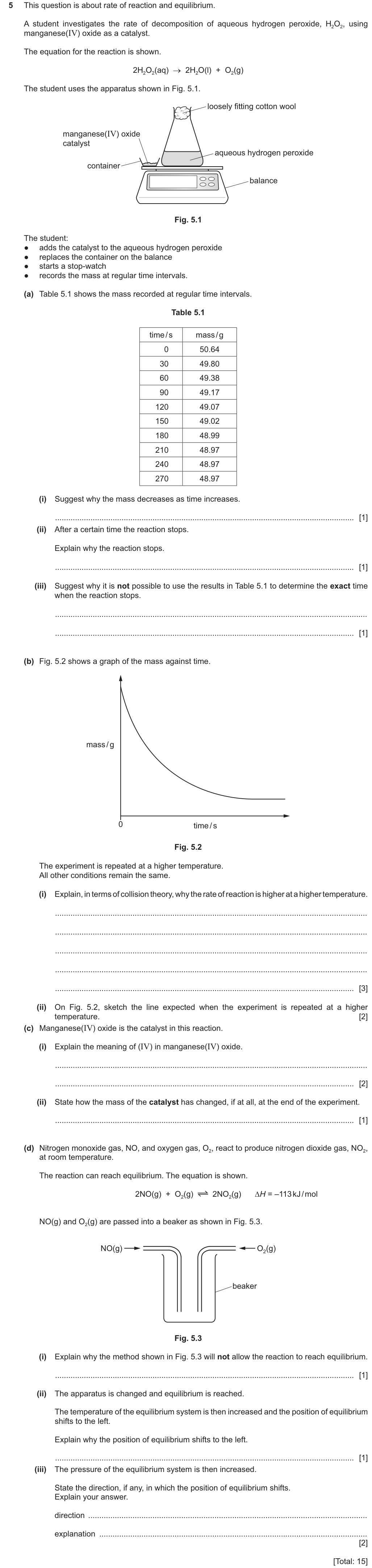
(a)(i) Oxygen gas escapes from the flask ✓ — saying oxygen is produced is not enough; only matter leaving can lower the mass. (ii) The hydrogen peroxide is used up ✓ (not “the catalyst is used up”). (iii) The time intervals are too large ✓.
(b)(i) Kinetic energy of the particles increases ✓; frequency of collisions increases ✓; a higher proportion of collisions have energy ≥ Ea ✓. (ii) Line starts at the same mass with a steeper gradient ✓ and levels off at the same mass but earlier ✓.
(c)(i) (IV) is the oxidation number of manganese ✓, +4 ✓. (ii) No change ✓.
(d)(i) It is not a closed system ✓. (ii) The forward reaction is exothermic ✓, so raising the temperature favours the reverse reaction. (iii) To the right ✓; there are fewer gas molecules on the right ✓ (3 → 2).
Examiner feedback: many omitted the word “kinetic”, or referred to activation energy without saying that more collisions have energy ≥ Ea. In (a)(iii) many answered about human error rather than the size of the time intervals.
B8 [12]
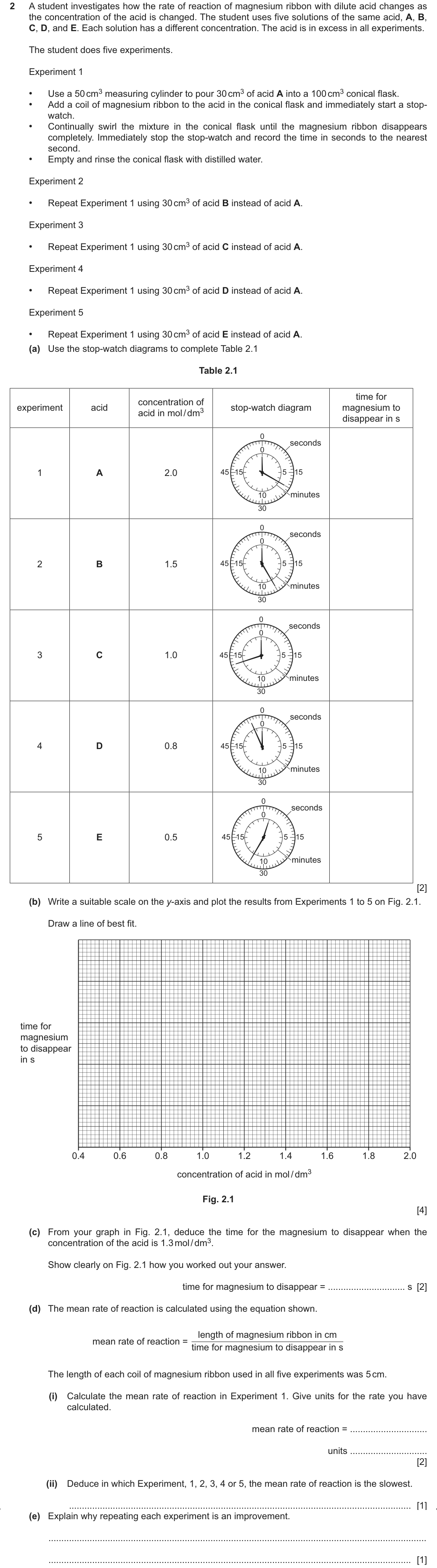
(a) Times 20, 25, 42, 56 and 95 s ✓, all in whole seconds as instructed ✓.
(b) A linear y-axis scale using over half the grid ✓; all five points plotted correctly ✓✓; a smooth curve of best fit ✓ — time falls steeply then levels as concentration increases.
(c) Construction lines drawn at 1.3 mol/dm3 ✓ and the time read correctly from your curve ✓.
(d)(i) 5 ÷ 20 = 0.25 ✓ cm/s ✓. (ii) Experiment 5 ✓ (longest time, lowest concentration).
(e) Repeating allows results to be compared (checked), so anomalous results can be identified ✓.
Examiner feedback: times such as 42.0 or times in minutes lost the mark; the minute hand was sometimes ignored. Many drew straight lines from first point to last although the points lay on a curve. In (d) some inverted the calculation (4) or left a fraction. In (e) “more reliable” or “more accurate” did not score.
6.3 · Reversible reactions and equilibrium
6Reversible reactions and hydrated salts 6.3.1–6.3.2 Core
Some reactions can go in either direction: the products can react to re-form the reactants. These are reversible reactions, shown by the symbol ⇌. Which direction happens depends on the conditions.
Many salts crystallise with water molecules built into the crystal: they are hydrated. The water is called water of crystallisation. Heating drives the water off and leaves the anhydrous salt; adding water reverses the change.
CuSO4·5H2O(s) ⇌ CuSO4(s) + 5H2O(l)
blue → heat → white ← add water ←
CoCl2·6H2O(s) ⇌ CoCl2(s) + 6H2O(l)
pink → heat → blue ← add water ←
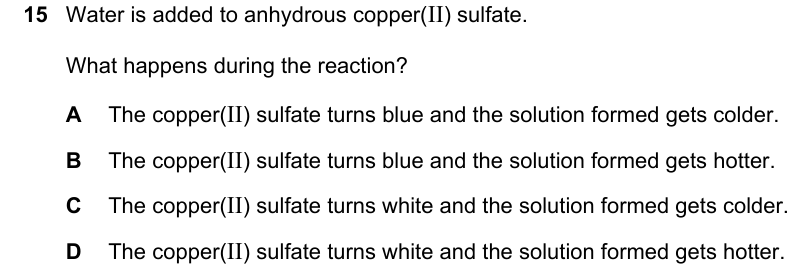
Removing the water (the forward direction) needs heat, so it is endothermic. The reverse reaction must therefore be exothermic: when water is added to white anhydrous copper(II) sulfate, it turns blue and becomes hot. These colour changes are the chemical tests for water (Topic 10), and cobalt(II) chloride paper is blue when dry and turns pink in water.
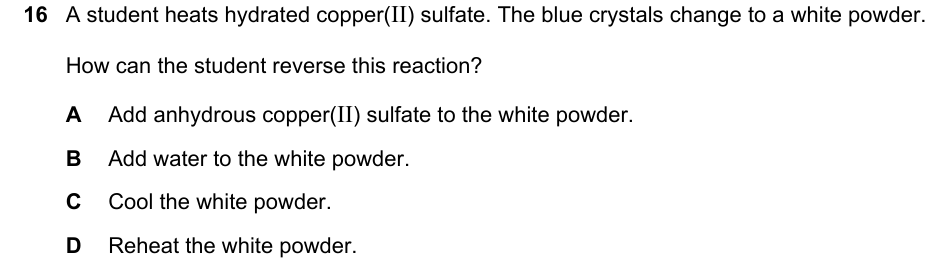
To reverse the dehydration you must add water. Cooling the white powder does nothing, and adding more anhydrous salt does nothing. Also remember the energy: adding water to anhydrous copper(II) sulfate releases heat. Most candidates recall the blue colour but many predict that the mixture gets colder.
7Equilibrium 6.3.3 Supplement
If a reversible reaction takes place in a closed system — nothing can enter or leave — it eventually reaches equilibrium. At first only the forward reaction occurs, quickly, because the reactant concentrations are high. As products build up, the reverse reaction speeds up while the forward reaction slows down. Eventually the two rates become equal.
A reversible reaction in a closed system is at equilibrium when:
(a) the rate of the forward reaction is equal to the rate of the reverse reaction, and
(b) the concentrations of reactants and products are no longer changing.
Both reactions are still happening — the equilibrium is dynamic — but because they happen at the same rate there is no overall change. The concentrations are constant, not equal: an equilibrium mixture might contain mostly products or mostly reactants. An open beaker is not a closed system, because a gaseous product escapes and can never react back.
8Changing the position of equilibrium 6.3.4 Supplement
The position of equilibrium describes how far the reaction has gone: “to the right” means more products, “to the left” means more reactants. When the conditions of a system at equilibrium are changed, the position of equilibrium shifts in the direction that opposes the change. Predictions use information given in the question: the sign of ΔH and the number of moles of gas on each side.
| Change | Shift | Reason |
|---|---|---|
| increase temperature | in the endothermic direction | the endothermic reaction takes in the added heat |
| decrease temperature | in the exothermic direction | the exothermic reaction releases heat |
| increase pressure (gases) | to the side with fewer moles of gas | fewer gas molecules reduce the pressure; no effect if the numbers are equal |
| decrease pressure | to the side with more moles of gas | more gas molecules raise the pressure |
| increase the concentration of a reactant, or remove a product | to the right | the added reactant is used up / the removed product is replaced |
| add a catalyst | no change | forward and reverse rates increase equally; equilibrium is reached sooner but the yield is the same |
2NO(g) + O2(g) ⇌ 2NO2(g) ΔH = −113 kJ/mol. What happens to the yield of NO2 when (a) the temperature is increased, (b) the pressure is increased?
| (a) Temperature | the forward reaction is exothermic, so the reverse is endothermic; raising the temperature shifts equilibrium to the left: the yield of NO2 decreases |
| (b) Pressure | left side 2 + 1 = 3 mol gas, right side 2 mol; higher pressure favours fewer gas moles, so the shift is to the right: the yield increases |
| Rate | both changes also increase the rate — a separate question from the position of equilibrium |
Colour can reveal a shift. For 2HI(g) ⇌ H2(g) + I2(g) (only iodine is coloured, purple), if cooling makes the mixture paler, less iodine is present, so the equilibrium has shifted left on cooling: the exothermic direction is the reverse, and the forward reaction is endothermic. Increasing the pressure of this mixture does not shift the equilibrium (2 mol of gas on each side), yet the colour darkens — the same iodine molecules are squeezed into a smaller volume, so their concentration rises.
9The Haber process and the Contact process 6.3.5–6.3.11 Supplement
Two industrial equilibria are required knowledge.
| Haber process (ammonia) | Contact process (sulfur trioxide stage) | |
|---|---|---|
| Equation | N2(g) + 3H2(g) ⇌ 2NH3(g) | 2SO2(g) + O2(g) ⇌ 2SO3(g) |
| Sources of raw materials | nitrogen: air; hydrogen: methane (natural gas) | sulfur dioxide: burning sulfur or roasting sulfide ores; oxygen: air |
| Temperature | 450 °C | 450 °C |
| Pressure | 20 000 kPa / 200 atm | 200 kPa / 2 atm |
| Catalyst | iron | vanadium(V) oxide, V2O5 |
| Forward reaction | exothermic; 4 mol gas → 2 mol gas | exothermic; 3 mol gas → 2 mol gas |
Why these conditions? (6.3.11)
- Temperature. The forward reaction is exothermic, so a lower temperature would shift the equilibrium to the right and give a higher yield — but the rate would be too slow. 450 °C is a compromise that gives an acceptable yield at an acceptable rate. A higher temperature would be faster but would lower the yield.
- Pressure (Haber). There are fewer moles of gas on the right, so high pressure increases the yield; it also increases the rate (more particles per unit volume). But very high pressures need thick-walled equipment and a lot of energy to compress the gases, so they are expensive and a safety risk. 200 atm is a compromise.
- Pressure (Contact). The position of equilibrium already lies far to the right, so the yield at 2 atm is high; raising the pressure would add cost and risk for very little gain.
- Catalyst. Increases the rate (lowers Ea) so that equilibrium is reached quickly at 450 °C. It has no effect on the yield.
- In the Haber process, ammonia is removed by cooling and liquefying it, and unreacted nitrogen and hydrogen are recycled.
Candidates are expected to learn the conditions for both processes exactly. Common errors: giving the Contact-process pressure or catalyst (vanadium(V) oxide) for the Haber process and vice versa; giving temperatures outside the syllabus value; copying conditions for a different reaction from elsewhere in the question. The source of hydrogen is methane (natural gas) — not water, air, “hydrocarbons” or ammonia.
Attempt these before opening the solutions. Each reference gives the component, session and question number of the original examination; the answers follow the published mark scheme.
Solutions and mark-scheme guidance · set C
C1 Answer B
Heating removes the water of crystallisation; adding water puts it back and restores the blue colour.
C2 Answer B
Anhydrous copper(II) sulfate turns blue, and the reaction is exothermic, so it gets hotter. Most candidates chose the option with a blue colour but a temperature fall.
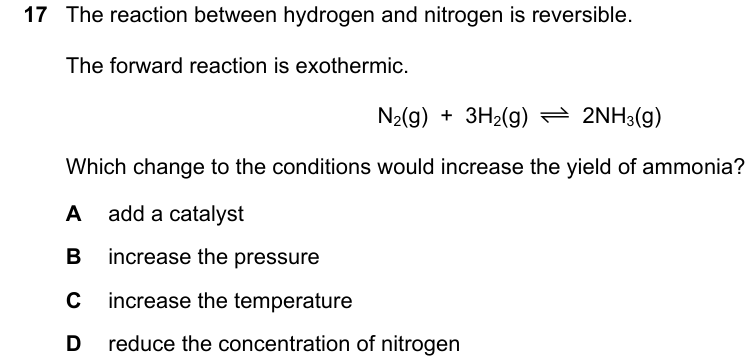
C3 Answer B
4 mol gas → 2 mol gas, so higher pressure shifts the equilibrium right. A catalyst does not change the yield; a higher temperature favours the endothermic reverse reaction. Weaker candidates confused rate with yield and chose A or C.
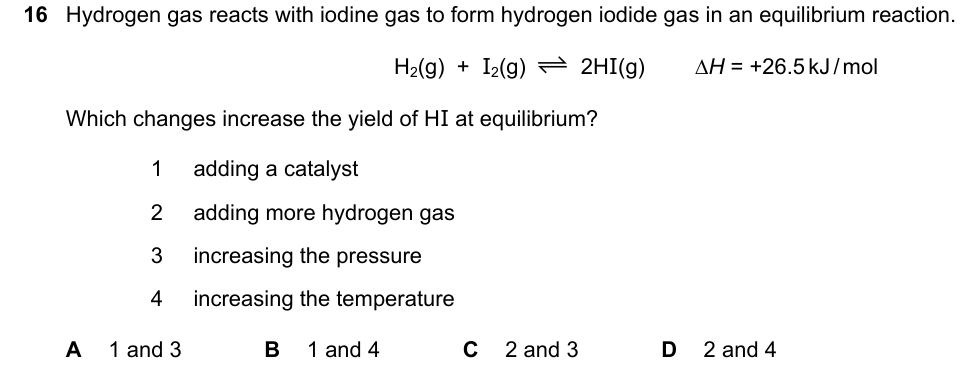
C4 Answer D
Adding hydrogen shifts the equilibrium right (2). ΔH is positive, so a higher temperature favours the forward reaction (4). Pressure has no effect (2 mol gas each side) and a catalyst does not change the yield — the error made by most weaker candidates.
C5 Answer C
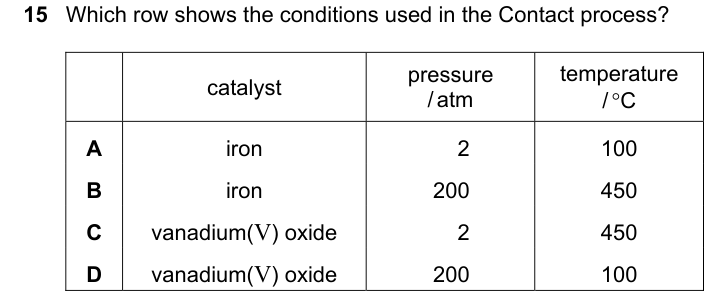
Contact process: 2 atm, 450 °C, vanadium(V) oxide. Many chose the row with 200 atm, confusing it with the Haber process.
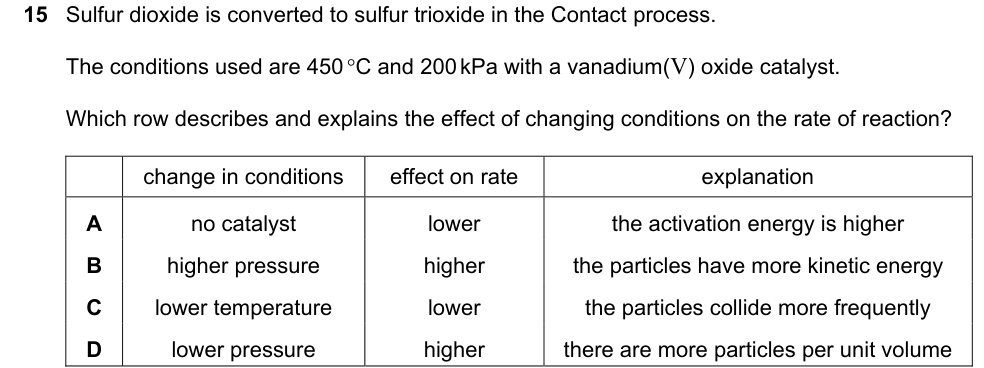
C6 Answer A
Without the catalyst the activation energy is higher, so the rate is lower. Higher pressure increases rate by increasing particles per unit volume (not kinetic energy); lower temperature does not increase collision frequency; lower pressure decreases rate.
C7 [10]
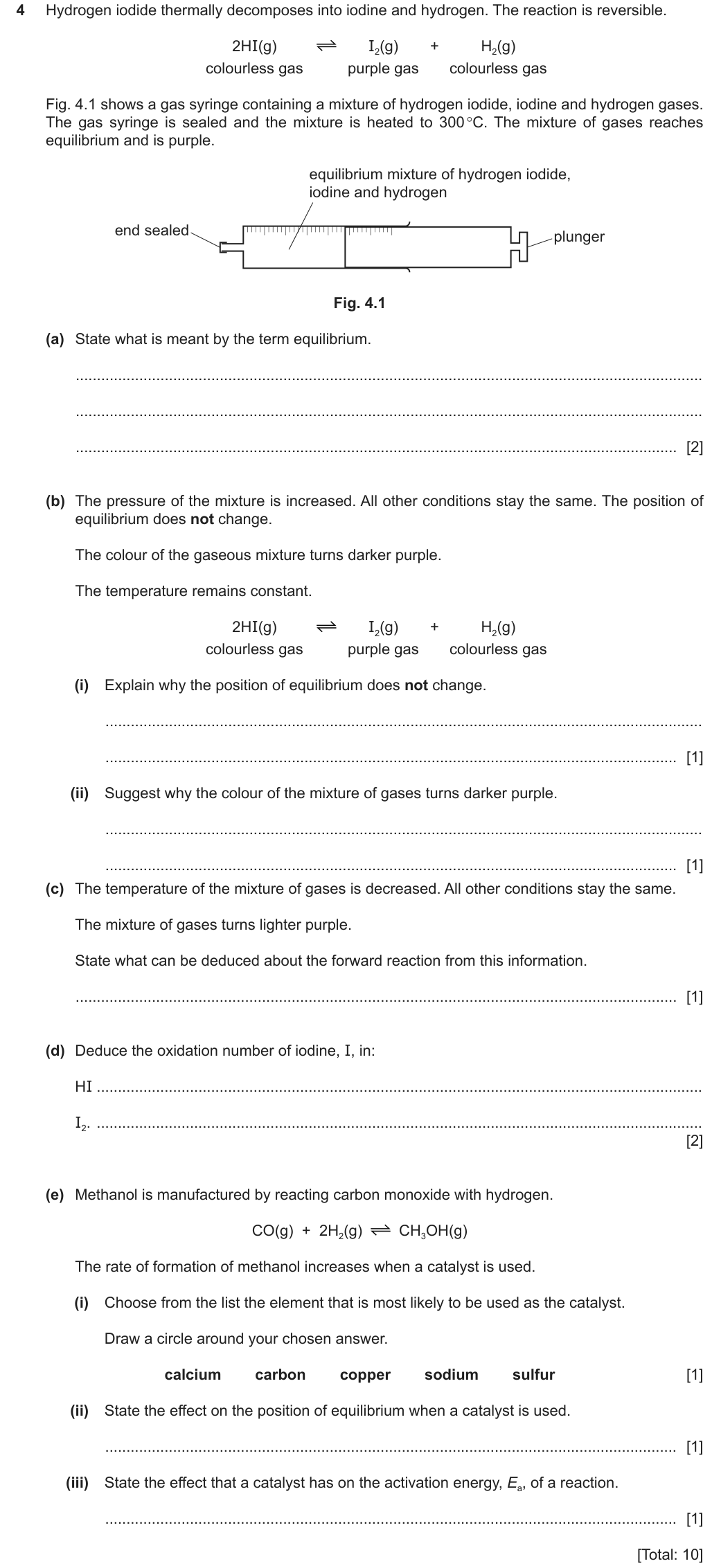
(a) The rate of the forward reaction equals the rate of the reverse reaction ✓; the concentrations of reactants and products are no longer changing ✓.
(b)(i) Same number of moles (molecules) of gas on both sides ✓. (ii) The iodine molecules are forced closer together — same number in a smaller volume ✓.
(c) The forward reaction is endothermic ✓ (cooling removes iodine, so equilibrium moves left, the exothermic direction).
(d) HI: −1 ✓; I2: 0 ✓.
(e)(i) copper ✓ (a transition element). (ii) No effect ✓. (iii) It lowers the activation energy ✓.
Examiner feedback: “the forward reaction is equal to the reverse reaction” (no “rate”) and “concentrations are equal” were common errors. In (b)(ii) very few mentioned iodine. In (c) “exothermic” was the commonest wrong answer. Oxidation numbers other than zero need a sign.
C8 [7]
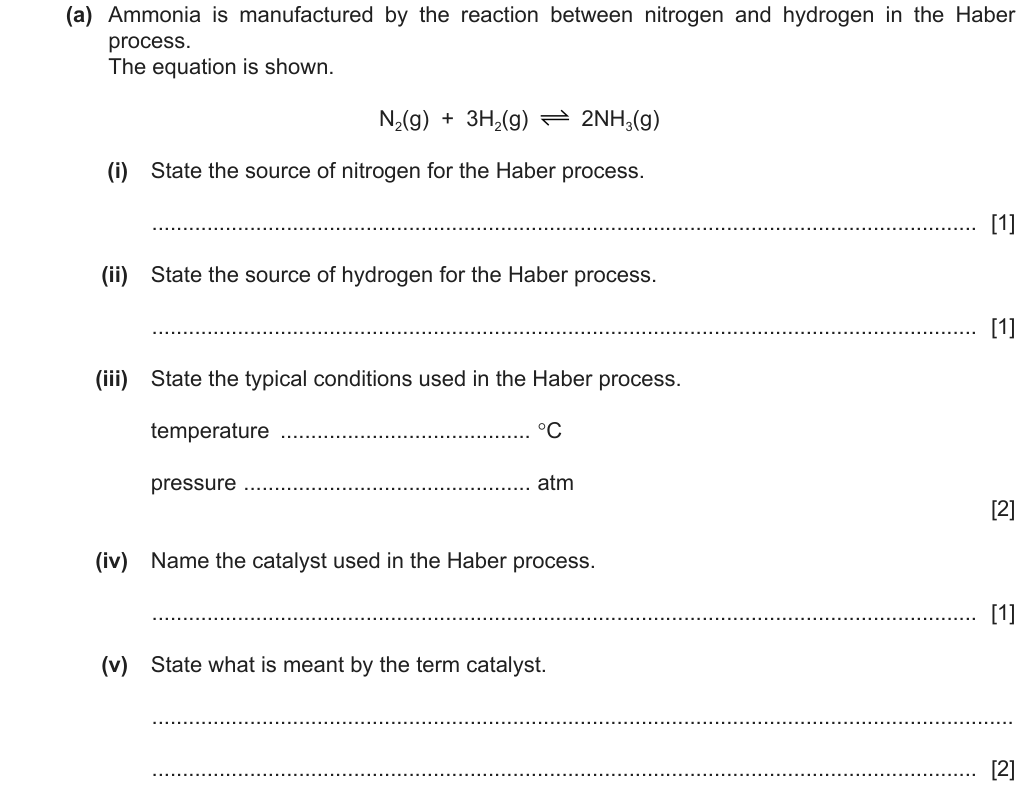
(i) air ✓. (ii) methane / natural gas ✓. (iii) 450 °C and 200 atm ✓✓. (iv) iron ✓. (v) It increases the rate of reaction ✓ and is unchanged at the end ✓.
Examiner feedback: vanadium(V) oxide was the commonest wrong catalyst; many copied 900 °C and 7 atm from later in the question; water, air and “3H2” were given as the source of hydrogen; “not used up” did not earn the second catalyst mark.
6.4 · Redox
10Oxidation and reduction in terms of oxygen 6.4.1–6.4.5 Core
The simplest definitions involve oxygen.
Oxidation is the gain of oxygen. Reduction is the loss of oxygen. A redox reaction is one in which oxidation and reduction happen simultaneously.
In the blast furnace, carbon monoxide removes oxygen from iron(III) oxide:
Fe2O3(s) + 3CO(g) → 2Fe(l) + 3CO2(g)
Iron(III) oxide loses oxygen — it is reduced. Carbon monoxide gains oxygen — it is oxidised. One cannot happen without the other: the oxygen lost by one substance is gained by another. Other examples are combustion (the fuel gains oxygen) and the thermite reaction, 2Al + Fe2O3 → 2Fe + Al2O3.
Roman numerals in a name show the oxidation number of an element in a compound: iron(II) oxide contains iron with oxidation number +2 (FeO); iron(III) oxide contains iron with oxidation number +3 (Fe2O3); copper(II) sulfate contains Cu2+; manganese(IV) oxide, MnO2, contains manganese in the +4 state; potassium manganate(VII) contains manganese in the +7 state.
11Oxidation and reduction in terms of electrons and oxidation number 6.4.6–6.4.9 Supplement
Many redox reactions involve no oxygen at all. The more general definitions are based on electrons:
| Oxidation | Reduction | |
|---|---|---|
| oxygen (Core) | gain of oxygen | loss of oxygen |
| electrons | loss of electrons | gain of electrons |
| oxidation number | increase in oxidation number | decrease in oxidation number |
When magnesium burns, Mg → Mg2+ + 2e− (oxidation: electrons lost) and O2 + 4e− → 2O2− (reduction: electrons gained). In the displacement Zn(s) + Cu2+(aq) → Zn2+(aq) + Cu(s), zinc atoms lose electrons and copper(II) ions gain them — a redox reaction with no oxygen transferred.
An oxidation number is a way of keeping track of electrons. Deduce it with these rules:
- An element in its uncombined state has oxidation number 0 (Fe, O2, Cl2).
- A monatomic ion has an oxidation number equal to its charge (Na+ +1, Fe3+ +3, Cl− −1).
- The oxidation numbers in a compound add up to zero.
- The oxidation numbers in an ion add up to the charge on the ion.
Oxygen in compounds is usually −2 and hydrogen +1, which lets you work out the others.
| Fe2O3 | 2x + 3(−2) = 0 → x = +3 |
| SO42− | x + 4(−2) = −2 → x = +6 |
| MnO4− | x + 4(−2) = −1 → x = +7 — hence manganate(VII) |
| NH3 | x + 3(+1) = 0 → x = −3 |
| Trap | write the sign: “+3”, not “3” or “3+” or “Fe3+” |
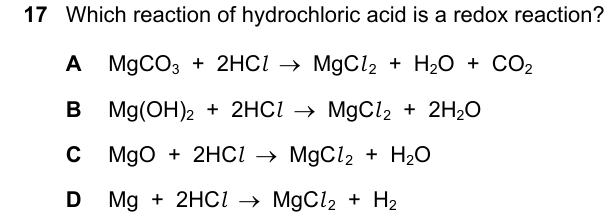
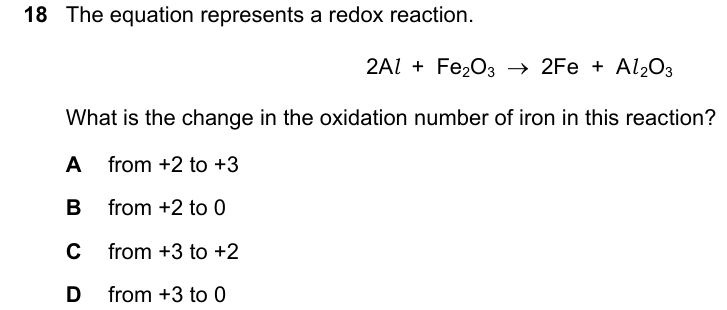
To decide whether a reaction is redox, assign oxidation numbers to every element on both sides. If any change, it is redox. In 2Al + Fe2O3 → 2Fe + Al2O3, iron goes from +3 to 0 (reduced) and aluminium from 0 to +3 (oxidised). In a neutralisation such as MgO + 2HCl → MgCl2 + H2O, nothing changes (Mg +2, O −2, H +1, Cl −1 throughout), so it is not redox even though an oxide is involved.
12Oxidising agents, reducing agents and colour tests 6.4.10–6.4.13 Supplement
An oxidising agent is a substance that oxidises another substance and is itself reduced.
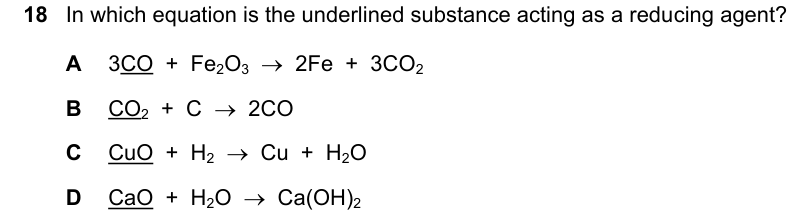
A reducing agent is a substance that reduces another substance and is itself oxidised.
In Fe2O3 + 3CO → 2Fe + 3CO2, carbon monoxide is the reducing agent (it removes oxygen from iron(III) oxide and is itself oxidised); Fe2O3 is the oxidising agent. In Br2 + 2I− → 2Br− + I2, bromine gains electrons (Br2 + 2e− → 2Br−), so bromine is the oxidising agent; iodide ions lose electrons and are the reducing agent. Oxidising and reducing agents are always reactants.
| Reagent | Acts as | Colour change when it reacts | Detects |
|---|---|---|---|
| acidified aqueous potassium manganate(VII) | oxidising agent (Mn +7 is reduced) | purple → colourless | a reducing agent |
| aqueous potassium iodide | reducing agent (I− is oxidised to I2) | colourless → brown | an oxidising agent |
Potassium manganate(VII) must be acidified (dilute sulfuric acid is added) for this reaction. The brown colour with potassium iodide is iodine in solution.
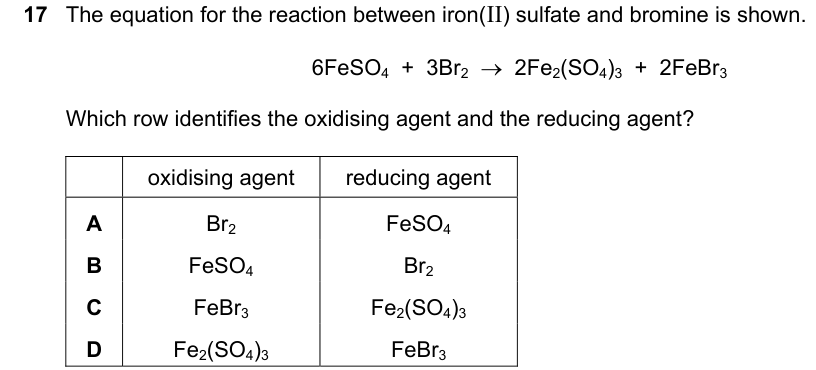
When identifying agents, candidates often chose products (for example Fe2(SO4)3 or FeBr3) rather than reactants, or named the substance that is reduced when asked for the reducing agent. Answers must give a correct name or formula: “Br” is not bromine. A reason should say what the agent itself does — bromine gains electrons (is reduced) — rather than only “it oxidises the iodide”. Many did not know that potassium iodide solution is colourless.
Attempt these before opening the solutions. Each reference gives the component, session and question number of the original examination; the answers follow the published mark scheme.
Solutions and mark-scheme guidance · set D
D1 Answer D
Only the reaction with magnesium metal is redox: Mg 0 → +2 and H +1 → 0. The most common answer was MgO + 2HCl, chosen by looking for oxygen rather than for changes in oxidation number.
D2 Answer D
Fe in Fe2O3 is +3; uncombined Fe is 0: +3 to 0. Weaker candidates often chose +2 to 0, knowing the element is zero but not working out the oxide.
D3 Answer B
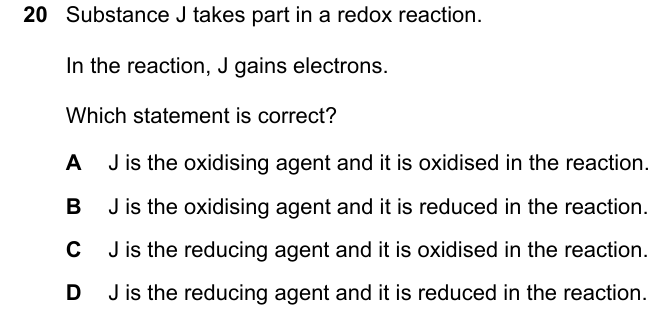
Gaining electrons is reduction; a substance that is reduced is the oxidising agent. Some chose C, the exact reverse.
D4 Answer A
Br2 (0 → −1) is reduced, so it is the oxidising agent; FeSO4 (Fe +2 → +3) is oxidised, so it is the reducing agent. Agents are always reactants — many chose the rows containing only products.
D5 Answer A
CO removes oxygen from Fe2O3 and is itself oxidised: a reducing agent. The commonest wrong answer identified the substance that is reduced rather than the one causing reduction.
D6 Answer D
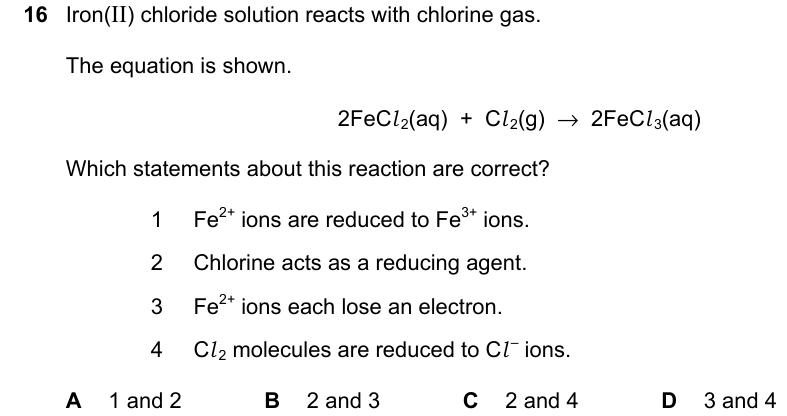
Each Fe2+ loses an electron to become Fe3+ (oxidised) and Cl2 gains electrons to become Cl− (reduced), so chlorine is the oxidising agent: statements 3 and 4.
D7 [5]
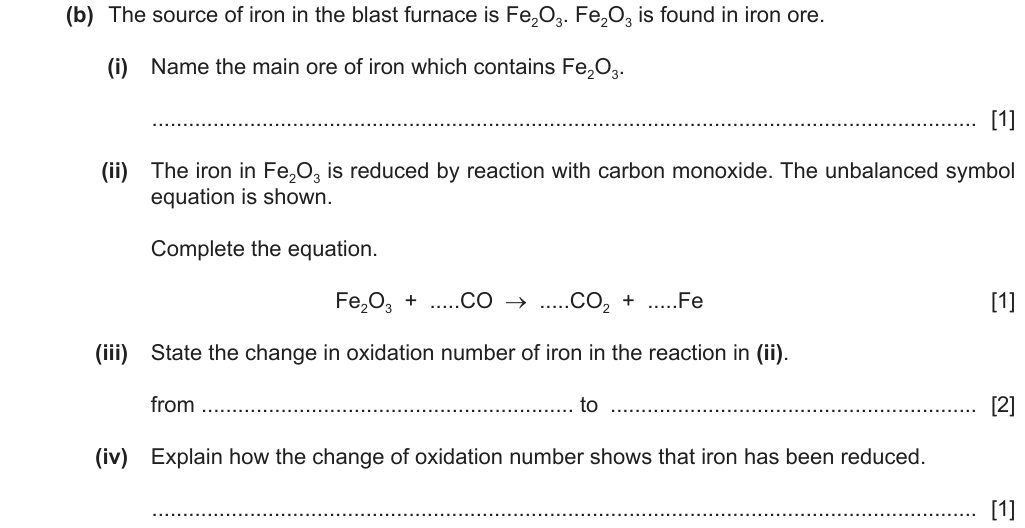
(i) hematite ✓. (ii) Fe2O3 + 3CO → 3CO2 + 2Fe ✓. (iii) from +3 ✓ to 0 ✓. (iv) The oxidation number decreases ✓.
Examiner feedback: “3” without a sign, “Fe3+” and “Fe(III)” were not credited. In (iv) many relied on OILRIG and wrote “iron lost electrons”, or described loss of oxygen — the question asked about oxidation number.
D8 [5]
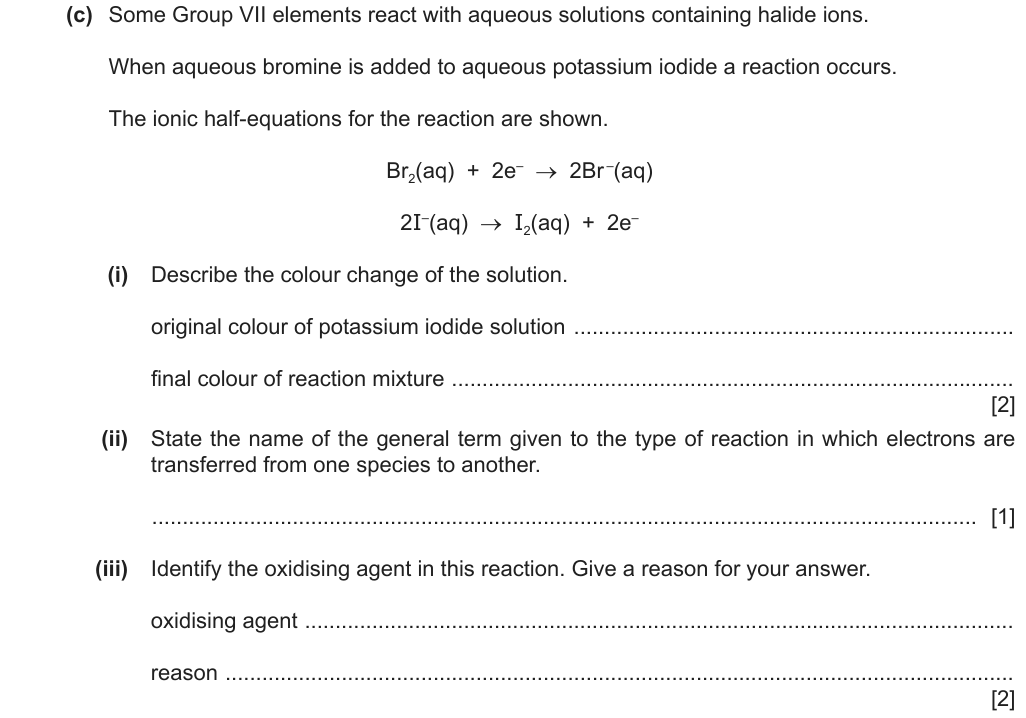
(i) colourless ✓ to brown ✓. (ii) redox ✓. (iii) Br2 (bromine) ✓; it is reduced / gains electrons ✓.
Examiner feedback: most did not know potassium iodide solution is colourless. “Br”, iodine and potassium iodide were common wrong answers for the oxidising agent.
D9 [5]
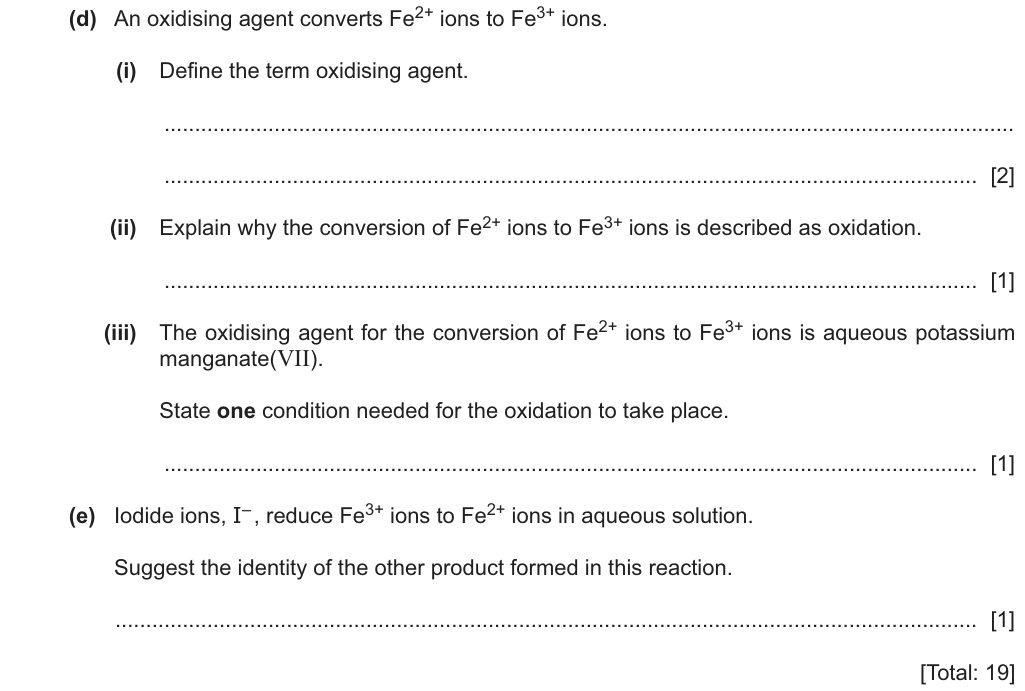
(d)(i) A substance that oxidises another substance ✓ and is itself reduced ✓. (ii) Each Fe2+ loses an electron ✓. (iii) The manganate(VII) must be acidified ✓.
(e) iodine ✓.
Examiner feedback: weaker answers described oxidation and reduction instead of defining an oxidising agent. “High temperature” or “a catalyst” were common wrong conditions. Iron iodide was often given instead of iodine.
Review · Topic 6
13Misconceptions and the examiner’s view
- “The rate is greatest when the most gas has been collected.” The rate is the gradient; it is greatest where the curve is steepest, usually at the start.
- “Higher concentration gives particles more energy.” It increases particles per unit volume and so collision frequency only; the proportion with E ≥ Ea is unchanged.
- “More collisions.” The rate depends on the frequency of collisions (per second) and, for temperature and catalysts, on the proportion of successful collisions.
- “A catalyst is not used up.” The required idea is that it is unchanged at the end; and it lowers Ea without changing ΔH or the position of equilibrium.
- “At equilibrium the concentrations are equal” / “the reaction has stopped.” Concentrations are constant, not equal; both reactions continue at equal rates.
- “A catalyst increases the yield.” It speeds up both directions equally; equilibrium is reached sooner with the same composition.
- “Any reaction involving an oxide is redox.” Check oxidation numbers; acid–base reactions of oxides are not redox.
- “The oxidising agent is the substance that is oxidised.” It is reduced; it causes oxidation of something else.
Rate questions are best answered when candidates separate the two parts of collision theory. Collision frequency is well known, but many explanations stop at “particles have more energy” without the word kinetic, or mention activation energy without stating that a greater proportion of collisions have energy equal to or above it. Concentration is wrongly credited with giving particles more energy, and a catalyst is wrongly said to change ΔH, collision frequency or kinetic energy. On graphs, the highest point is mistaken for the fastest rate, and sketches for a faster reaction often fail to level off at the same final value. In practical work, times must be recorded to the stated resolution, best-fit lines should be curves where the points lie on a curve, and repeats are for comparing results, not for making them “more reliable”. Definitions of equilibrium lose marks by omitting “rate” or by saying concentrations are “equal”; candidates commonly confuse yield with rate and believe a catalyst increases yield. The conditions of the Haber and Contact processes are frequently interchanged, and methane as the source of hydrogen is poorly known. In redox, oxidation numbers must carry a sign, agents must be chosen from the reactants and named correctly, and candidates who search for oxygen rather than electron transfer miss redox reactions altogether. Strong answers state what the particles or electrons are doing and link each observation to a clearly stated cause.
14Summary and knowledge organiser
Essential knowledge
- Chemical change: a new substance forms; physical change: no new substance.
- Rate increases with concentration, gas pressure, surface area, temperature and a catalyst.
- Collision theory: rate depends on collision frequency and the proportion of collisions with E ≥ Ea.
- Rate graphs: gradient = rate; horizontal line = a reactant used up; final amount set by the limiting reactant.
- Hydrated CuSO4 blue ⇌ anhydrous white; hydrated CoCl2 pink ⇌ anhydrous blue; adding water is exothermic.
- Equilibrium (closed system): forward rate = reverse rate; concentrations no longer changing.
- Oxidation: gain of O, loss of e−, increase in oxidation number; reduction is the reverse.
Essential conditions
- Haber: N2 (air) + 3H2 (methane) ⇌ 2NH3; 450 °C, 200 atm, iron.
- Contact: 2SO2 (burning sulfur / roasting sulfide ores) + O2 (air) ⇌ 2SO3; 450 °C, 2 atm, V2O5.
- Acidified KMnO4: purple → colourless. KI(aq): colourless → brown.
Examination checklist
- Temperature: kinetic energy ↑, collision frequency ↑, proportion of collisions with E ≥ Ea ↑.
- Sketching a faster reaction: steeper start, same final value, levels off earlier.
- Give times and temperatures to the resolution asked for; units on every rate.
- Equilibrium definition: “rate” of forward = “rate” of reverse; concentrations “no longer changing”.
- Separate the effect on rate from the effect on yield.
- Signs on oxidation numbers; agents are reactants.
Knowledge organiser · chemical reactions
| Idea | What to know | Must-remember distinctions and common errors |
|---|---|---|
| Physical / chemical 6.1.1 | Chemical: new substance. Physical: state or mixture changes only. | Reversibility is not the test. |
| Rate factors 6.2.1–2 | Concentration, pressure, surface area, temperature, catalyst (enzymes). | Catalyst unchanged at the end. |
| Measuring rate 6.2.3–4, 6.2.8 | Gas volume (syringe), mass loss (balance), time to disappear. | Mass loss poor for H2; gradient = rate; repeats allow comparison. |
| Collision theory 6.2.5–7 | Particles per unit volume, collision frequency, kinetic energy, Ea. | Concentration: frequency only. Temperature and catalyst: proportion successful ↑. |
| Hydrates 6.3.1–2 | CuSO4·5H2O blue/white; CoCl2·6H2O pink/blue. | Reverse by adding water; it gets hot. |
| Equilibrium 6.3.3–4 | Equal rates, constant concentrations; shifts oppose a change. | Not equal concentrations; catalyst: no shift. |
| Haber / Contact 6.3.5–11 | 450 °C, 200 atm, Fe / 450 °C, 2 atm, V2O5. | Compromise of rate, yield, cost and safety. |
| Redox 6.4.1–9 | O gain/loss; e− loss/gain; oxidation number up/down. | Element 0; ion = charge; sum = 0 or charge. |
| Agents and tests 6.4.10–13 | Oxidising agent reduced; reducing agent oxidised. | KMnO4 purple → colourless; KI colourless → brown. |