
Topic 10 has three sub-topics: 10.1 Water, 10.2 Fertilisers and 10.3 Air quality and climate. Core statements cover testing water, substances found in natural water, water treatment, NPK fertilisers, the composition of air, the sources and effects of pollutants, strategies to reduce them and photosynthesis. Supplement statements add how greenhouse gases cause global warming, how oxides of nitrogen form and are removed by catalytic converters, and the symbol equation for photosynthesis.
Central idea: the chemistry of the earlier topics — combustion, acids, redox, catalysts — explains the state of the water we drink and the air we breathe, and it also supplies the solutions.
Before you start
- Hydrated and anhydrous salts; pure substances have fixed melting and boiling points (Topics 1, 6, 7).
- Complete and incomplete combustion of hydrocarbons (Topic 11).
- Acidic oxides; neutralisation (Topic 7). Oxidation and reduction; catalysts (Topic 6).
Learning objectives
- Describe chemical tests for water and a test for its purity; explain why distilled water is used in the laboratory.
- State substances found in natural water, whether they are beneficial or harmful; describe water treatment.
- State that ammonium salts and nitrates are fertilisers; describe NPK fertilisers.
- State the composition of clean, dry air and the sources and effects of pollutants; state and explain strategies to reduce them.
- Describe photosynthesis; Supplement describe how greenhouse gases cause global warming and how catalytic converters remove oxides of nitrogen.
Introduction: two gases, two problems
A car engine burns petrol in air. Most of the carbon becomes carbon dioxide, which adds to global warming; some becomes carbon monoxide, which is toxic; and in the heat of the engine, nitrogen and oxygen from the air itself combine to make oxides of nitrogen, which cause acid rain and smog. A catalytic converter uses one pollutant to remove another. Understanding these reactions is the key to the environmental chemistry in this topic.
10.1 · Water
1Testing for water and for pure water 10.1.1–10.1.3 Core
Two anhydrous salts change colour when water is added. They show that water is present:
| Test reagent | Colour change with water | Equation |
|---|---|---|
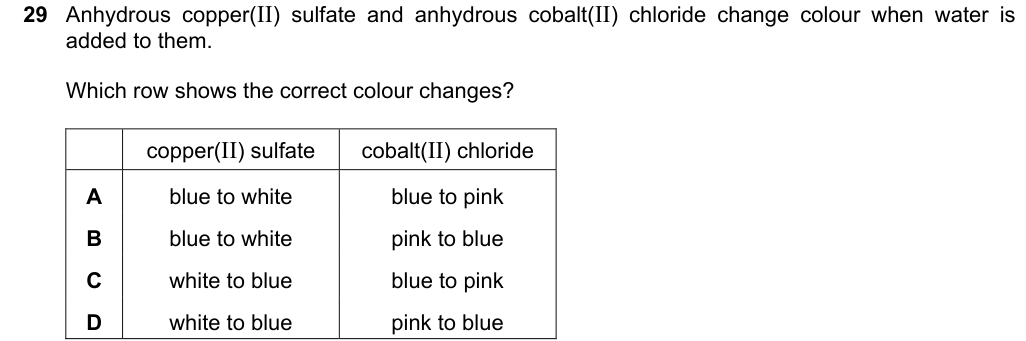
| anhydrous cobalt(II) chloride (often as test paper) | blue → pink | CoCl2 + 6H2O → CoCl2·6H2O |
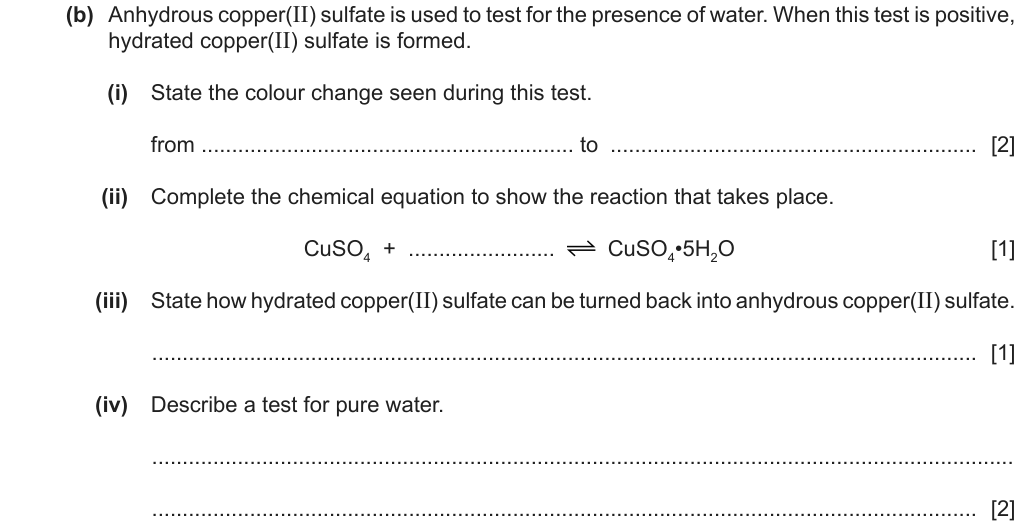
| anhydrous copper(II) sulfate | white → blue | CuSO4 + 5H2O → CuSO4·5H2O |
These tests give a positive result with any liquid containing water — sea water, a solution of salt, or a product of combustion. To show that water is pure, measure its melting point or boiling point: pure water melts at exactly 0 °C and boils at exactly 100 °C (at atmospheric pressure). Dissolved impurities lower the melting point and raise the boiling point, and make them less sharp.
Distilled water is used in practical chemistry rather than tap water because it contains fewer chemical impurities. The dissolved ions in tap water (for example chloride, calcium or metal ions) could react with reagents or give false positive results in tests.
The colour change for copper(II) sulfate is from white (a solid) to blue — not from colourless. A test for pure water must give the fixed value: “boiling point is 100 °C”. Filtering, testing pH or using anhydrous copper(II) sulfate do not show purity.
2Substances in natural water and water treatment 10.1.4–10.1.7 Core
Water from rivers, lakes and underground may contain:
| Substance | Beneficial or harmful? |
|---|---|
| dissolved oxygen | beneficial — needed by aquatic life (fish) |
| metal compounds | some are beneficial, providing essential minerals for life; some are toxic |
| plastics | some harm aquatic life |
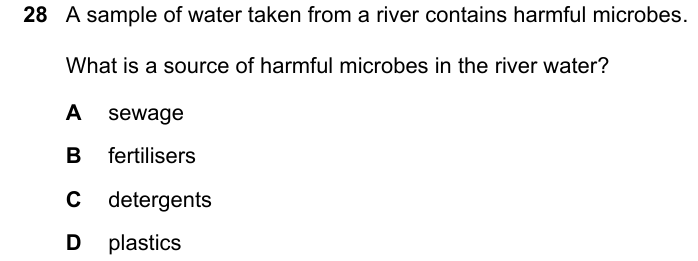
| sewage | contains harmful microbes which cause disease |
| harmful microbes | cause disease |
| nitrates from fertilisers; phosphates from fertilisers and detergents | lead to deoxygenation of water and damage to aquatic life |
The domestic water supply is treated in stages:
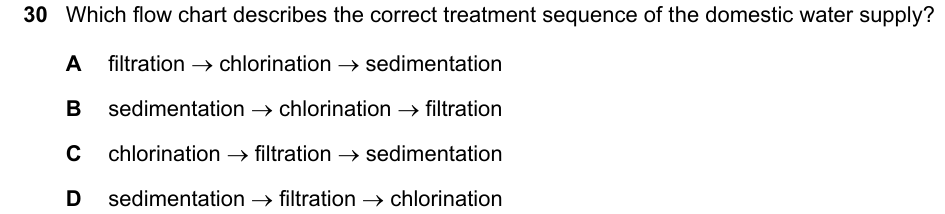
- Sedimentation and filtration — to remove solids: large insoluble particles settle out in tanks; the water is then filtered through beds of sand and gravel.
- Carbon (activated charcoal) — to remove tastes and odours.
- Chlorination — to kill microbes.
None of these removes dissolved salts: treated tap water is safe to drink but is not pure water.
Attempt these before opening the solutions. Each reference gives the component, session and question number of the original examination; the answers follow the published mark scheme.
Solutions and mark-scheme guidance · set A
A1 Answer C
Copper(II) sulfate: white → blue; cobalt(II) chloride: blue → pink.
A2 Answer D
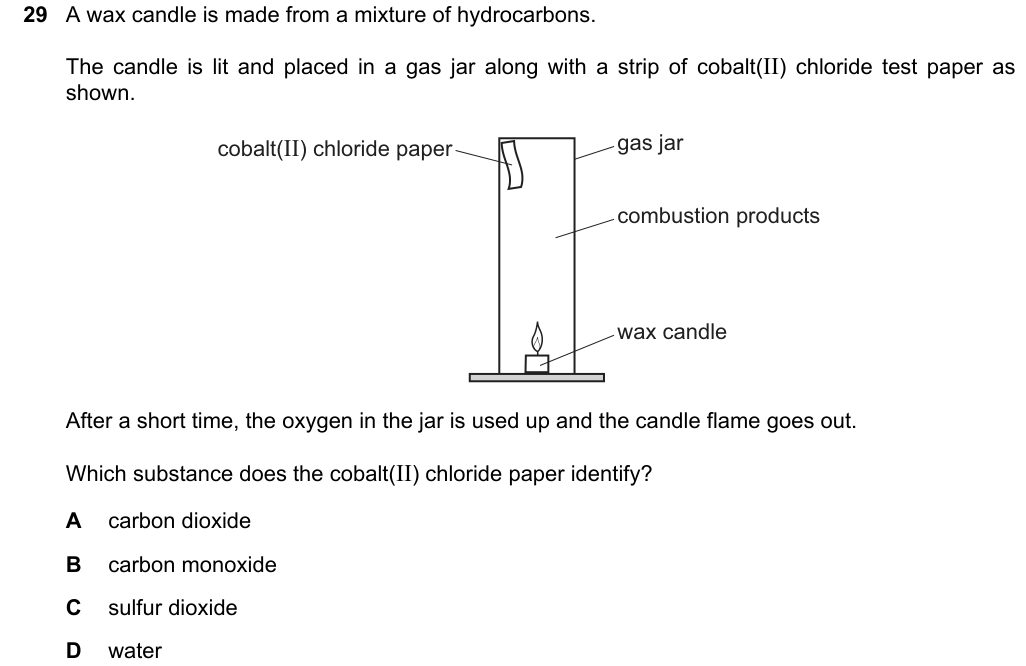
Cobalt(II) chloride paper detects water, a product of burning hydrocarbons. Nearly half of weaker candidates chose carbon dioxide.
A3 Answer D
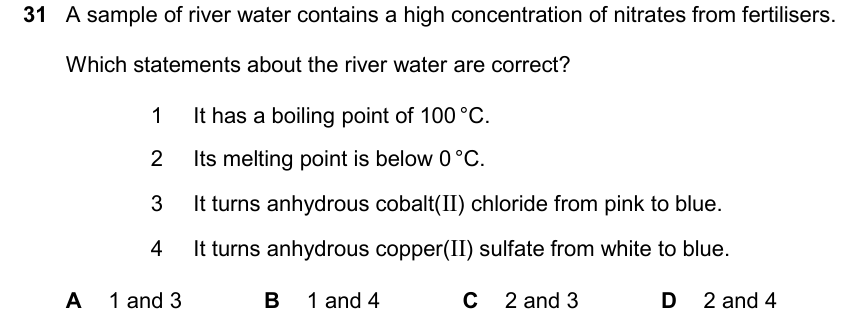
Dissolved nitrates make the water impure: its melting point is below 0 °C (and boiling point above 100 °C); it contains water, so it turns anhydrous copper(II) sulfate white to blue. Weaker candidates did not link impurity to melting and boiling point, or reversed the cobalt chloride colours.
A4 Answer C
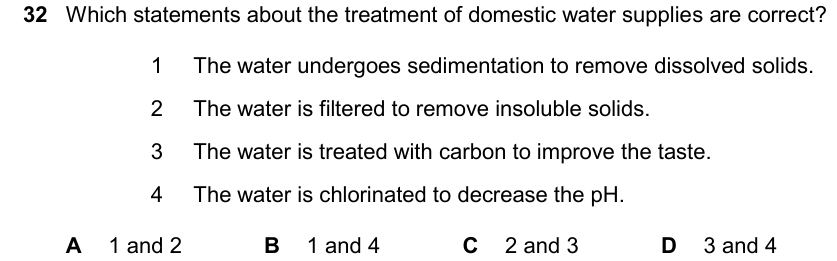
Filtration removes insoluble solids; carbon improves the taste. Sedimentation removes insoluble (suspended) solids, not dissolved ones; chlorination kills microbes. A, the commonest wrong answer, misunderstood sedimentation.
A5 Answer D
Sedimentation → filtration → chlorination.
A6 Answer A
Sewage contains harmful microbes.
A7 [6]
(i) From white ✓ to blue ✓. (ii) 5H2O ✓. (iii) Heat it ✓. (iv) Measure the boiling point ✓; it is 100 °C ✓ (or freezing point, 0 °C).
Examiner feedback: “colourless to blue” was a common error — some did not know the difference between colourless and white. “Evaporate the water” did not say how; a solid cannot be “boiled”. Filtering or testing pH do not test purity.
10.2 · Fertilisers
3Fertilisers 10.2.1–10.2.2 Core
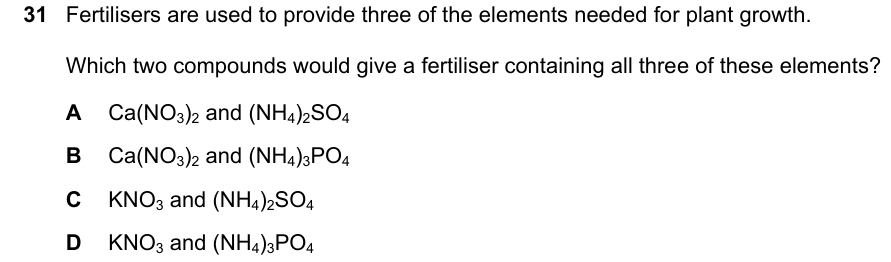
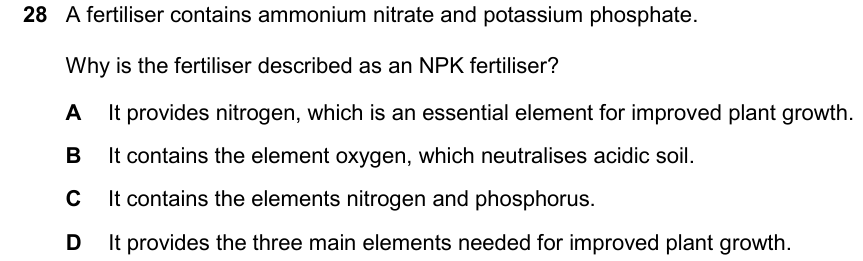
Plants need three main elements for healthy growth: nitrogen (N), phosphorus (P) and potassium (K). Crops remove these from the soil, so farmers replace them with fertilisers. Ammonium salts (such as ammonium nitrate, NH4NO3, and ammonium sulfate, (NH4)2SO4) and nitrates (such as potassium nitrate, KNO3) are used as fertilisers because they supply nitrogen in a water-soluble form that plants can absorb.
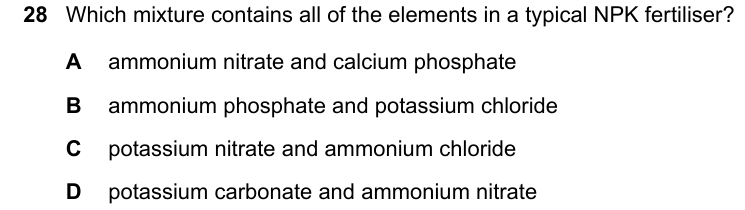
An NPK fertiliser is a mixture of salts that together provide all three elements for improved plant growth. For example, ammonium phosphate, (NH4)3PO4, supplies N and P, and potassium chloride supplies K. To decide whether a mixture is NPK, check its formulae for N, P and K.
2NH3 + H2SO4 → (NH4)2SO4 NH3 + HNO3 → NH4NO3
Ammonium fertilisers are made by neutralising acids with ammonia from the Haber process (Topic 6). Excess fertiliser washed into rivers adds nitrates and phosphates to the water, leading to deoxygenation (10.1).
Attempt these before opening the solutions. Each reference gives the component, session and question number of the original examination; the answers follow the published mark scheme.
Solutions and mark-scheme guidance · set B
B1 Answer D
KNO3 provides K and N; (NH4)3PO4 provides N and P: all three of N, P, K. Many candidates appeared to guess.
B2 Answer B
Ammonium phosphate (N, P) and potassium chloride (K).
B3 Answer D
An NPK fertiliser provides the three main elements needed for improved plant growth: nitrogen, phosphorus and potassium.
10.3 · Air quality and climate
4The composition of clean, dry air 10.3.1 Core
Clean, dry air is a mixture of elements and compounds:
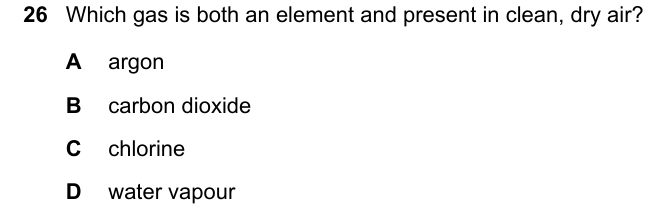
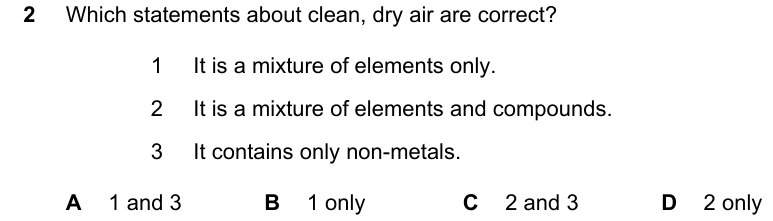
Air is a mixture of elements (N2, O2, Ar) and a compound (CO2); all its components are non-metals. Real air also contains variable amounts of water vapour, which is why the composition is quoted for dry air.
5Air pollutants: sources and effects 10.3.2–10.3.3 Core
| Pollutant | Source | Adverse effect |
|---|---|---|
| carbon dioxide, CO2 | complete combustion of carbon-containing fuels | higher levels lead to increased global warming, which leads to climate change |
| carbon monoxide, CO | incomplete combustion of carbon-containing fuels | toxic gas |
| particulates (tiny particles of carbon, soot) | incomplete combustion of carbon-containing fuels | increased risk of respiratory problems and cancer |
| methane, CH4 | decomposition of vegetation and waste gases from digestion in animals | higher levels lead to increased global warming, which leads to climate change |
| oxides of nitrogen, NO and NO2 | car engines | acid rain, photochemical smog and respiratory problems |
| sulfur dioxide, SO2 | combustion of fossil fuels which contain sulfur compounds | acid rain |
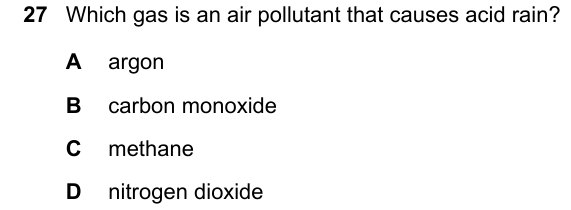
Carbon monoxide is toxic because it combines with haemoglobin in the blood and prevents it from carrying oxygen. Carbon monoxide is a neutral oxide and does not cause acid rain. Acid rain forms when sulfur dioxide and oxides of nitrogen dissolve in rain water to form acids; it damages buildings made of limestone, kills trees and makes lakes acidic.
6How greenhouse gases cause global warming 10.3.7 Supplement
Carbon dioxide and methane are greenhouse gases. The process:
- Energy from the Sun passes through the atmosphere and is absorbed by the Earth's surface, which warms up.
- The warm surface emits thermal energy (infrared radiation) back towards space; some is reflected.
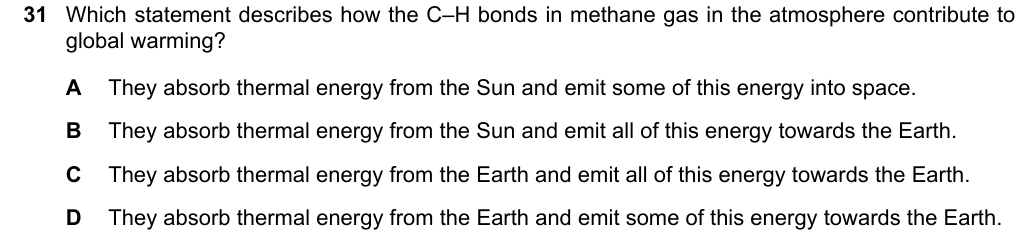
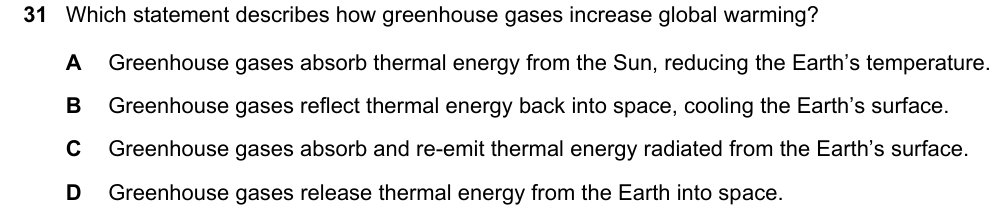
- Greenhouse gas molecules in the atmosphere absorb some of this thermal energy and re-emit it in all directions — some back towards the Earth.
- This reduces the thermal energy lost to space. Increasing the amount of greenhouse gases increases the amount of energy retained, so the average temperature of the atmosphere rises: increased global warming, leading to climate change.
Credit is given for: greenhouse gases absorb thermal energy (from the Earth); energy from the Sun is absorbed by the Earth's surface; the Earth emits (or reflects) thermal energy; greenhouse gases reduce thermal energy loss to space; more greenhouse gas → higher temperature. Greenhouse gases do not absorb thermal energy directly from the Sun, and they have nothing to do with the ozone layer.
7Strategies to reduce environmental problems 10.3.4 Core
| Problem | Strategy | Explanation |
|---|---|---|
| climate change | planting trees | trees remove CO2 from the air by photosynthesis |
| reduction in livestock farming | fewer animals produce less methane from digestion | |
| decreasing use of fossil fuels | less CO2 released by combustion | |
| increasing use of hydrogen and renewable energy (wind, solar) | hydrogen burns to water only; wind and solar produce no CO2 when generating electricity | |
| acid rain | catalytic converters in vehicles | convert oxides of nitrogen to nitrogen |
| low-sulfur fuels | less sulfur is burned, so less SO2 is formed | |
| flue gas desulfurisation with calcium oxide | calcium oxide (basic) reacts with sulfur dioxide (acidic) in power-station waste gases: CaO + SO2 → CaSO3 |
8Oxides of nitrogen and catalytic converters 10.3.8 Supplement
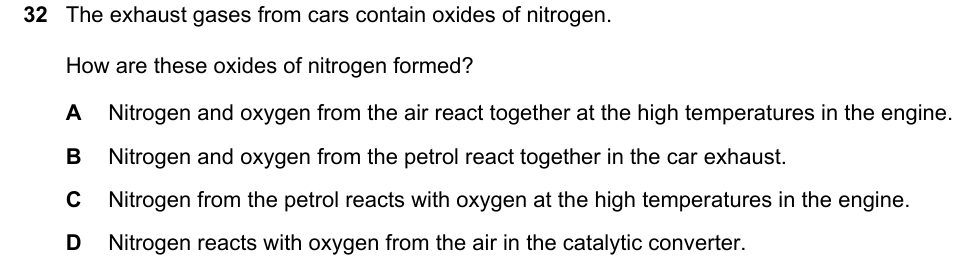
Petrol contains no nitrogen. Oxides of nitrogen form in car engines because nitrogen and oxygen from the air react together at the high temperature inside the engine:
N2(g) + O2(g) → 2NO(g) 2NO(g) + O2(g) → 2NO2(g)
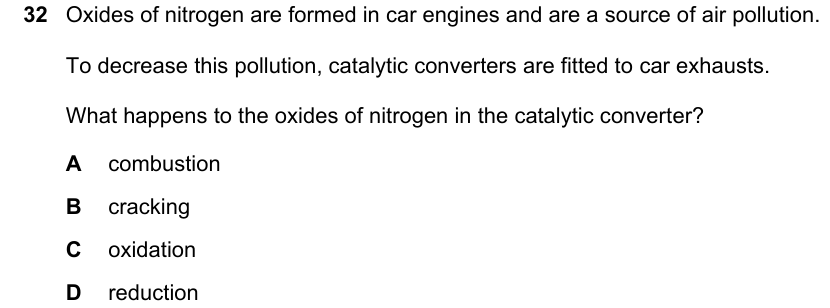
A catalytic converter in the exhaust contains a catalyst (transition metals) on a honeycomb with a large surface area. It converts pollutant gases into less harmful ones. Oxides of nitrogen react with carbon monoxide (from incomplete combustion):
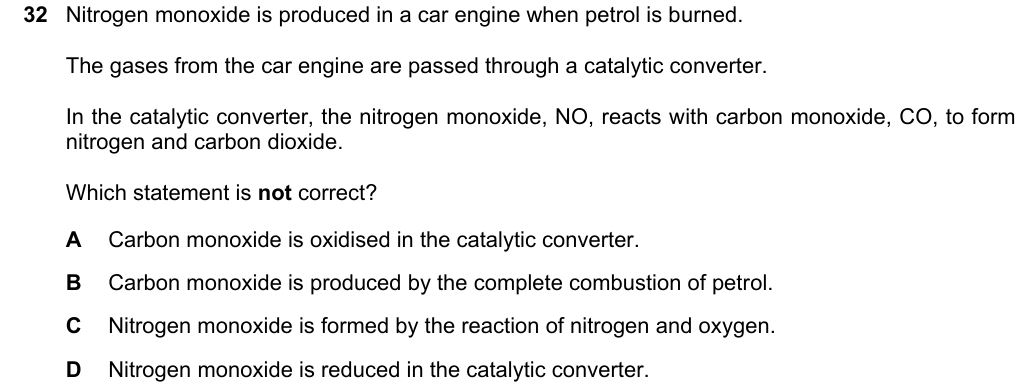
2CO(g) + 2NO(g) → 2CO2(g) + N2(g)
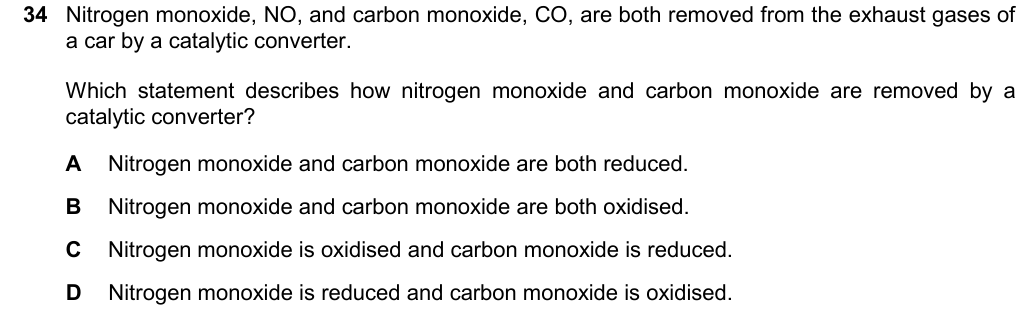
This is a redox reaction: nitrogen monoxide is reduced (it loses oxygen; N goes from +2 to 0) and carbon monoxide is oxidised (it gains oxygen). Both toxic gases are removed together.
“The nitrogen comes from the petrol” is wrong: petrol is a mixture of hydrocarbons. The catalytic converter removes oxides of nitrogen — it does not produce them — and the change is reduction, not combustion or oxidation.
9Photosynthesis 10.3.5–10.3.6, 10.3.9 CoreSupplement
Photosynthesis is the reaction between carbon dioxide and water to produce glucose and oxygen, in the presence of chlorophyll and using energy from light:
carbon dioxide + water → glucose + oxygen
Supplement 6CO2 + 6H2O → C6H12O6 + 6O2
Photosynthesis is endothermic: light energy is stored as chemical energy in glucose. It removes carbon dioxide from the atmosphere, which is why planting trees helps to reduce climate change. Respiration and combustion do the reverse, releasing carbon dioxide.
Attempt these before opening the solutions. Each reference gives the component, session and question number of the original examination; the answers follow the published mark scheme.
Solutions and mark-scheme guidance · set C
C1 Answer A
Argon is an element in clean, dry air. Carbon dioxide is a compound — the choice of many weaker candidates.
C2 Answer C
Air contains elements (N2, O2, Ar) and a compound (CO2), all non-metals.
C3 Answer D
Nitrogen dioxide causes acid rain. Carbon monoxide, the commonest answer, is a neutral oxide.
C4 Answer D
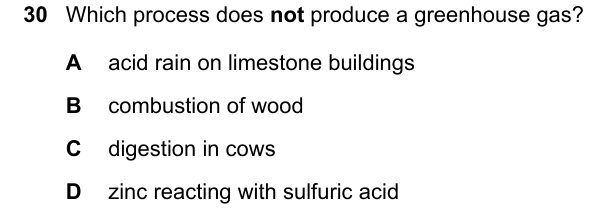
Zinc with sulfuric acid gives hydrogen, not a greenhouse gas. Acid on limestone and burning wood give CO2; digestion in cows gives methane — true, but not the answer to a “not” question; many chose C.
C5 Answer D
Methane absorbs thermal energy from the Earth and emits some of it back towards the Earth. B, with energy from the Sun, was the commonest wrong answer.
C6 Answer C
Greenhouse gases absorb and re-emit thermal energy radiated from the Earth's surface.
C7 Answer A
Nitrogen and oxygen from the air react at high temperature in the engine. Over two thirds chose C or D — but petrol contains no nitrogen, and a catalytic converter removes oxides of nitrogen.
C8 Answer D
Oxides of nitrogen are reduced to nitrogen. “Combustion” was a common misconception.
C9 Answer D
NO is reduced (loses oxygen) and CO is oxidised (gains oxygen). All wrong answers were popular with weaker candidates.
C10 Answer B
The incorrect statement is B: carbon monoxide comes from incomplete combustion. Take care with questions containing “not”.
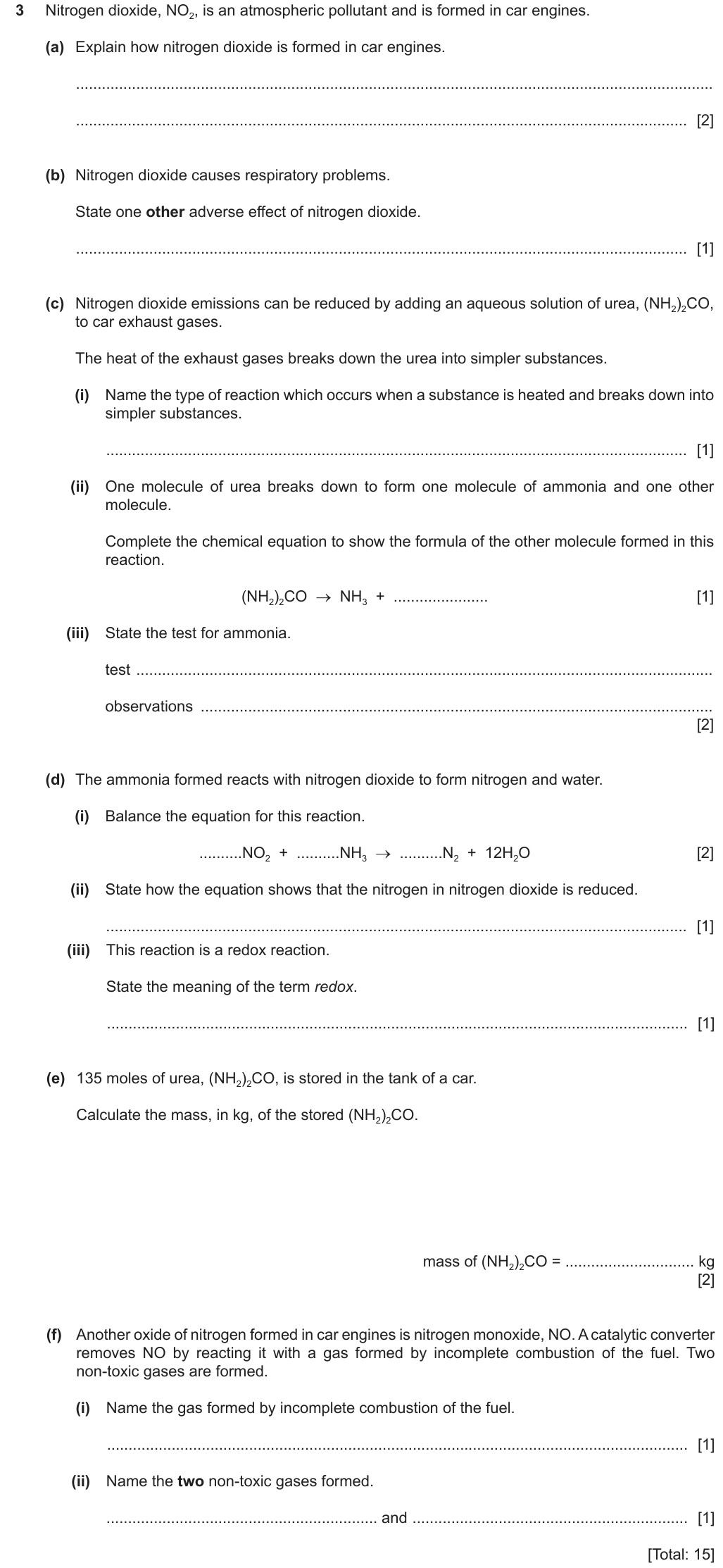
C11 [15]
(a) Nitrogen and oxygen from the air react ✓ at the high temperature of the engine ✓.
(b) acid rain ✓. (c)(i) thermal decomposition ✓. (ii) HCNO (atoms in any order) ✓. (iii) Damp red litmus ✓ turns blue ✓.
(d)(i) 6NO2 + 8NH3 → 7N2 + 12H2O: 6 or 8 ✓; all three ✓. (ii) The nitrogen loses oxygen ✓. (iii) Reduction and oxidation both occur ✓.
(e) Mr = 60 ✓; 135 × 60 = 8100 g = 8.1 kg ✓.
(f)(i) carbon monoxide ✓. (ii) carbon dioxide and nitrogen ✓.
Examiner feedback: a surprising number thought the nitrogen comes from the fuel; weaker candidates called NO2 a greenhouse gas. Many tried to give a familiar formula (CO, CO2) in (c)(ii). “Pungent smell” is not a test for ammonia. In (d)(ii) the equation had to be used: loss of oxygen. 14N2 showed nitrogen not treated as diatomic.
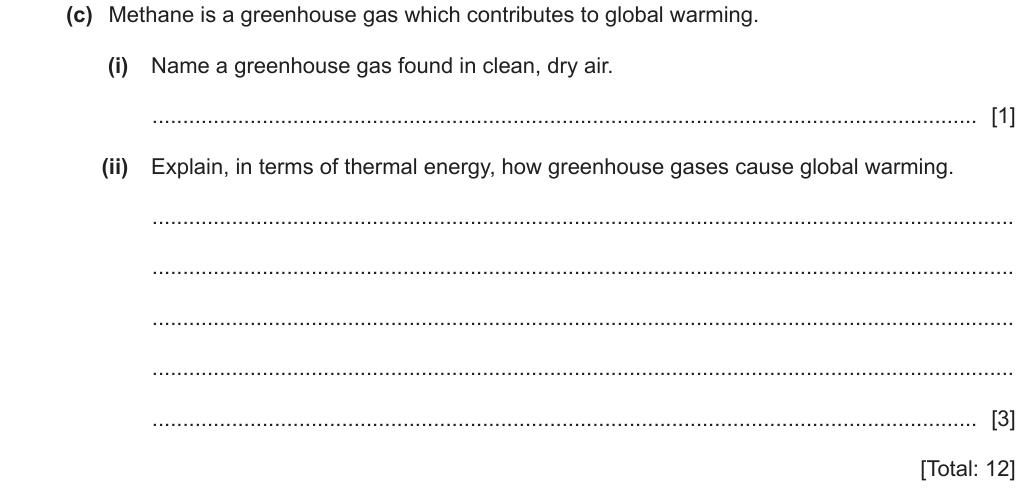
C12 [4]
(i) carbon dioxide ✓.
(ii) Greenhouse gases absorb thermal energy from the Earth ✓, plus two of: energy from the Sun is absorbed by the Earth's surface; the Earth emits (reflects) thermal energy; greenhouse gases reduce thermal energy loss to space; more greenhouse gas gives a higher atmospheric temperature ✓✓.
Examiner feedback: carbon monoxide was occasionally given as a greenhouse gas, and water vapour is not in clean, dry air. Part (ii) was found extremely difficult: many confused greenhouse gases with the ozone layer, or thought they create thermal energy or absorb it directly from the Sun.
Review · Topic 10
10Misconceptions and the examiner’s view
- “Copper(II) sulfate turns from colourless to blue.” Anhydrous copper(II) sulfate is a white solid.
- “A positive cobalt chloride test shows water is pure.” It shows water is present; purity needs the boiling point 100 °C or melting point 0 °C.
- “Sedimentation removes dissolved substances.” It removes insoluble, suspended solids; chlorination kills microbes.
- “Carbon monoxide causes acid rain.” CO is toxic and neutral; SO2 and oxides of nitrogen cause acid rain.
- “The nitrogen in NOx comes from petrol.” Both N2 and O2 come from the air.
- “Catalytic converters oxidise NO.” NO is reduced to N2; CO is oxidised to CO2.
- “Greenhouse gases absorb energy from the Sun.” They absorb thermal energy emitted by the Earth's surface.
This topic is largely recall, and marks are lost through imprecise or confused recall rather than through difficulty. The colours of the anhydrous-salt tests are frequently reversed or described with “colourless” instead of white, and the tests for water are confused with a test for purity, which requires a fixed boiling or melting point. The purpose of each stage of water treatment is often misplaced, especially sedimentation. Pollutants are mismatched with their effects — carbon monoxide is commonly chosen as a cause of acid rain and nitrogen dioxide as a greenhouse gas — and carbon dioxide is not recognised as a compound. The origin of oxides of nitrogen is one of the least well-answered areas: most candidates think the nitrogen comes from the fuel, and many think the catalytic converter produces rather than removes these oxides, or that it works by combustion or oxidation. Explanations of global warming must be written in terms of thermal energy absorbed from the Earth's surface and reduced loss to space. Questions containing “not” need particular care. Strong answers match each pollutant to its specific source and effect and use the redox chemistry of the catalytic converter correctly.
11Summary and knowledge organiser
Essential knowledge
- Water tests: cobalt(II) chloride blue → pink; copper(II) sulfate white → blue. Purity: bp 100 °C, mp 0 °C.
- Treatment: sedimentation + filtration (solids), carbon (tastes, odours), chlorination (microbes).
- Fertilisers: ammonium salts, nitrates; NPK provides N, P, K.
- Air: 78% N2, 21% O2, rest noble gases and CO2.
- CO2, CH4 → global warming; CO toxic; particulates → respiratory problems, cancer; NOx → acid rain, smog; SO2 → acid rain.
- Catalytic converter: 2CO + 2NO → 2CO2 + N2. Photosynthesis: 6CO2 + 6H2O → C6H12O6 + 6O2.
Examination checklist
- Give the starting and final colour of each water test.
- Match each pollutant to its own source and effect.
- NOx: N2 and O2 from air + high temperature.
- Global warming: absorb thermal energy from Earth, re-emit, less lost to space.
- Strategies must be the syllabus ones, with a reason.
Knowledge organiser · chemistry of the environment
| Idea | What to know | Must-remember distinctions and common errors |
|---|---|---|
| Water tests 10.1.1–3 | CoCl2, CuSO4; mp/bp for purity; distilled water. | White (not colourless) → blue. |
| Natural water 10.1.4–6 | O2, metal compounds, plastics, sewage, microbes, nitrates, phosphates. | Beneficial vs harmful. |
| Treatment 10.1.7 | Sedimentation, filtration, carbon, chlorination. | Carbon: tastes/odours; chlorine: microbes. |
| Fertilisers 10.2.1–2 | Ammonium salts, nitrates; NPK. | Check formulae for N, P and K. |
| Air, pollutants 10.3.1–3 | Composition; six pollutants, sources, effects. | CO toxic not acidic. |
| Strategies 10.3.4 | Trees, less livestock and fossil fuel, H2/renewables; converters, low-S fuels, FGD with CaO. | Link each to the pollutant. |
| Greenhouse, NOx 10.3.7–8 | Absorb/re-emit thermal energy; 2CO + 2NO → 2CO2 + N2. | NO reduced, CO oxidised. |
| Photosynthesis 10.3.5–6, 9 | CO2 + H2O → glucose + O2; chlorophyll, light. | 6, 6, 1, 6. |